US reviewing its global force posture to counter China's threat to India: Mike Pompeo
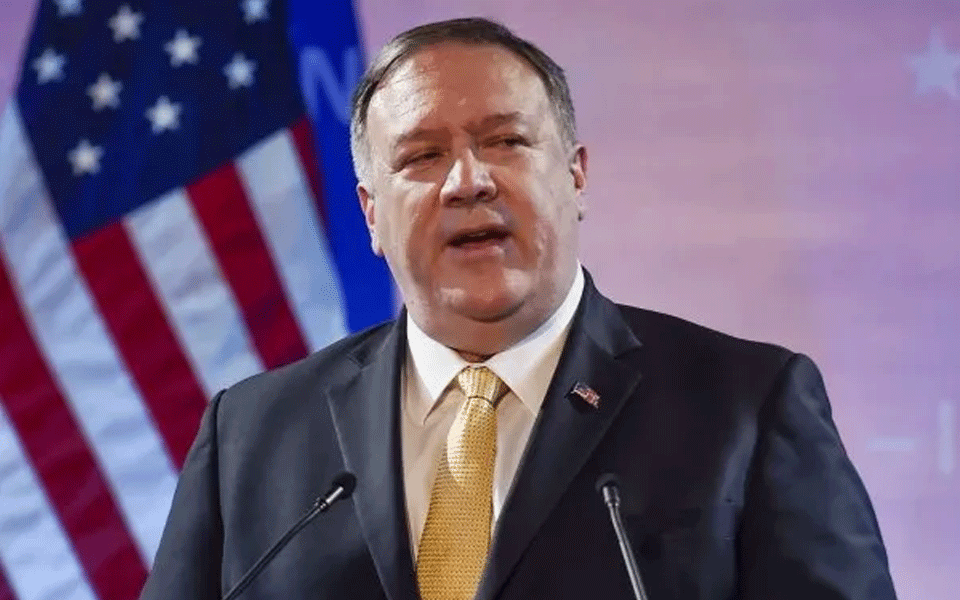
Washington: The US is reviewing its global deployment of forces to ensure it is postured appropriately to counter the People's Liberation Army, given the increasing threat posed by China to Asian countries like India, Malaysia, Indonesia, and the Philippines, Secretary of State Mike Pompeo said on Thursday.
Pompeo made those remarks in response to a question during the virtual Brussels Forum 2020 of the German Marshall Fund.
"We're going to make sure we're postured appropriately to counter the PLA. We think that the challenge of our times, and we're going to make sure we have resources in place to do that," Pompeo said.
The force posture review is being done at the direction of President Donald Trump, as part of which the US is reducing the number of its troops in Germany from about 52,000 to 25,000, he said.
Pompeo said that the force posture would be dictated by the ground realities.
"In certain places there will be fewer American resources. There'll be other places - I just talked about the threat from the Chinese Communist Party, so now threats to India, threats to Vietnam, threats to Malaysia, Indonesia, South China Sea challenges, the Philippines," he said.
"To the extent that that changed, the difference in what the US decided to do impacts adversely a threat some place, it may be that other nations need to step up and take responsibility for their own defense in ways that they hadn't done previously. So, we want to do this in full consultation with all of our partners all around the world, and certainly our friends in Europe," Pompeo said.
President Trump is being criticised for reducing troops from Germany. His critics say that this will increase the threat from Russia to Europe.
Pompeo, however, did not agree with that argument.
It has been a long time since there has been a strategic review of our force posture all across the world. The US undertook that starting about 2.5 years ago, whether that was our forces in Africa, our forces in Asia, the force we have in the Middle East and in Europe, he said.
"We began to say these are often decisions that were made in a different time. Should we reallocate those a different way? Should we have a different composition of those forces? Everyone always wants to talk about ground troops. I get it. I was a young tank officer. You described that. There's nothing I like as much as a good M1 tank.
"But it's often the case that the capacity to deter Russia or other adversaries isn't determined any longer by just having a bunch of folks garrisoned someplace. So, we really went to back fundamentally relook, what is the nature of the conflict, what's the nature of the threat, and how should we allocate our resources, whether that's our resources in the intelligence community, our resources from the Air Force or the Marines and Army," Pompeo said.
Last week, Pompeo criticised the Chinese Army for "escalating" the border tension with India and militarising the strategic South China Sea. He also described the ruling Communist Party of China (CPC) as a "rogue actor."
"Our broad set of allocation of security apparatus, our ability to counter cyber threats, how do we allocate them? What's the best way to do this? And the decision that you see the president made with respect to Germany is an outcome from a collective set of decisions about how we're going to posture our resources around the world," said the top American diplomat on Thursday.
Changes in force posture is being taken in consultations with allies and friends, Pompeo said.
"President Trump has spoken to this. (Defense ) Secretary (Mark) Esper will be in London today and in Brussels tomorrow. We'll talk about our plan and how we're thinking about delivering it," he said.
"But you should understand this, and I hope our European partners will understand this as well. When you see what we ultimately conclude, how we ultimately deliver on the statements of the president made, that they're aimed squarely at what we believe to be democracies' fundamental interest and certainly America's most fundamental interest," Pompeo said.
Earlier this month, Pompeo had said that China's actions, be it on the India border, or in Hong Kong or in the South China Sea, were part of the behaviour of the ruling Communist Party in Beijing in the recent past.
China has been fast expanding military and economic influence in the Indo-Pacific region, triggering concern in various countries of the region and beyond.
China is engaged in hotly contested territorial disputes in both the South China Sea and the East China Sea. Beijing has built up and militarised many of the islands and reefs it controls in the region. Both areas are stated to be rich in minerals, oil and other natural resources and are vital to global trade.
Let the Truth be known. If you read VB and like VB, please be a VB Supporter and Help us deliver the Truth to one and all.
US warns shipping firms they could face sanctions over paying Iranian tolls in Strait of Hormuz
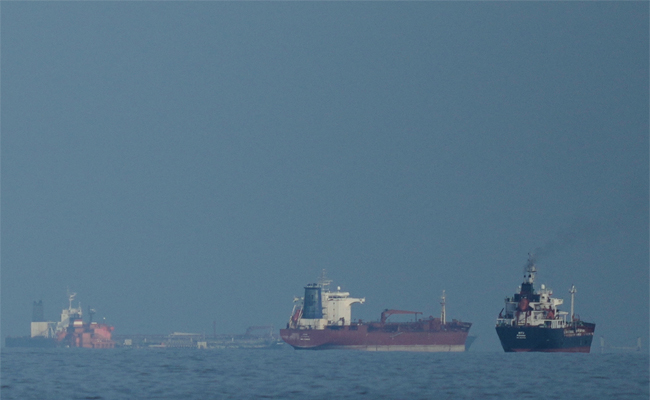
Dubai (AP): The United States is warning shipping companies that they could face sanctions for making payments to Iran to safely pass through the Strait of Hormuz.
The alert posted Friday by the US Office of Foreign Assets Control adds another layer of pressure in the standoff between the US and Iran over control of the Strait of Hormuz.
About a fifth of the world's trade in oil and natural gas typically passes through the strait at the mouth of the Persian Gulf in peacetime.
Iran effectively closed the strait to normal traffic by attacking and threatening to attack ships after the US and Israel launched a war on Feb. 28. It later began offering some ships safe passage by detouring them through alternate routes closer to its shoreline, charging fees at times for the service.
That "tollbooth” effort is the focus of the US sanctions warning.
The payment demands could include transfers not only in cash but also “digital assets, offsets, informal swaps, or other in-kind payments,” including chartibale donations and payments at Iranian embassies, OFAC said.
“OFAC is issuing this alert to warn US and non-US persons about the sanctions risks of making these payments to, or soliciting guarantees from, the Iranian regime for safe passage. These risks exist regardless of payment method,” it said.
ALSO READ: Student preparing for NEET dies after falling from hostel's fourth floor in Kota
The US responded to Iran's closure of the strait with a naval blockade of its own on April 13, preventing any Iranian tankers from leaving and depriving Iran of oil revenue it needs to shore up its ailing economy.
The US Central Command said 45 commercial ships have been told to turn around since the blockade began.
Trump rejects Iranian proposal
--------------------------------------
The warning came as US President Donald Trump swiftly rejected Iran's latest proposal to end the war between the countries.
“They want to make a deal, I'm not satisfied with it, so we'll see what happens,” Trump said Friday at the White House. He didn't elaborate on what he saw as its shortcomings but expressed frustration with the Iranian leadership.
“It's a very disjointed leadership,” Trump said. “They all want to make a deal, but they're all messed up.”
Iran's state-run IRNA news agency reported Iran handed over its plan to mediators in Pakistan on Thursday night.
The shaky three-week ceasefire between the US and Iran appears to be holding, though both countries have traded accusations of violations. The standoff is increasingly putting pressure on the global economy, driving up prices and leading to shortages of fuel and other products tied to the oil industry.
Negotiations continued by phone after Trump called off his envoys' trip to Pakistan last week, the president said. Trump this week floated a new plan to reopen the critical passageway used by America's Gulf allies to export their oil and gas.
Iranian Foreign Minister Abbas Araghchi has briefed many of his regional counterparts on the country's initiatives to end the ear, according to his social media. He also held talks Friday with European Union foreign policy chief Kaja Kallas, who is in contact with the EU's Gulf partners.
China's UN envoy urges Iran to lift restrictions
------------------------------------------------------
Fu Cong, the Chinese ambassdor to the United Nations, said Friday that maintaining the ceasefire is “the most urgent issue" as well as bringing together the sides to resume good faith negotiations “to make sure that the ground is laid for reopening of Hormuz.”
Foreign Minister Wang Yi “has been on the phone almost constantly” with representatives from all sides, Fu said, adding that China supports Pakistan's efforts to mediate between the parties.
Fu stressed the root cause of the tremendous suffering in Iran and neighboring countries and the growing turmoil in the global economy, especially in developing countries, “is the illegitimate war by the US and Israel.