US: Russia to buy rockets, artillery shells from North Korea
Washington (AP): The Russian Ministry of Defence is in the process of purchasing millions of rockets and artillery shells from North Korea for its ongoing fight in Ukraine, according to a newly downgraded U.S. intelligence finding.
A U.S. official, who spoke on the condition of anonymity to discuss the intelligence determination, said Monday that the fact Russia is turning to the isolated state of North Korea demonstrates that the Russian military continues to suffer from severe supply shortages in Ukraine, due in part to export controls and sanctions.
U.S. intelligence officials believe that the Russians could look to purchase additional North Korean military equipment in the future. The intelligence finding was first reported by The New York Times.
The U.S. official did not detail how much weaponry Russia intends to purchase from North Korea.
The finding comes after the Biden administration recently confirmed that the Russian military in August took delivery of Iranian-manufactured drones for use on the battlefield in Ukraine.
The White House said last week that Russia has faced technical problems with Iranian-made drones acquired from Tehran in August for use in its war with Ukraine.
Russia picked up Mohajer-6 and Shahed-series unmanned aerial vehicles over several days last month as part what the Biden administration says is likely part of a Russian plan to acquire hundreds of Iranian UAVs for use in Ukraine.
North Korea has sought to tighten relations with Russia as much of Europe and the West has pulled away, blaming the United States for the Ukraine crisis and decrying the West's hegemonic policy as justifying military action by Russia in Ukraine to protect itself.
The North Koreans have hinted interest in sending construction workers to help rebuild Russian-occupied territories in the country's east.
North Korea's ambassador to Moscow recently met with envoys from two Russia-backed separatist territories in the Donbas region of Ukraine and expressed optimism about cooperation in the field of labor migration, citing his country's easing pandemic border controls.
In July North Korea became the only nation aside from Russia and Syria to recognize the independence of the territories, Donetsk and Luhansk, further aligning with Russia over the conflict in Ukraine.
The provocative move by North Korea comes as the Biden administration has become increasingly concerned about stepped-up activity by North Korea in pursuit of nuclear weapons.
North Korea has test-fired more than 30 ballistic missiles this year, including its first flights of intercontinental ballistic missiles since 2017, as leader Kim Jong Un pushes to advance his nuclear arsenal despite U.S.-led pressure and sanctions.
The U.S. has frequently downgraded and unveiled intelligence findings over the course of the grinding war in Ukraine to highlight plans for Russian misinformation operations or to throw attention on Moscow's difficulties in prosecuting the war. Ukraine's smaller military has put up a stiff resistance against the militarily superior Russian forces.
Russian President Vladimir Putin and Kim have recently exchanged letters in which they both called for comprehensive and strategic and tactical cooperation between the countries. Moscow, for its part, has issued statements condemning the revival of large-scale military exercises between the United States and South Korea this year, which North Korea views as an invasion rehearsal.
Russia, along with China, has called for the easing of U.N. sanctions imposed on North Korea over its nuclear and missile tests. Both countries are members of the U.N. Security Council, which has approved a total of 11 rounds of sanctions on the North since 2006. In May, Russia and China vetoed a U.S.-led bid to impose new economic sanctions on North Korea over its high-profile missile tests this year.
Some experts say that Kim could likely bolster his resolve to retain his nuclear weapons because he may think the Russian attack happened because Ukraine had signed away its nuclear arsenal.
Relations between Moscow and Pyongyang go back to the 1948 foundation of North Korea, as Soviet officials installed young, ambitious nationalist Kim Il Sung, the late grandfather of Kim Jong Un, as the country's first ruler. Since then, Soviet aid shipment had been crucial in keeping North Korea's economy afloat for decades before the disintegration of the Soviet Union in the early 1990s.
Moscow had since established formal diplomatic relations with Seoul as part of its hopes to draw South Korean investment and allowed its Soviet-era military alliance with North Korea to expire. But after his election in 2000, Putin actively sought to restore his country's ties with North Korea in what was seen as an effort to regain its traditional domains of influence and secure more allies to better deal with the United States. (AP)
Let the Truth be known. If you read VB and like VB, please be a VB Supporter and Help us deliver the Truth to one and all.
Bengaluru airport introduces AI-based system to enhance safety at vehicle-aircraft intersections
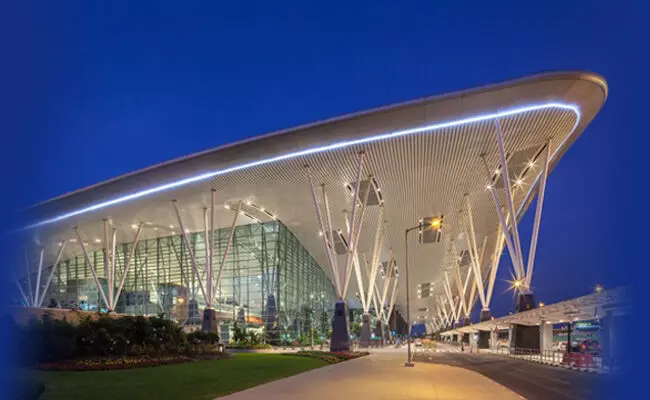
Bengaluru: Bangalore International Airport Limited (BIAL) has introduced an integrated smart airside safety system at Kempegowda International Airport to improve operational safety at key intersection zones.
According to The Hindu, the system has been designed to enhance safety at Cross Service Roads (CSRs), where aircraft and ground vehicle movements intersect.
According to BIAL, the system integrates AI-based computer vision, automation, and centralised monitoring to manage right-of-way movements and reduce the risk of human error.
“CRSs are among the most sensitive areas within airport operations, requiring precise and seamless coordination between aircraft and ground vehicles. Traditionally, right of way protection at these intersections relied on manual or semi-manual inset light activation, creating dependencies on human intervention, increasing the risk of delays and limiting operational visibility,” TH quoted BIAL as saying.
The new system uses real-time detection of vehicle movement, risk assessment, and automated signalling. AI-enabled cameras identify potential conflicts and trigger automated inset light signals to ensure aircraft priority. Normal operations resume once the area is confirmed clear.
“Based on these detections, the system triggers automated inset light activation to protect aircraft right‑of‑way and restores normal signalling once the intersection is confirmed clear. A centralised monitoring and analytics platform digitally logs all events, strengthening governance, compliance, and operational control,” BIAL said.
By embedding technology into operations, the system creates a data-driven separation layer between aircraft and ground vehicles, significantly reducing human error, especially during night and low-visibility conditions.
“Precision-led signal activation improves traffic flow, minimises unnecessary stoppage and enhances turnaround efficiency. It also establishes a scalable foundation for predictive safety analytics, enabling trend analysis, peak-hour optimisation, compliance mapping and risk forecasting to support continuous improvement and stronger airside governance,” BIAL said.