US sees Pakistan useful only for clearing mess in Afghanistan: Imran Khan
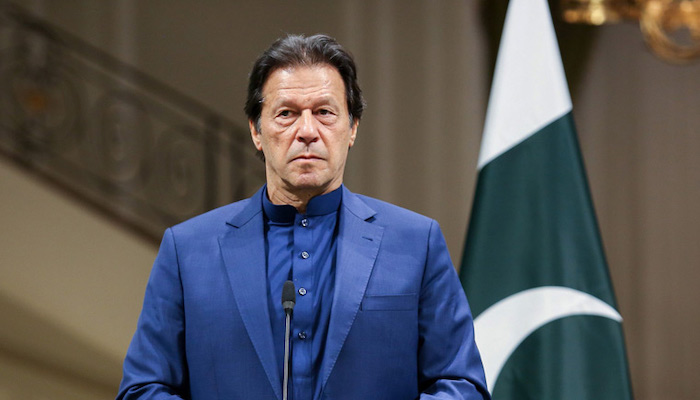
Islamabad, Aug 12: Taking a dig at the US, Prime Minister Imran Khan has said that Washington sees Pakistan as "useful" only for clearing the "mess" it has left behind in Afghanistan after 20 years of fighting and prefers India when it comes to forming a strategic partnership.
Afghanistan has seen an uptick in violence by the Taliban after US President Joe Biden's announcement of the withdrawal of American and NATO troops by August 31.
Pakistan is just considered only to be useful in the context of somehow settling this mess which has been left behind after 20 years of trying to find a military solution when there was not one, Khan told foreign journalists at his home here on Wednesday.
Khan said that since the US decided to have a strategic partnership with India, Washington was treating Pakistan differently, according to a journalist present at the meeting.
Islamabad is unhappy that Biden has not spoken to Prime Minister Khan since he assumed the presidency in January.
Pakistan's National Security Adviser Moeed Yusuf recently expressed disappointment over President Biden's reluctance to contact Prime Minister Khan despite considering Islamabad as an important country in some critical issues like Afghanistan.
Yousuf also said that Islamabad has other "options" if the American leader continues to ignore the country's leadership.
The US State Department, however, had assured Islamabad that Washington recognises Pakistan's vital role in restoring peace in Afghanistan and wants Islamabad to play that role.
US Defence Secretary Lloyd Austin spoke over the phone with Pakistan Army chief Gen Qamar Javed Bajwa this week and discussed the current situation in Afghanistan.
After the call, the Pentagon said the US was having conversations with the Pakistani leadership about the need to shut down the safe havens for Taliban militants along the Afghan-Pakistan border that are providing a source of more insecurity and instability inside Afghanistan.
Afghanistan and the US have criticised Pakistan in the past for allowing Taliban fighters to cross into Pakistan where they are provided safe havens and also receive medical treatment.
At the meeting with foreign journalists, Prime Minister Khan said that a political solution to the Afghan problem was difficult as the Taliban was not ready to talk with the Kabul government as long as President Ashraf Ghani is there.
He said the Taliban leaders told him during a visit that the Ghani government was a puppet.
The condition is that as long as Ashraf Ghani is there, we (Taliban) are not going to talk to the Afghan government, Khan quoted the Taliban leaders as saying.
Khan has taken a strong stand on the hasty withdrawal of the US troops from Afghanistan, which has plunged the country into a chaotic situation.
Khan also reiterated that Pakistan wouldn't provide bases to the US forces after the drawdown. Though it was unclear if the US formally asked for the facility.
Pakistan has said that it has used its influence over the Taliban to press the insurgents into talks with the US and the Afghan government to find a political solution to the crisis.
Khan last month said that the US really messed it up in Afghanistan as he questioned the American motive for the 2001 invasion of the country in the first place and then their subsequent attempts of seeking a political solution with the Taliban from a position of weakness.
Let the Truth be known. If you read VB and like VB, please be a VB Supporter and Help us deliver the Truth to one and all.
Two injuries, one DNF, a DQ as India end messy World Relays campaign

Gaborone (Botswana) (PTI): Amoj Jacob and Ragul Kumar got injured during the men's 4x400m and 4x100 races respectively as India ended their World Athletics Relays campaign in disappointment on the second day of competitions here on Sunday.
The Indian camp had high hopes of making the 2027 World Championships in the men's 4x400m relay but the team did not finish (DNF) the race as Jacob suffered cramps and pulled out of the race after taking the baton from the first leg runner Dharamveer Choudhary. Rajesh Ramesh and Vishal TK were to run in the third and fourth legs.
Those teams which could not qualify for the 2027 Beijing World Championships by reaching the final round of each of the six relay events on Saturday were given another chance in the second qualification round on Sunday.
The top two teams in each of the two heats (in all six relay events) booked the Beijing ticket on Sunday.
India will now have to try and qualify for the World Championships through the Top Lists of the World Athletics, which is a long and tedious process.
In the men's 4x100m race, third leg runner Ragul Kumar fell down the track after failing to hand over the baton inside the exchange zone to fourth leg runner Gurindervir Singh, which clearly showed the lack of coordination among the runners.
Harsh Santosh Raut and Animesh Kujur ran the first two legs.
The Indian quartet was disqualified and Kumar was seen being taken away from the Field of Play with the help of the volunteers.
It was a comedy of errors in the case of the women's 4x100m race, which saw the baton being dropped during an exchange between first leg runner Tamanna and second runner Nithya Gandhe, though the Indians finished the race in 53.09 seconds.
Gandhe started running quite a distance, but after realising that the baton was not in her hand, she turned and ran back to pick it up.
The only silver-lining for the Indian contingent was the national record time in the mixed 4x100m relay race, though the quartet of Ragul Kumar, Nithya Gandhe, Animesh Kujur and Sneha SS finished sixth in heat number two with a time of 41.35 seconds, bettering the previous national mark of 42.30 seconds set in March in Chandigarh.
The mixed 4x400m relay quartet of Theerthesh P Shetty, Kumari Saloni, Nihal William and Rashdeep Kaur ended at fifth in heat number one with a time of 3 minutes and 19.40 seconds.
On Saturday, all the five Indian relay teams had failed to make it to the respective final rounds and thus missed out on the 2027 World Championships berths.