US supreme court upholds Trump's travel ban
Blow to anti-discrimination advocates as justices rule 5-4 in favor of Trump administration after months of legal battles
The US supreme court has upheld Donald Trump’s travel ban targeting several Muslim-majority countries, in a significant victory for the administration and a blow to anti-discrimination advocates.
In a 5-4 ruling handed down on Tuesday, the court accepted the government’s argument that the ban was within the president’s power to craft national security policy and his authority to “suspend entry of aliens into the United States”.
Minutes after the ruling was issued, Trump tweeted: “SUPREME COURT UPHOLDS TRUMP TRAVEL BAN. Wow!”
Opponents of the ban have said it has not made the country safer, while singling out Muslims for unfair treatment and violating constitutional protections against discrimination on religious grounds.
Even as the court upheld the ban, chief justice John Roberts criticised Trump, and emphasised the importance of the principle of religious non-discrimination in US history.
“The president of the United States possesses an extraordinary power to speak to his fellow citizens and on their behalf,” Roberts wrote. “Our presidents have frequently used that power to espouse the principles of religious freedom and tolerance on which this nation was founded.”
Roberts pointed out that George W Bush defended “the true faith of Islam” after the September 11 attacks and said America is “a great country because we share the same values of respect and dignity and human worth”.
“Yet it cannot be denied,” Roberts wrote, “that the federal government and the presidents who have carried its laws into effect have – from the nation’s earliest days – performed unevenly in living up to those inspiring words.”
The lawyer who argued against the ban, Neal Katyal, tweeted that he was “disappointed by [the] decision” but that Trump “shouldn’t take ruling as approval to continue attacking our constitution. I will always fight it.”
Trump has issued three executive orders curbing travel from certain Muslim-majority countries. Lower courts have blocked various versions of the ban. The current order was allowed to come into full effect in December 2017.
The ban targets travelers from Syria, Iran, Libya, Yemen and Somalia. It also includes limited sanctions against North Korea and Venezuela.
Trump’s controversial ban was elevated to America’s highest court after several versions of the policy were rejected by the lower courts.
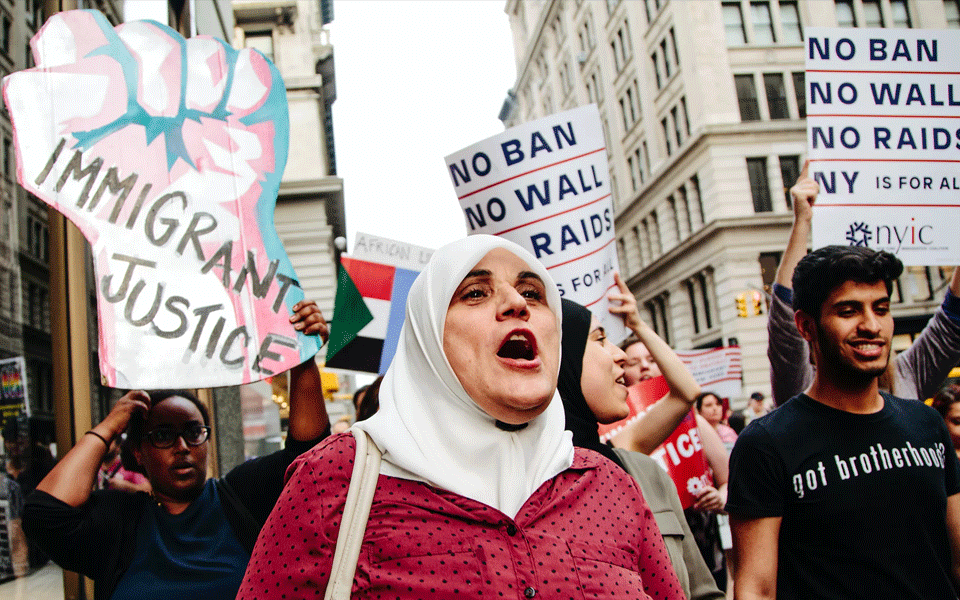
The president issued his first travel ban just a week after taking office in January 2017, prompting widespread chaos and protests at airports and in cities across the US. Although the administration sought to modify the policy to pass legal muster, different versions of the travel ban have since been rejected as unconstitutional by federal judges in Hawaii, California, Maryland and Virginia.
The appeals process ultimately forced the conservative-leaning supreme court to determine the validity of the travel ban, which in its third version seeks to bar or limit entry to immigrants from five Muslim-majority countries – Iran, Libya, Somalia, Syria and Yemen. The policy also imposed travel restrictions on certain government officials from Venezuela and their families, as well as North Korea, which were not challenged in court.
Oral arguments before the supreme court in April focused largely on Trump’s motivations in ordering the travel ban, given his sharp rhetoric against Muslims on the 2016 presidential campaign trail.
Opponents of the travel ban argued the policy was a watered-down attempt by Trump to make good on his campaign pledge to ban all Muslims from coming to the US. They also cited Trump’s repeated derogatory statements about Muslims and Islam, both as a candidate and since taking office, to demonstrate that the policy was rooted in religious discrimination.
While several of the supreme court justices acknowledged Trump’s record of espousing anti-Muslim views, chief justice John Roberts and Justice Anthony Kennedy, the two most likely swing votes, signaled they were reluctant to challenge the president’s authority on what he claims is a matter of national security. The bench also grappled with the relevance of campaign statements in assessing official policy.
While earlier versions of Trump’s travel ban indefinitely suspended all refugee admissions to the US, the president signed an executive order in October that resumed the processing of refugees. In doing so, Trump also called for a 90-day review of the program for 11 countries, most of them Muslim-majority, deemed as “high risk” by his administration.
Courtesy: www.theguardian.com
Let the Truth be known. If you read VB and like VB, please be a VB Supporter and Help us deliver the Truth to one and all.
Two injuries, one DNF, a DQ as India end messy World Relays campaign

Gaborone (Botswana) (PTI): Amoj Jacob and Ragul Kumar got injured during the men's 4x400m and 4x100 races respectively as India ended their World Athletics Relays campaign in disappointment on the second day of competitions here on Sunday.
The Indian camp had high hopes of making the 2027 World Championships in the men's 4x400m relay but the team did not finish (DNF) the race as Jacob suffered cramps and pulled out of the race after taking the baton from the first leg runner Dharamveer Choudhary. Rajesh Ramesh and Vishal TK were to run in the third and fourth legs.
Those teams which could not qualify for the 2027 Beijing World Championships by reaching the final round of each of the six relay events on Saturday were given another chance in the second qualification round on Sunday.
The top two teams in each of the two heats (in all six relay events) booked the Beijing ticket on Sunday.
India will now have to try and qualify for the World Championships through the Top Lists of the World Athletics, which is a long and tedious process.
In the men's 4x100m race, third leg runner Ragul Kumar fell down the track after failing to hand over the baton inside the exchange zone to fourth leg runner Gurindervir Singh, which clearly showed the lack of coordination among the runners.
Harsh Santosh Raut and Animesh Kujur ran the first two legs.
The Indian quartet was disqualified and Kumar was seen being taken away from the Field of Play with the help of the volunteers.
It was a comedy of errors in the case of the women's 4x100m race, which saw the baton being dropped during an exchange between first leg runner Tamanna and second runner Nithya Gandhe, though the Indians finished the race in 53.09 seconds.
Gandhe started running quite a distance, but after realising that the baton was not in her hand, she turned and ran back to pick it up.
The only silver-lining for the Indian contingent was the national record time in the mixed 4x100m relay race, though the quartet of Ragul Kumar, Nithya Gandhe, Animesh Kujur and Sneha SS finished sixth in heat number two with a time of 41.35 seconds, bettering the previous national mark of 42.30 seconds set in March in Chandigarh.
The mixed 4x400m relay quartet of Theerthesh P Shetty, Kumari Saloni, Nihal William and Rashdeep Kaur ended at fifth in heat number one with a time of 3 minutes and 19.40 seconds.
On Saturday, all the five Indian relay teams had failed to make it to the respective final rounds and thus missed out on the 2027 World Championships berths.