US to make final conclusions on Saudi killing in 'next two days': Trump
Washington, Nov 18: The United States will make final conclusions by early next week over the killing of Jamal Khashoggi, President Donald Trump said, following reports that the CIA had held Saudi Crown Prince Mohammed bin Salman responsible.
Saudi Arabia has repeatedly changed its official narrative of the October 2 murder, first denying any knowledge of dissident journalist Khashoggi's whereabouts and later saying he was killed when an argument degenerated into a fistfight.
Earlier this week, a Saudi prosecutor exonerated the crown prince of involvement in the brutal murder.
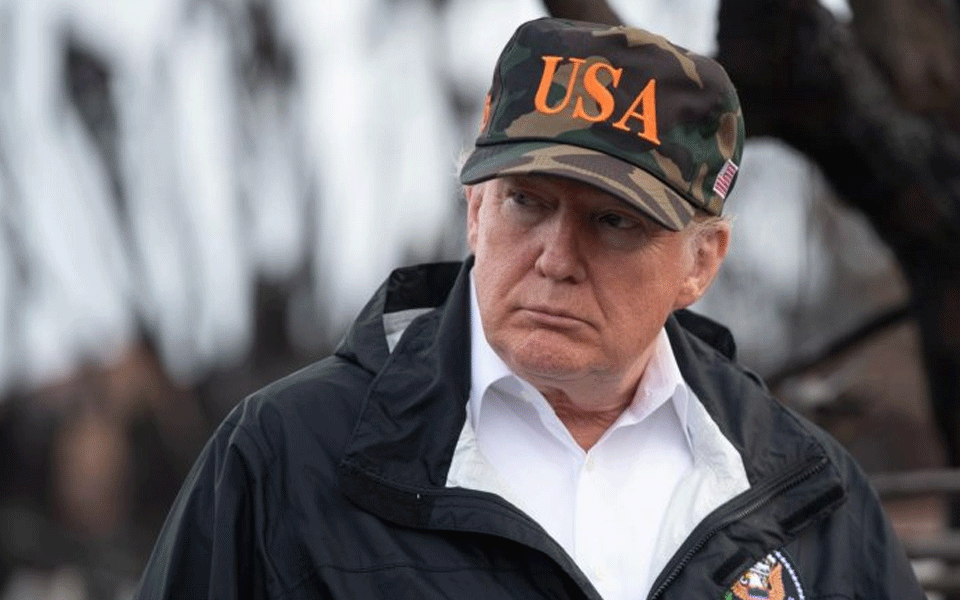
Speaking to reporters in Malibu, California after surveying damage from wildfires, Trump said, "We'll be having a very full report over the next two days, probably Monday or Tuesday."
State Department spokeswoman Heather Nauert earlier said reports indicating the United States had already made final conclusions in the case were "inaccurate."
"There remain numerous unanswered questions with respect to the murder of Mr Khashoggi," she added.
The State Department will continue to seek facts and work with other countries to hold those involved in the killing accountable, Nauert said, adding "while maintaining the important strategic relationship between the United States and Saudi Arabia."
"In the meantime, we will continue to consult Congress, and work with other nations to hold accountable those involved in the killing of Jamal Khashoggi."
She noted that Washington had already taken "decisive measures" against individuals, including visa and sanctions actions.
The remarks appeared to contradict reports that the Central Intelligence Agency (CIA) had determined Saudi Arabia's powerful Crown Prince Mohammed bin Salman ordered the killing of Khashoggi, a vocal critic.
The killing and the international uproar it triggered has frayed ties between Washington and longtime ally Riyadh, which has sought to end discussion of the murder and rejected calls for an international investigation.
But ahead of a briefing by his secretary of state and CIA director, Trump demured when asked about possible retaliation against Riyadh.
"They have been a truly spectacular ally in terms of jobs and economic development," Trump told reporters.
"And I also take that -- you know, I'm president -- I have to take a lot of things into consideration."
The Washington Post, which broke the story, said the CIA found that 15 Saudi agents flew on government aircraft to Istanbul and assassinated Khashoggi in the Saudi consulate.
Khashoggi, a Post columnist, had gone to the consulate to obtain documents necessary to marry his Turkish fiancee.
Meanwhile, European Union foreign affairs chief Federica Mogherini reiterated calls for a "thorough, credible and transparent" probe into Khashoggi's killing.
"The need remains to shed full clarity on the circumstances surrounding this horrendous crime as well as to ensure accountability for all those responsible for it," she said in a statement.
Reiterating the EU's categorical opposition to the death penalty, Mogherini said "we will continue to stress that the kingdom of Saudi Arabia must put in place measures to ensure that something like this can never happen again."
"In due course, the EU and its member states will consider how they can act together towards appropriate measures against those responsible, in support of the rules based international system," she added.
Let the Truth be known. If you read VB and like VB, please be a VB Supporter and Help us deliver the Truth to one and all.
Brothers awaiting board exam results drown in canal

Erode (Tamil Nadu) (PTI): Minor brothers who were awaiting their board exam results have drowned in a canal in this district while spending their Summer holidays at their aunt's place, police said.
According to Arachalure Police, Santhosh, aged 17, and his younger brother Sanjai, aged 15, natives of Musiri village in Tiruchirapalli district, came to Gopaliparai hamlet near Arachalure to their Aunt's house a couple of days ago after writing their annual 12th and 10th examinations, respectively.
The police said on Friday that both boys went to the nearby Lower Bhavani Project canal to take a bath. It was alleged that while taking a bath, both boys went to a deeper area of the canal and went missing.
As they didn't return home, even two hours after they left, their aunt grew suspicious and informed the Fire and Rescue Services, Chennimalai. A rescue team from the department rushed to the spot. After a few minutes of searching, they located the dead bodies of the brothers and sent them to the hospital. Arachalure police registered a case of death due to drowning and are investigating.