US, UK and Australia agree on nuclear submarine project amidst China's aggressive behaviour
Washington (PTI): The United States, Australia and the United Kingdom have announced a nuclear-powered submarine deal, a step aimed at countering the Chinese aggressive behaviour in the resource-rich Indo-Pacific region and ensuring that the region remains "free and open."
Under the Aukus agreement, Australia will first receive at least three nuclear-powered submarines from the US.
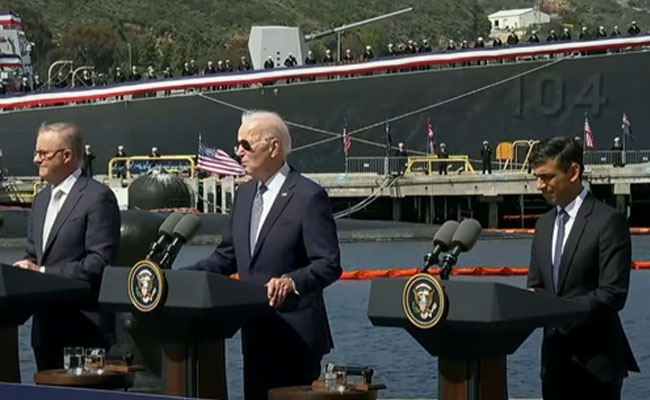
The announcement was made after US President Joe Biden, UK Prime Minister Rishi Sunak and Australian Prime Minister Anthony Albanese attended a summit meeting in San Diego on Monday and asserted that the move is to keep the Indo-Pacific region "free and open."
"With the support and approval of the Congress, beginning in the early 2030s, the United States will sell three Virginia-class submarines to Australia with the potential to sell up to two more if needed, jumpstarting their undersea capability a decade earlier than many predicted," Biden said in the presence of Australian Prime Minister Albanese and British Prime Minister Sunak.
As part of the announcement, the US has also pledged a total of USD 4.6 billion over the next few years to build its submarine construction capacity and to improve the maintenance of its Virginia-class submarines.
"This state-of-the-art conventionally armed nuclear-powered submarine will work -- that will combine the UK submarine technology and design with the American technology," he said.
The Indo-Pacific is a biogeographic region, comprising the Indian Ocean and the western and central Pacific Ocean, including the South China Sea.
India, the US and several other world powers have been talking about the need to ensure a free, open and thriving Indo-Pacific in the backdrop of China's rising military manoeuvring in the region.
China claims nearly all of the disputed South China Sea, though Taiwan, the Philippines, Brunei, Malaysia and Vietnam all claim parts of it. Beijing has built artificial islands and military installations in the South China Sea.
Australia's future SSN, which Biden described as "SSN-AUKUS", will also be a state-of-the-art platform designed to leverage the best of submarine technology from all three nations.
SSN-AUKUS will be based upon the United Kingdom's next-generation SSN design while incorporating cutting-edge US submarine technologies and will be built and deployed by both Australia and the United Kingdom.
"Beginning this year, Australian personnel will embed with US and UK crews on boats and at bases in our schools and shipyards. We will also begin to increase our port visits to Australia. In fact, as we speak, the nuclear-powered submarine, the USS Asheville, is making a port call in Perth," Biden said.
"And later this decade, we will be establishing a rotational presence of the US and UK nuclear-powered subs in Australia to help develop the workforce Australia is going to need to build and maintain its fleet," he said.
Describing it as a new chapter in the relationship between the three countries, Albanese said this is a friendship built on their shared values, commitment to democracy, and a common vision for a peaceful and prosperous future.
"The AUKUS agreement, we confirm here in San Diego, represents the biggest single investment in Australia's defence capability in all of our history, strengthening Australia's national security and stability in our region; building a future made in Australia with record investments in skills, jobs, and infrastructure; and delivering a superior defence capability into the future," he said.
President Biden said all three countries were committed to ensuring that the region would remain free and open.
"Forging this new partnership, we're showing again how democracies can deliver our own security and prosperity... not just for us but for the entire world," he said. From early in the next decade, Australia will take delivery of three US Virginia-class nuclear-powered submarines. This is the first time in 65 years and only the second time in history that the United States has shared its nuclear propulsion technology, he said.
Commenting on the deal, Sunak noted, "Sixty years ago, here in San Diego, President Kennedy spoke of a higher purpose: the maintenance of freedom, peace, and security. Today, we stand together united by that same purpose. Recognising that to fulfil it, we must forge new kinds of relationships to meet new kinds of challenge, just as we have always done."
"In the last 18 months, the challenges we face have only grown. Russia's illegal invasion of Ukraine, China's growing assertiveness, and the destabilising behaviour of Iran and North Korea all threaten to create a world defined by danger, disorder, and division," he said.
"Faced with this new reality, it is more important than ever that we strengthen the resilience of our own countries. That is why the UK is today announcing a significant uplift in our defence budget.
"We are providing an extra 5 billion pounds over the next two years, immediately increasing our defence budget to around 2.25 per cent of GDP. This will allow us to replenish our war stocks and modernise our nuclear enterprise, delivering AUKUS and strengthening our deterrent. Our highest priority is to continue providing military aid to Ukraine because their security is our security," Sunak added.
Australian Prime Minister Albanese said the submarine plan would create thousands of new jobs and marked the "biggest single investment in Australia's defence capability in all of its history".
"This will be an Australian sovereign capability, commanded by the royal Australian navy and - sustained by Australian workers in Australian shipyards with construction to begin this decade," said Albanese.
Let the Truth be known. If you read VB and like VB, please be a VB Supporter and Help us deliver the Truth to one and all.
Allahabad HC orders probe into 'reinstatement' of teacher in UP's Barabanki
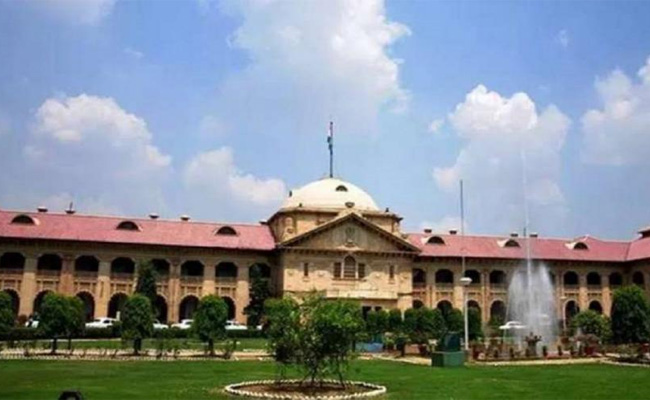
Lucknow (PTI): The Lucknow Bench of the Allahabad High Court on Friday ordered a probe by the special task force (STF) into alleged irregularities in the rejoining of a teacher at City Intermediate College in Barabanki, observing that the reinstatement appeared to be prima facie illegal.
The court also directed the recovery of the salary paid to the teacher during the disputed period.
A bench of Justice Rajeev Singh passed the order on a petition filed by the college management committee. The court expressed doubts over the roles of the District Inspector of Schools (DIOS), Barabanki, the college principal and the teacher concerned and hence, directed a detailed inquiry into the matter.
Taking note of alleged manipulation of records and misleading submissions, the court ordered the immediate transfer of the Barabanki DIOS to ensure a fair probe. It also directed the initiation of disciplinary proceedings against the then joint director of education of the Ayodhya division.
In its order, the court found that the teacher, Abhay Kumar, was initially appointed as an assistant teacher in 2018 but joined an Eklavya Model Residential School in Chhattisgarh as a lecturer in June 2024 without obtaining permission from the management. His subsequent request to retain the lien was rejected.
Despite this, he was allowed to rejoin the Barabanki College in September 2025 on the directions of the joint director of education and the DIOS, and was even paid the salary for October 2025. The court termed the rejoining "wholly illegal" and lacking any legal basis.
The bench also expressed concern over lapses in communication within the education department and directed the Uttar Pradesh chief secretary to ensure that official orders are communicated through email and WhatsApp as well, to prevent disputes.
The matter is next listed for hearing on May 28 when a compliance report is sought.