Vaccine certification for travel must meet 'minimum criteria', says UK
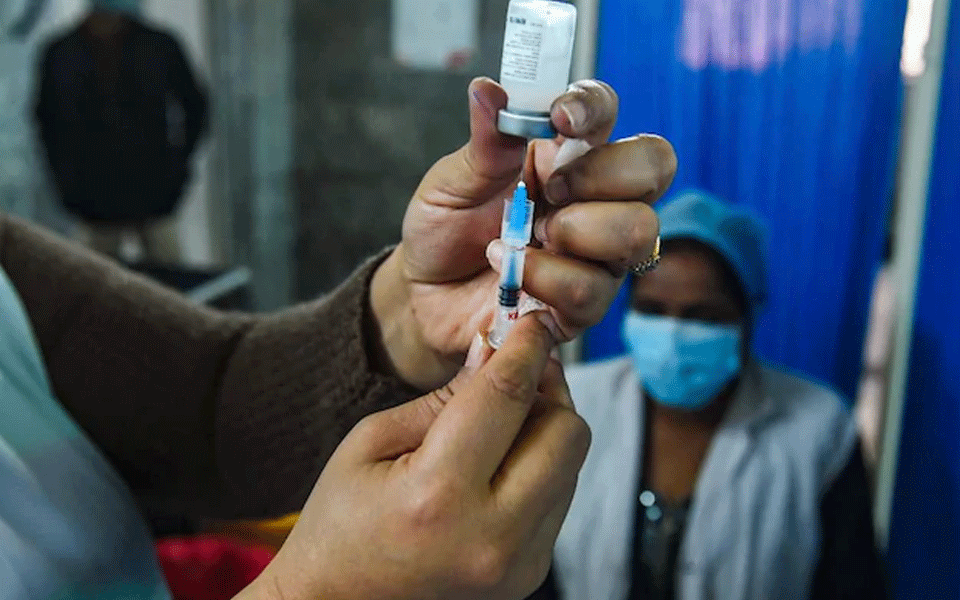
London(PTI): The UK government has said that COVID-19 vaccine certification from all countries must meet a minimum criteria and that it is working with India on a phased approach to its international travel norms.
It follows Covishield, the Serum Institute of India manufactured Oxford/AstraZeneca vaccine, being added as eligible to an expanded UK travel advisory on Wednesday.
But with India's vaccine certification not on a list of 18 approved countries, Indian travellers to the UK will continue to be treated as non-vaccinated and therefore required to quarantine for 10 days on arrival.
Following much confusion over this process, UK government sources said on Wednesday night that additions or changes to the approved country listings are being kept under regular consideration , but there was no further clarity on the required criteria for approving a country's vaccine certification.
As part of our recently expanded inbound vaccination policy, we recognise the following vaccines Pfizer BioNTech, Oxford AstraZeneca, Moderna and Janssen (J&J), for the purposes of international travel. This now includes the formulations AstraZeneca Covishield, AstraZeneca Vaxzevria and Moderna Takeda, a UK government spokesperson said.
Our top priority remains protecting public health, and reopening travel in a safe and sustainable way, which is why vaccine certification from all countries must meet the minimum criteria taking into account public health and wider considerations. We continue to work with international partners, including India, to roll out our phased approach, the spokesperson said.
Travellers who are not fully vaccinated, or vaccinated in a country such as India currently not on the UK government's recognised list, must take a pre-departure test, pay for day two and day eight PCR tests after arrival in England and self-isolate for 10 days, with an option to test to release after five days following a negative PCR test.
With reference to an outcry over India's vaccination certification not being recognised despite Covishield being one of two main COVID-19 vaccines administered in India, UK government sources would only say that the rollout of its inbound vaccination programme to other countries and territories was always intended as a phased approach , building on the success of pilots with the US and Europe.
From October 4, England's traffic light system of red, amber and green countries based on levels of COVID-19 risk is to be officially scrapped. However, despite Covishield now being recognised within the UK's eligible vaccine formulations, it would not offer any advantage to Covishield-vaccinated Indian travellers planning a UK visit.
The Indian government has expressed its strong condemnation of such a move and warned of reciprocal measures if vaccinated travellers from India continued to be treated in a "discriminatory" way.
At a Global COVID summit hosted by US President Joe Biden on Wednesday, Prime Minister Narendra Modi reiterated that international travel should be made easier through mutual recognition of vaccine certificates .
Let the Truth be known. If you read VB and like VB, please be a VB Supporter and Help us deliver the Truth to one and all.
Congress’ Umesh Meti wins Bagalkot bypoll

Bagalkot: The Congress has secured a victory in the Bagalkot Assembly by-election, with its candidate Umesh Meti winning the seat after maintaining a lead from the first round of counting till the end.
The seat had fallen vacant following the death of sitting MLA H Y Meti. Umesh Meti, his son, has now been elected to the Assembly.
Party leaders attributed the victory to a combination of factors, including sympathy votes, the state government’s schemes, and campaign strategies led by Chief Minister Siddaramaiah and senior leader Satish Jarkiholi.
The Congress maintained a consistent lead throughout the counting process, eventually securing a decisive win in the constituency.