Vatican, China sign deal over bishops, allowing Pope a veto
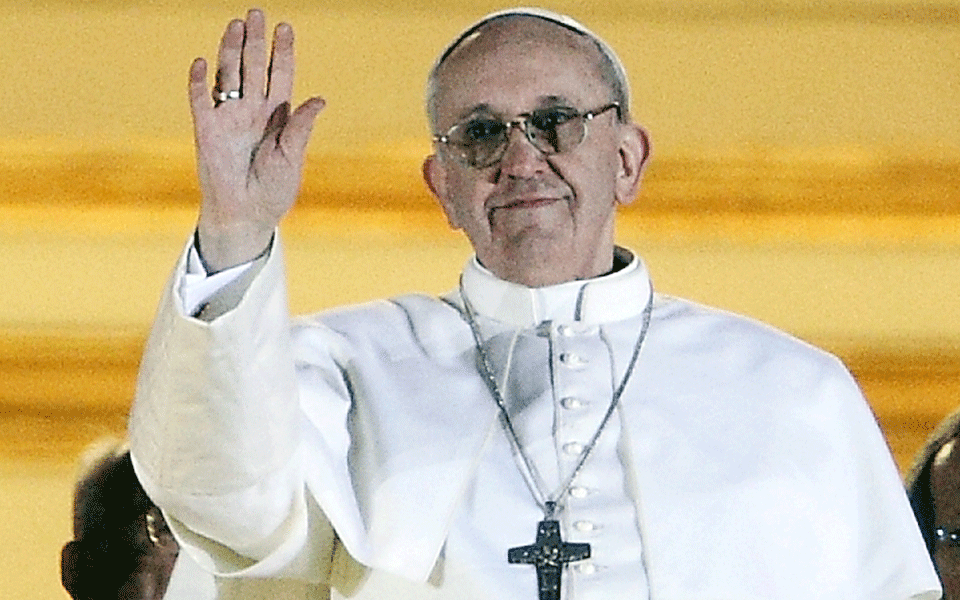
Rome/Beijing, Sep 22 : The Vatican and the Chinese government signed an agreement on Saturday on the appointment of bishops in China, ending a decades-long struggle over who chooses the leaders of Catholicism in the world's most populous country, but leaving major tensions in their relationship unresolved.
The "provisional agreement" was signed in Beijing by Msgr. Antoine Camilleri, the Holy See's undersecretary for relations with states, and Wang Chao, China's Deputy Foreign Affairs Minister, the Vatican said in a statement.
Details of the agreement weren't made public, but people familiar with the matter said it allows the Pope to veto new nominees for bishops proposed by the Chinese government, Efe news reported.
"This is not the end of a process. It's the beginning," said Vatican spokesman Greg Burke in a statement. "The objective of the accord is not political but pastoral, allowing the faithful to have bishops who are in communion with Rome but at the same time recognized by Chinese authorities."
The controversial deal constitutes the first official recognition by the Communist government that the Pope is the head of the Catholic Church in China, the report said.
But the agreement also means that the Vatican will no longer approve the ordination of bishops in China without Beijing's permission.
Coming amid an intensified government crackdown on Christians and other religious groups in China, the deal has drawn protests, including from some Catholics there, that it represents a defeat for the principle of religious freedom, according to the report.
Beijing's major condition for the agreement was that the Pope recognize seven excommunicated Chinese bishops who had been appointed without Vatican approval over the years.
As part of the understanding between China and the Vatican, the Pope was supposed to fulfil that requirement before the signing of the agreement, according to people familiar with the matter.
In two of the seven cases, government-backed bishops will take the place of bishops who shunned government control -- the first time the Vatican asked so-called underground bishops to step aside for this purpose.
For Beijing, the agreement is a step towards resumption of diplomatic relations with the Vatican, which Beijing broke off in 1951, and hence part of an intensifying campaign for the isolation of Taiwan, a democratic, self-ruled island that Beijing considers a renegade province.
The Holy See is the most prestigious of Taiwan's diplomatic partners, which now number only 17 after Beijing peeled off three others this year.
Among the important unknown details about the agreement were whether the Pope will have a choice of nominees or merely a right of veto over a single candidate at a time. And also how thoroughly the Vatican will be able to vet bishop candidates ahead of time.
The agreement also leaves unresolved the fate of some 30 so-called underground bishops recognized by the Vatican but not by China.
Another complication was a major discrepancy in the number of dioceses recognized by the two sides. The Vatican tallies 144 Catholic dioceses in the country while Chinese government's count is only 96, according to the Holy Spirit Study Centre.
It was unclear whether Beijing will nominate bishops to lead the dioceses it hasn't recognized till now.
Let the Truth be known. If you read VB and like VB, please be a VB Supporter and Help us deliver the Truth to one and all.
4 workers die after being buried under coal slurry in Jharkhand's Dhanbad

Dhanbad (Jharkhand) (PTI): At least four workers died after being buried under coal slurry in Jharkhand's Dhanbad district on Saturday, a police official said.
The incident took place at Moonidih coal washery in the command area of Bharat Coking Coal Limited (BCCL).
"Bodies of all four workers were dug out of debris during a rescue operation," Putki police station in-charge Waqar Hussain told PTI.
The incident took place when coal slurry was being loaded into trucks by workers, during which a large chunk of slurry fell and trapped several workers underneath, officials said.
The deceased have been identified as Manik Bauri, Dinesh Bauri, Deepak Bauri, and Hemlal Gope.
Meanwhile, the family members of the deceased and local villagers placed the bodies in front of the washery gate and began a protest.
They demanded compensation, jobs for dependents and action against those responsible for the incident.
Police and administration officials are trying to pacify the protesters, an official said.