Very excited to invite India to join Pax Silica, says top US official
New York (PTI): The US has said it is “very excited” to have extended an invitation to India to join the Pax Silica initiative on supply chain security and will be soon signing with the Indian Government, underlining there is “very positive momentum” in relations with New Delhi.
Highlighting the "great relationship" between President Donald Trump and Prime Minister Narendra Modi, Washington also stressed that India is probably the only other country on Earth to be able to "rival China" in terms of the sheer volume of its human talent.
“We are very excited to have extended an invitation for India to join" Pax Silica, and “I’ll be travelling to India in just a couple weeks for a major signing with the Indian Government,” Under Secretary of State for Economic Affairs Jacob Helberg told reporters on Friday.
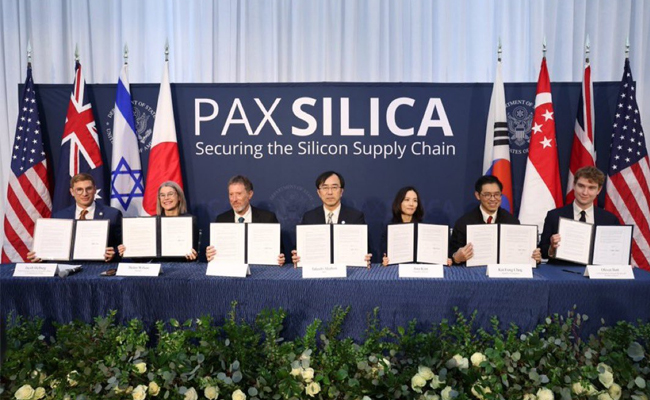
The US had last year in December launched ‘Pax Silica’, a strategic initiative to build a secure, prosperous, and innovation driven silicon supply chain—from critical minerals and energy inputs to advanced manufacturing, semiconductors, AI infrastructure, and logistics.
The signatories are Australia, Greece, Israel, Japan, Qatar, South Korea, Singapore, the United Arab Emirates and the United Kingdom. India was not included in the initial group of countries for the Pax Silica initiative.
Helberg added that while the Pax Silica was launched in December, and by January, the US had “already had a meeting of the minds” around India joining Pax Silica.
“And so we’re very pleased at the pace at which things have been moving in a very positive direction with our partners in India,” Helberg said during a briefing organised by the Washington Foreign Press Centre on the Critical Minerals Ministerial that the US hosted last week.
“India is also home to a large – very large mining and processing operations, which obviously holds great promise to make significant contributions to the supply chain ecosystem. And so there’s a lot of terrain in which we will be able to partner on with India,” he said.
Helberg further pointed out that outside of China, "India is probably the only other country on Earth to be able to rival China with respect to the breadth and depth of the sheer volume of young, technically trained talent, human talent.”
“We view India very positively, and President Trump has a great relationship with (Prime Minister) Narendra Modi,” he added.
Helberg also said that “we’re very excited and very proud about the bilateral trade deal being concluded with India.”
Helberg’s comment about the trade deal came just hours before India and the US issued a joint statement announcing that the two sides have reached a framework for an Interim Agreement regarding reciprocal and mutually beneficial trade.
Under the agreement, India will eliminate or reduce tariffs on all US industrial goods and a wide range of US food and agricultural products, including dried distillers’ grains, red sorghum for animal feed, tree nuts, fresh and processed fruit, soybean oil, wine and spirits, and additional products.
According to the joint statement, the US will reduce tariffs on Indian goods to 18 per cent. US President Donald Trump also issued an Executive Order removing the punitive 25 per cent tariffs imposed on India for its purchases of Russian oil.
Helberg further said that India and the United States are two very large countries, with America by far the world’s largest economy and India the world’s largest country demographically and a very young country, very fast-growing economy.
“So for us to align on things, it takes a little bit more work because of the sheer size of our countries,” he said, responding to a question on the role the US envisages for India in Pax Silica and why the country was not initially included in the initiative.
During the briefing, Helberg spoke about the inaugural Critical Minerals Ministerial meeting hosted in Washington on February 4 by US Secretary of State Marco Rubio. The ministerial brought together 55 delegations to explore ways to diversify and secure global critical minerals supply chains.
External Affairs Minister S Jaishankar participated in the ministerial and, in his remarks, “underlined challenges of excessive concentration and the importance of de-risking supply chains through structured international cooperation.”
Let the Truth be known. If you read VB and like VB, please be a VB Supporter and Help us deliver the Truth to one and all.
UP govt sacks five doctors, orders action against 16 health officials for negligence
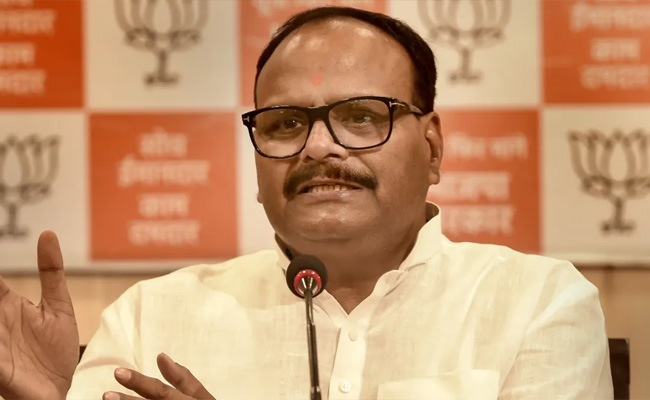
Lucknow (PTI): Uttar Pradesh Deputy Chief Minister and Health Minister Brajesh Pathak on Friday ordered strict action against several health officials, including the dismissal of five doctors from service, over alleged negligence, dereliction of duty and irregularities in the health department.
According to an official statement issued by his office, five medical officers were dismissed for remaining absent from duty for a prolonged period without information and for staying away from medical work.
Those dismissed include Dr Alaknanda of the district hospital in Gorakhpur, Dr Ramji Bhardwaj posted under the Kushinagar Chief Medical Officer (CMO), Dr Saurabh Singh posted under the Balrampur CMO, Dr Viklesh Kumar Sharma of CHC Jagdishpur in Amethi and Dr Monica Verma of CHC Dibiyapur in Auraiya, it stated.
The government also ordered departmental disciplinary proceedings against 16 medical officers, including Ambedkar Nagar CMO Dr Sanjay Kumar Shaival and Deputy CMO Dr Sanjay Verma, over alleged irregularities in the registration and renewal process of private hospitals, nursing homes and ultrasound centres, it added.
According to the statement, "the two officers were found guilty of deliberately violating government norms, misusing their positions and showing negligence in clearing files for personal interests."
"A preliminary inquiry conducted by a three-member committee, including an Additional District Magistrate, reportedly confirmed several complaints against them, following which Pathak ordered strict action."
Departmental proceedings were also ordered against Hardoi Medical Superintendent Dr Manoj Kumar Singh for allegedly failing to act against unauthorised private hospitals operating in the district and neglecting official responsibilities.
The health department has also sought an explanation from the Hardoi CMO over assigning senior-level responsibilities to a junior doctor despite the availability of senior officers in the district.
The statement said action has also been initiated against several doctors in separate cases related to alleged negligence in treatment, administrative lapses, improper medico-legal examinations and misconduct with colleagues.
Among them are Dr Shameem Akhtar of Prayagraj, doctors and a pharmacist posted at CHC Lambhua in Sultanpur, and two doctors at the district hospital in Mathura accused of negligence in preparing medico-legal reports in an assault case.
Departmental proceedings were also ordered against doctors posted in Balrampur, Varanasi, Badaun, Lakhimpur Kheri, Sambhal and other districts for alleged negligence in medical duties.
In another case, Dr Rituj Agrawal, an associate professor in the orthopaedics department of the government medical college in Badaun, faces disciplinary action over allegations of abusing and misbehaving with a woman doctor and another colleague.
Two doctors -- Dr Pratibha Yadav of Bahraich and Dr Rakesh Singh of Mathura -- have been awarded censure punishment in separate negligence-related cases.
The statement further said the deputation of Dr Aditya Pandey, who was posted with the State Health Agency under the cashless treatment scheme for government employees, has been terminated with immediate effect over alleged misconduct and inappropriate behaviour with a colleague.
He has been sent back to his original posting in Raebareli and departmental action has also been ordered, it added.
The government has also ordered withholding of salary increments in several cases. Dr Lalmani, a gynaecologist currently posted in Hamirpur, has been penalised with permanent stoppage of three increments and censure punishment over allegations of extortion from patients and misbehaviour during an earlier posting in Azamgarh.
Four increments of Dr Santosh Singh of Balrampur and two increments of Dr Nisha Bundela of Jhansi have also been withheld.
Action has also been directed against Dr Pawan Sahu, an orthopaedic surgeon at the trauma centre in Moth, Jhansi, after allegations of private practice against him were found to be true, the statement added.