Video shows Syrian prime minister escorted by armed men
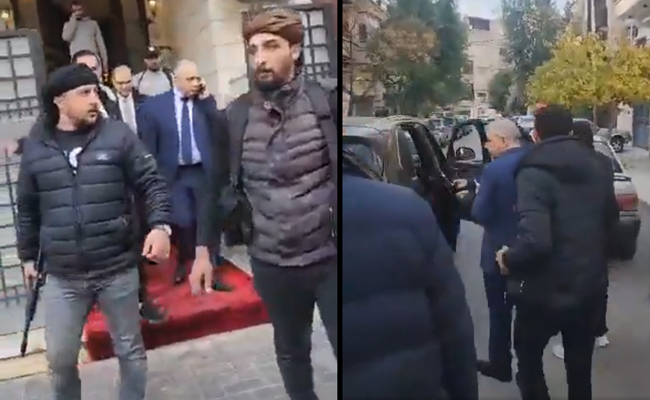
Damascus (AP): A video shared on Syrian opposition media showed a group of armed men escorting Syrian Prime Minister Mohammed Ghazi Jalali out of his office and to the Four Seasons hotel on Sunday.
Meanwhile, Syrians have crowded the Lebanese side of the Masnaa border crossing Sunday waiting to cross back into Syria after the fall of Bashar Assad.
Lebanon's General Security closed the crossing overnight but reopened it in the morning, allowing Syrians to freely cross out of Lebanon while restricting their entry from Syria into the country.
Lebanese officials have long complained about the country's population of refugees — the largest per capita in the world. As of Sept 30, some 768,353 Syrian refugees were registered with the UN refugee agency in Lebanon, with hundreds of thousands more believed to be unregistered.
Many fled Lebanon after the escalation of the conflict between Israel and the Lebanese militant group Hezbollah in late September, but others crossed back from Syria into Lebanon in recent days as insurgents marched toward Damascus.
With Syrian officials having abandoned the Syrian side of the border, an Associated Press photographer who crossed from Lebanon into Syria said he saw some people taking the opportunity to loot the duty-free store between the two borders.
Qatari official says there is regional consensus on engaging all parties in Syria
DOHA, Qatar — Qatar's foreign ministry spokesman and adviser to the prime minister, Majed bin Mohammed al-Ansari, says participants of the emergency meeting of foreign ministers and top officials from eight countries with interests in Syria, agreed on the need “to engage all parties on the ground and be inclusive in our engagement.”
The late Saturday meeting, hosted by Qatar, included Iran, Saudi Arabia, Russia and Turkey.
Al-Ansari also said that would include the HTS, the main rebel group that has taken control of Damascus, branded a terrorist organization by the US and United Nations.
He said the meeting participants were caught off guard by how quickly Assad was toppled and that the Syrian leader had not reached out to Qatar, but had spoken to other countries in the region in his final days. He said he did not know where Assad was.
Al-Ansari said the international community must now work together to create conditions where all Syrians can live in peace, regardless of their religious or ethnic group.
The main concern is “stability and safe transition,” he said. “No one group or party should feel unsafe in a future Syria.”
Al-Ansari spoke to reporters on the sidelines of the Doha Forum.
Syrian Prime Minister Mohammad Ghazi al-Jalali was escorted by opposition forces out of his #Damascus home early this morning to hand over control of state institutions to the opposition leader.#دمشق #Syria pic.twitter.com/jmYLAvrJnj
— Pamir News (@PamirNews) December 8, 2024
Let the Truth be known. If you read VB and like VB, please be a VB Supporter and Help us deliver the Truth to one and all.
EC role, Hindu vote consolidation among factors for BJP win in Bengal polls: J-K CM Omar
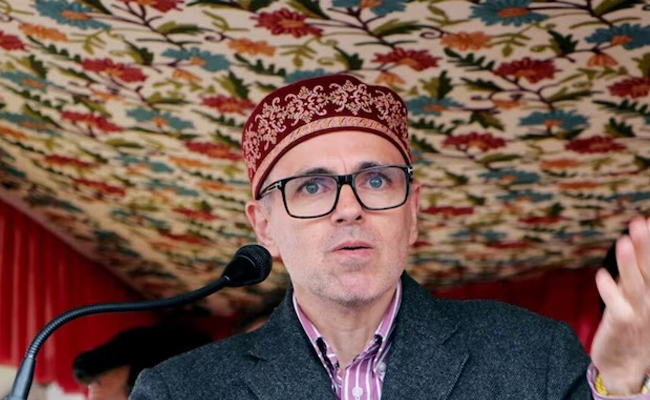
Srinagar (PTI): Jammu and Kashmir Chief Minister Omar Abdullah on Tuesday attributed the BJP's West Bengal win to a "significant role" played by the Election Commission (EC), alongside a consolidation of Hindu votes and a fractured minority mandate.
Abdullah also said the INDIA bloc needs to define its role in the political landscape of the country and make it clear whether the opposition alliance was limited to the parliamentary elections or extended to the state elections as well.
Talking to PTI Videos, Abdullah hinted that the EC has compromised its neutrality by conducting the Special Intensive Revision (SIR) in West Bengal and linked it to the BJP's gains in the state, claiming large-scale deletion of legitimate voters.
On the performance of the BJP in the just concluded assembly elections, Abdullah said the saffron party has almost nothing to show in southern states.
"So then you look at West Bengal and Assam. Yes, the BJP improved its tally in Assam. There are various reasons for that. You know as well as I do, what those are. West Bengal, I think we need to look at the results very carefully," he said.
"The easiest explanation for the West Bengal result is the serious curtailing of voter list," Abdullah said.
"Voters found their names deleted. People who served in uniform and fought for this country on the borders, who were considered Indian citizens all their lives, were suddenly held to a higher standard and not allowed to vote. Something is not right," he said.
While alleging that the EC played a "significant part" in the results, the chief minister admitted the outcome was multifaceted and noted a consolidation of over 60 per cent of the Hindu vote towards the BJP and a "significant fracture" in the minority vote, particularly in seats where Muslims constitute over 50 per cent of the population.
"There is no doubt that the role of the Election Commission played a significant part in the results but we will also have to look at the other factors," he said.
He said the results of West Bengal cannot be compared to those in other states. "The situation was unique to West Bengal. The SIR that was done, the way in which the voter lists were changed, the sort of minute scrutiny that the Election Commission subjected West Bengal to, the role of the central investigative agencies.
"All of these are situations that at least in recent electoral history of India are unique to West Bengal. So to suggest that we can learn lessons from West Bengal and implement them in other parts of the country, I think would not be correct," he said.
Abdullah had recently said that if the West Bengal results throw a surprise, the role of EC will come under scrutiny.
However, during Tuesday's interview, the chief minister said he still maintains that electronic voting machines (EVMs) do not lead to vote theft.
"What we saw in West Bengal...I know there are a lot of people who believe that the EVMs themselves are flawed. I am not a proponent of that conspiracy theory.
"But I do believe that the Election Commission has done itself no favours in the way in which it has gone about both the process of delimitation and the process of finalisation of electoral rolls," he said and cited the example of delimitation exercise in Jammu and Kashmir or Assam.
"These are clear examples of how the process was done to benefit one party or in the case of Jammu and Kashmir, one party and its allies. And the results speak for themselves. You created seven new seats in Jammu and Kashmir and out of those six seats were won by the BJP. You redrew assembly constituencies to benefit one particular party or its allies. And the same is true for West Bengal as well," he said.
Referring to the INIDA bloc, he said the election results were no new message for the alliance.
"We need to decide what the INDIA bloc is for. Is it only for Parliament or for state elections as well?" he asked.
"What happened in West Bengal is unfortunate. The Congress and TMC fought against each other. Now the Congress agrees with Mamata Banerjee that 100 seats were stolen, but the fact is they fought each other," he said.
Despite the friction, Abdullah reaffirmed the "pre-eminent position" of the Congress within the opposition alliance, dismissing the idea of any other party assuming the mantle.
"The Congress is the only party other than the BJP with a pan-India presence. All of us acknowledge this," he stated.
"To suggest someone else can assume a leadership role would be incorrect. Kharge Sahib is the president of the Congress, and by virtue of that, he assumes leadership of the INDIA bloc meetings. That is the way it should be," the chief minister said.
Abdullah said any 'Common Minimum Programme' would depend on whether the opposition alliance decides to fight state assembly elections collectively, noting that he would share his specific views with the bloc internally rather than through the media.