Vijay Mallya loses UK High Court appeal, clock set for extradition to India
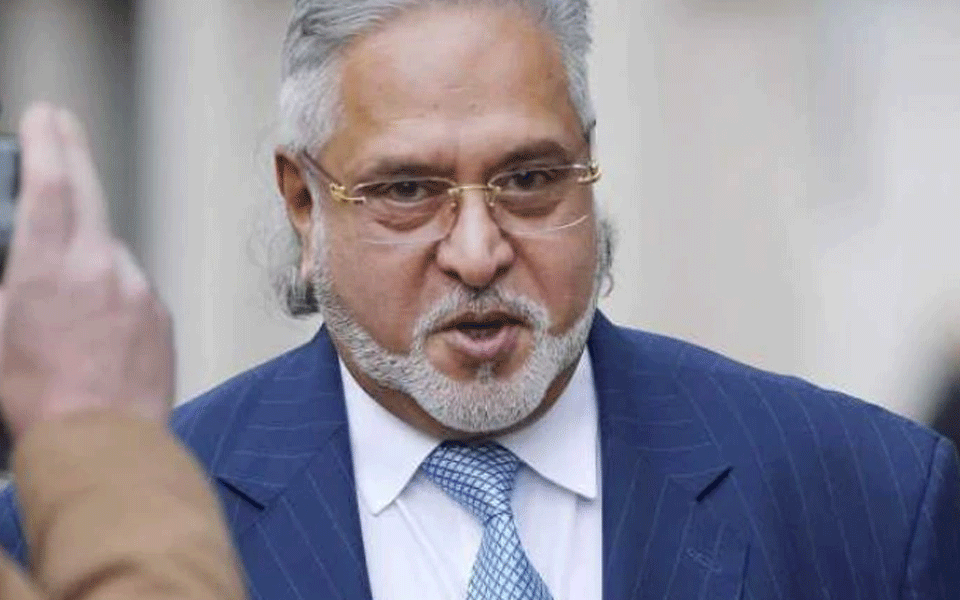
London/New Delhi: Embattled liquor baron Vijay Mallya on Monday lost a crucial appeal against his extradition to India with the UK High Court ruling that the ex-boss of Kingfisher Airlines did have a prima facie case to answer in the Indian courts over the alleged Rs 9,000-crore fraud associated with loans sought from Indian banks for his now defunct airline.
The dismissal of the High Court appeal effectively clears the decks for Mallya's extradition to India to face the charges in the Indian courts, with 14 days for him to apply for permission to appeal to the UK Supreme Court.
If he does apply, the UK Home Office would wait for the outcome of that appeal. But if he does not, under the India-UK Extradition Treaty, it would then be expected to formally certify the court order for the 64-year-old Mallya to be extradited to India within 28 days.
"We have held there is a prima facie case both of misrepresentation and of conspiracy, and thus there is also a prima facie case of money laundering," the High Court concluded.
This marks a major turning point for the Central Bureau of Investigation (CBI) and Enforcement Directorate (ED) case against the businessman, who has been on bail in the UK since his arrest on an extradition warrant in April 2017.
The ex-Kingfisher Airlines boss had appealed to the higher court against his extradition ordered by the Westminster Magistrates' Court in London in December 2018, and then signed off by then UK Home Secretary Sajid Javid in February last year, at a three-day hearing in February this year.
Lord Justice Stephen Irwin and Justice Elisabeth Laing, the two-member bench at the Royal Courts of Justice in London presiding over the appeal, dismissed it in a judgement handed down this week remotely due to the current coronavirus lockdown.
"We consider that while the scope of the prima facie case found by the SDJ (Senior District Judge Emma Arbuthnot) is in some respects wider than that alleged by the Respondent in India (CBI and ED), there is a prima facie case which, in seven important respects, coincides with the allegations in India," the judges noted.
They detail seven main points around which they based their decision to concur with Arbuthnot's extradition order.
Based on the documents setting out the Indian government's case against Mallya, the judges said they found that the loans in question were disbursed as the result of a conspiracy between the named conspirators and that they were made despite Kingfisher Airline's weak financials, negative net worth and low credit rating.
"The Appellant (Mallya) was party to false representations to induce the loans that funds would be inducted by way of unsecured loans, global depository receipts and equity," they note.
"The Appellant was party to false representations about inward investment, an exaggerated brand value, misleading growth forecasts, inconsistent business plans. The Appellant's dishonest intention not to repay the loans is shown by his later conduct in trying to avoid the personal and corporate guarantees," they said.
Mallya's legal team had sought to challenge the Indian government's case on multiple grounds, including whether their client would be safe at Barrack 12 in Arthur Road Jail in Mumbai where he is to be held on extradition.
Most of the grounds had already been dismissed by the High Court, with permission granted to appeal only on one ground - challenging the Indian government's prima facie case against Mallya of fraudulent intentions in acquiring bank loans.
"Mallya has 14 days to apply for permission to appeal to the Supreme Court. If he doesn't appeal - removal within 28 days thereafter. If he does appeal, we wait for the outcome on that application," said a spokesperson for the Crown Prosecution Service, which represented the Indian authorities in the UK courts.
In February, Mallya had again reiterated his message for the Indian banks to take back 100 per cent of the principal amount owed to them.
Reacting to the UK High Court's ruling, the CBI said it was a significant achievement for continuing the war against economic fugitives.
"It is a significant achievement in continuing war against economic fugitives who have been managing to stay away from the judicial process in the country," CBI spokesperson RK Gaur said in New Delhi.
Mallya, declared a fugitive by India, has been based in the UK since March 2016 and remains on bail on an extradition warrant executed three years ago by Scotland Yard on April 18, 2017.
In her verdict in December 2018, Judge Arbuthnot had ruled that the "flashy" former Kingfisher Airlines boss had a "case to answer" in the Indian courts. She found there was "clear evidence of dispersal and misapplication of the loan funds".
India and the UK have an extradition treaty signed in 1992 and in force since November 1993. Two major extraditions have taken place under this treaty so far - Samirbhai Vinubhai Patel, who was sent back to India in 2016 to face trial in connection with his involvement in the post-Godhra riots of 2002, and more recently alleged bookie Sanjeev Chawla, sent back in February this year to face match-fixing charges.
As India falls under the Category 2 set of countries within the UK's Extradition Act 2003, any decision of the courts must be endorsed by the UK Home Secretary - who has the authority to order extradition.
As Mallya's extradition has been signed off by the minister at the time, only a formal certification will now be required once all avenues of appeal have been exhausted in the UK.
Let the Truth be known. If you read VB and like VB, please be a VB Supporter and Help us deliver the Truth to one and all.
Man arrested with Rs 2.54-crore heroin in Mumbai

Mumbai (PTI): Police have arrested a man and seized over 500 grams of heroin worth Rs 2.54 crore in the illicit market from him in Mumbai, officials said on Friday.
The police's Anti-Narcotics Cell (ANC) made the drug seizure in Santacruz in the western suburbs. The operation was conducted by the Kandivali unit of the ANC on Thursday as part of a special crackdown against drug trafficking in the area, they said.
Acting on specific inputs, an ANC team conducted a raid in Santacruz (East) and intercepted a man. During a search, the team recovered 508 grams of high-grade heroin from his possession, an official said.
The seized contraband, a highly addictive, opioid drug derived from morphine, is estimated to be worth Rs 2.54 crore in the international market, he informed.
Following the seizure, a case was registered against the man under relevant sections of the Narcotic Drugs and Psychotropic Substances (NDPS) Act, 1985, and he was formally placed under arrest in the early hours of Friday.
The police are currently investigating the source of the drug and trying to identify the intended recipients of the consignment, he said.