We made some progress: EAM Jaishankar on India-China talks on eastern Ladakh row
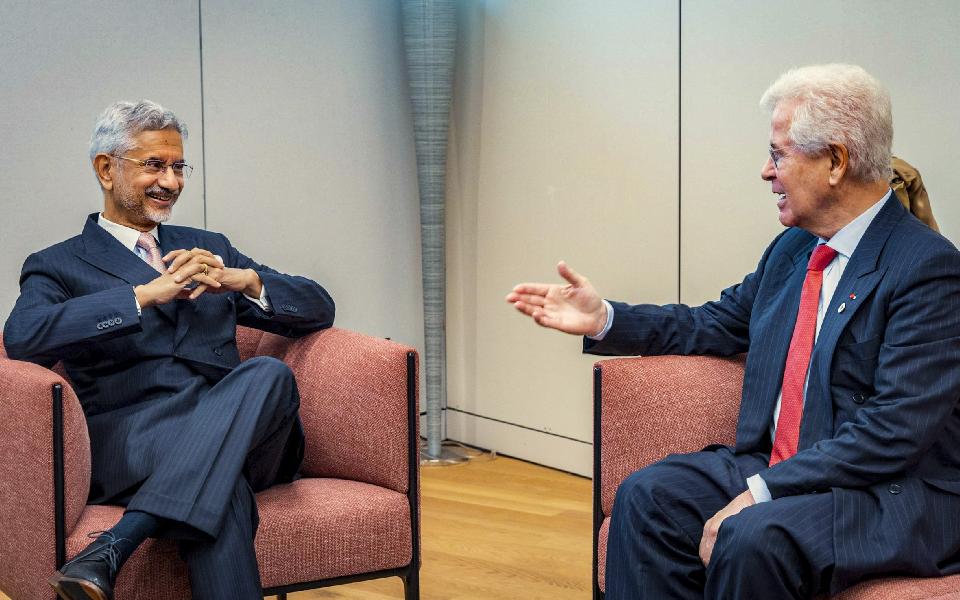
Geneva, Sep 12: Roughly 75 per cent of the "disengagement problems" with China are sorted out but the bigger issue has been the increasing militarisation of the frontier, External Affairs Minister S Jaishankar said on Thursday on the lingering border row in eastern Ladakh.
In an interactive session at a think-tank in this Swiss city, Jaishankar said the Galwan Valley clashes of June 2020 affected the "entirety" of India-China ties, asserting that one cannot have violence at the border and then say the rest of the relationship is insulated from it.
The external affairs minister said both sides have been engaged in negotiations for the last four years to find a solution to the outstanding issues.
"Now those negotiations are going on. We made some progress. I would say roughly you can say about 75 per cent of the disengagement problems are sorted out," he said at the Geneva Centre for Security Policy.
"We still have some things to do," Jaishankar, who is on a two-day visit to Switzerland, said.
But there is a bigger issue that both of us have brought forces close up and in that sense there is a militarisation of the border, he said.
"How does one deal with it? I think we have to deal with it. In the meanwhile, after the clash, it has affected the entirety of the relationship because you cannot have violence at the border and then say the rest of the relationship is insulated from it," he said.
The external affairs minister indicated that the relationship can improve if there is a resolution to the row.
"We hope that if there is a solution to the disengagement and there is a return to peace and tranquility, then we can look at other possibilities," he said.
The Indian and Chinese militaries have been locked in a standoff since May 2020 and a full resolution of the border row has not yet been achieved though the two sides have disengaged from a number of friction points following a series of talks.
The ties between the two countries nosedived significantly following the fierce clash in the Galwan Valley in June 2020 that marked the most serious military conflict between the two sides in decades.
India has been maintaining that its ties with China cannot be normal unless there is peace in the border areas.
Describing India-China relations as "complex", Jaishankar said the ties were kind of normalised in the late 1980s and the basis for it was that there would be peace at the border.
"The basis obviously for a good relationship, I would say even for a normal relationship, was that there would be peace and tranquility in the border. After things started to take a better turn in 1988, we had a series of agreements which stabilised the border," he said.
"What happened in 2020 was in violation of multiple agreements for some reasons which is still entirely not clear to us; we can speculate on it."
"The Chinese actually moved a very large number of troops to the Line of Actual Control at the border and naturally in response we moved our troops up. It was very difficult for us because we were in the middle of a Covid lockdown at that time," he said.
Jaishankar described the development as very dangerous.
"Now we could see straight-away that this was a very dangerous development because the presence of a large number of troops in these extreme heights and extreme cold in near proximity could lead to a mishap. And that's exactly what happened in June 2022," he said, referring to Galwan Valley clashes.
The external affairs minister said the issue for India was that why China disturbed the peace and tranquility and why they moved those troops and how to deal with this very close up situation.
"We have now been negotiating close to four years and the first step of that is what we called disengagement which is their troops go back to their normal operating bases and our troops go back to their normal operating bases and where required we have an arrangement about patrolling because both of us patrol regularly in that border as I said it is not a legally delineated border."
The ties between the two sides were affected in various domains including trade.
"Trade has got affected; exchanges have got affected. So it (the relationship) is not normal to put it very politely," he said.
The external affairs minister said though the border situation is the immediate priority, there are larger issues in India-China relations as well.
"That is the immediate issue. But I think there are larger issues in respect of India-China. We have long struggled with trade issues," he said.
The ballooning trade deficit in China's favour has been a major irritant in the ties before the border row erupted in April 2020.
Jaishankar also provided a historical perspective to the India China relationship and explained why it is a very complex one.
Let the Truth be known. If you read VB and like VB, please be a VB Supporter and Help us deliver the Truth to one and all.
CM Siddaramaiah alleges ‘criminal conspiracy’ in Sringeri recount, vows legal action
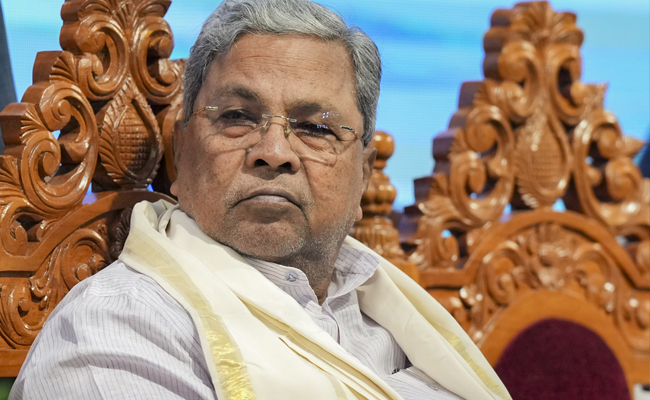
Bengaluru (PTI): Alleging a “criminal conspiracy” by BJP candidate D N Jeevaraj in the Sringeri Assembly poll recounting, Karnataka CM Siddaramaiah on Tuesday said the outcome was manipulated after valid postal ballot votes in favour of Congress leader T D Raje Gowda were tampered with during the recounting process.
Following a Karnataka High Court order on an election petition filed by Jeevaraj, challenging Raje Gowda’s election, the reverification and recounting were conducted on Saturday.
After the reverification and recount of postal ballots for the Sringeri Assembly constituency, votes polled in favour of Raje Gowda were reduced by 255, the returning officer said.
A report on the matter has been submitted to the Election Commission of India for further action, the officer added.
Congress leader Raje Gowda had won the 2023 Assembly polls from Sringeri by 201 votes, defeating his nearest rival Jeevaraj.
Addressing a press conference in Bengaluru, Siddaramaiah said the High Court had directed the recounting of postal ballots and that irregularities were noticed during the exercise conducted on May 2.
“This is a clear case of criminal conspiracy,” Siddaramaiah said, alleging that valid votes cast in favour of Raje Gowda were altered after being accepted by counting agents of all parties, including Congress, BJP, and JD(S).
He claimed that during the recounting of postal ballots, 255 votes were initially accepted as valid by all agents but were later tampered with by subordinate officials.
“There is a second mark on the votes polled in favour of Raje Gowda. They had accepted these as valid votes. Subsequently, another mark was made by officials. This is a clear case of criminal conspiracy,” he said.
When asked who was behind the alleged conspiracy, the CM replied, “It was hatched by Jeevaraj and others. It is planned.”
Siddaramaiah further alleged that the returning officer acted improperly by declaring the result despite the presence of an Election Commission observer during the recounting.
“Immediately after the counting, the returning officer announced the result. He should not have done so; this is against the law,” he said.
He pointed out that Raje Gowda had originally won by 201 votes, but after the recounting, the BJP candidate was declared the winner by 52 votes.
“The BJP has committed a criminal act of conspiracy. This is not vote chori but vote dacoity,” he alleged.
The CM said a police complaint had already been filed by Raje Gowda’s election agent, Sudhir Kumar, and emphasised the need for electoral integrity.
“We want transparency and free and fair elections. That is what our Constitution mandates,” he added.
Stating that the government would pursue legal remedies, Siddaramaiah said, “We are preparing an appeal challenging the returning officer’s announcement in a court of law.”
Responding to a separate query on elections in other states, the CM said there appeared to be an anti-incumbency factor in West Bengal, while results in Tamil Nadu were “surprising,” adding that Vijay’s party was emerging as the largest there.
Following the victory of party candidates in Bagalkote and Davanagere South, Siddaramaiah expressed confidence about future electoral prospects in Karnataka.
“Even in 2028, we will win the Assembly elections. We will come back,” the CM said.
Siddaramaiah added that he would order a forensic examination into the alleged tampering of postal ballots.