WikiLeaks founder Julian Assange can be extradited from UK to US: UK High Court rules
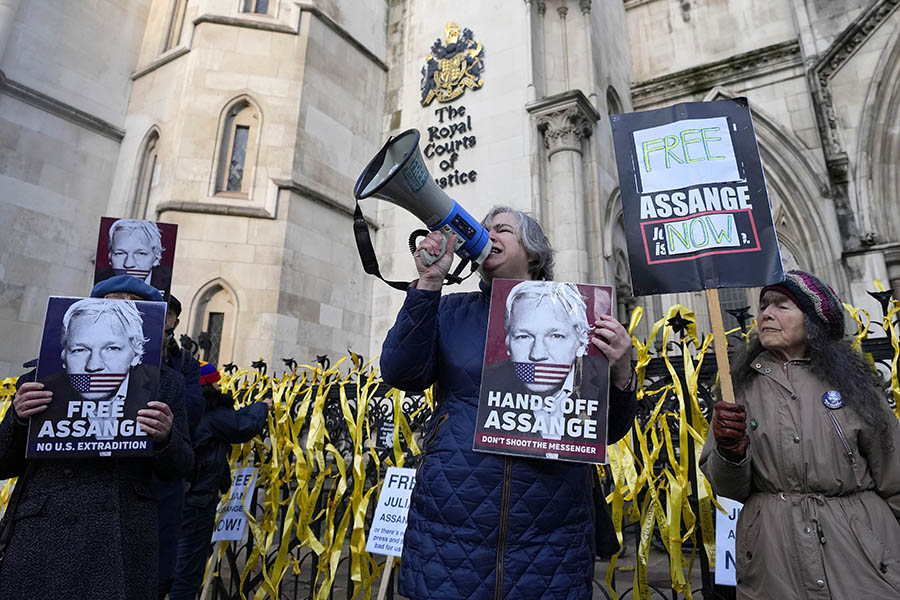
London, Dec 10: Julian Assange can be extradited from the UK to the US, the High Court in London ruled on Friday, overturning a lower court decision that the embattled WikiLeaks founder could not be sent to America to face spying charges due to concerns over his mental health.
The 50-year-old Australian has been charged in the US under the Espionage Act for his role in publishing thousands of classified military and diplomatic documents in 2010 and 2011. US prosecutors say the leaks of classified material endangered lives.
Friday's ruling means the US authorities won their appeal against a January UK court ruling that Assange could not be extradited due to concerns over his mental health after the court was felt reassured by the US promises to reduce the risk of suicide.
Lord Chief Justice Lord Burnett and Lord Justice Holroyde handed down the judgment following a hearing in October. Assange's fiancee, Stella Moris, said they intended to appeal against the "grave miscarriage of justice".
In January, District Judge Vanessa Baraitser, presiding over the case at the Old Bailey court in London, ruled that Assange was likely to take his own life if extradited to the US where he is wanted on 17 espionage charges and one charge of computer misuse over WikiLeaks publication of leaked military and diplomatic documents a decade ago.
The charges carry a maximum sentence of 175 years in prison.
The High Court judges found that Judge Barrister had based her decision on the risk of Assange being held in highly restrictive prison conditions if extradited. However, the US authorities later gave assurances that he would not face those strictest measures either pre-trial or post-conviction unless he committed an act in the future that required them.
Lord Burnett said: "That risk is in our judgment excluded by the assurances which are offered. It follows that we are satisfied that, if the assurances had been before the judge, she would have answered the relevant question differently.
"That conclusion is sufficient to determine this appeal in the USA's favour."
Lawyers acting for the US also argued Assange's health is well enough for extradition.
Judges ordered the case must return to Westminster Magistrates' Court for a district judge to formally send it to Home Secretary Priti Patel.
Assange's legal team said any appeal to the Supreme Court would relate to the question of assurances, rather than on issues such as free speech or "the political motivation of the US extradition request".
The US had offered four assurances, including that Assange would not be subject to solitary confinement pre or post-trial or detained at the ADX Florence Supermax jail - a maximum security prison in Colorado - if extradited.
Lawyers for the US said he would be allowed to transfer to Australia to serve any prison sentence he may be given closer to home, the BBC reported.
Assange was arrested in April 2019 when British authorities entered the Ecuadorian Embassy in London, where he had been holed up for seven years, and took him into custody on a US extradition warrant.
Assange has been held in Belmarsh Prison since 2019 after he was carried out of the Ecuadorian embassy by police before being arrested for breaching his bail conditions.
He had been living in the Ecuadorian Embassy since 2012 to avoid extradition to Sweden to face sex offence allegations, which he has always denied and were eventually dropped.
Assange's fiancee Moris called the ruling "dangerous and misguided", adding that the US assurances were "inherently unreliable".
In an emotional statement outside the court, Moris said: "For the past... two years and a half, Julian has remained in Belmarsh prison, and in fact he has been detained since 7 December 2010 in one form or another, 11 years. For how long can this go on?"
Wikileaks editor-in-chief Kristinn Hrafnsson said in a statement: "Julian's life is once more under grave threat, and so is the right of journalists to publish material that governments and corporations find inconvenient.
"This is about the right of a free press to publish without being threatened by a bullying superpower," Hrafnsson said.
Let the Truth be known. If you read VB and like VB, please be a VB Supporter and Help us deliver the Truth to one and all.
MP cruise boat tragedy: Search ops expanded to trace four missing passengers
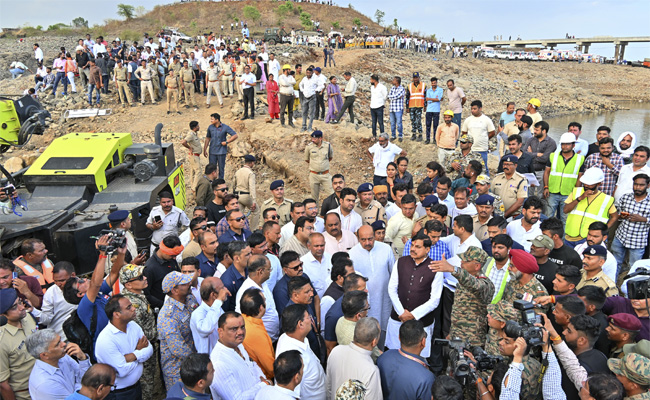
Jabalpur (PTI): Army divers and disaster response teams on Saturday expanded their search at Bargi Dam in Madhya Pradesh to locate a man and three children still missing after the cruise boat tragedy that claimed nine lives two days ago, officials said.
With 28 of the 41 identified passengers onboard the ill-fated cruise boat rescued safely, police are preparing to register an FIR in connection with the accident that occurred at the reservoir in Jabalpur district on Thursday evening, they said.
The search radius has been expanded to 5 km in the backwaters of the Bargi Dam, located downstream of the Narmada River, area sub-divisional officer of police (SDOP) Anjul Ayank Mishra told PTI.
Nine people drowned in the incident, while 28 were rescued, and efforts are ongoing to trace the missing persons, he said.
ALSO READ: Alleging unauthorised sorting of postal ballot covers, TMC files complaint with EC
According to the police, more than 200 rescuers, including around 20 Army divers airlifted from Agra, began the search operation at 5 am on Saturday to trace Kamraj, an employee of the Ordnance Factory in Khamaria, his son Tamil (5), Vijay Soni (6) and Mayuram (5).
Mishra said that an inquest case has been registered and the post-mortem of nine deceased persons has been completed.
"Our priority is to search for the missing persons. We will soon register an FIR," he said.
Investigators have said that CCTV footage near the boarding point showed 43 people heading towards the ill-fated boat, and the names of 41 persons, who boarded the vessel, have been ascertained so far.
Collector Raghvendra Singh confirmed that a search is underway for four missing persons.
The rescue operation, being carried out by the National Disaster Response Force (NDRF), State Disaster Response Force (SDRF) and local divers, was briefly affected around 9 am due to strong winds.
The state government on Friday ordered a probe into the incident and dismissed three crew members after survivors alleged negligence and safety lapses, including failure to provide life jackets.
The government also banned the operation of similar vessels in the state.
The boat, operated by the state tourism department, sank during a sudden storm around 6 pm on Thursday, and the wreckage was retrieved from the dam water on Friday, after the rescuers confirmed that there were no more bodies inside.
Eyewitnesses have said that strong winds made the water choppy, prompting passengers to raise an alarm and ask the crew to steer the vessel towards the riverbank.
A survivor alleged negligence by the crew and described a last-minute scramble for life jackets.