Wildfires race across Chile, leaving 15 dead, forcing thousands to flee
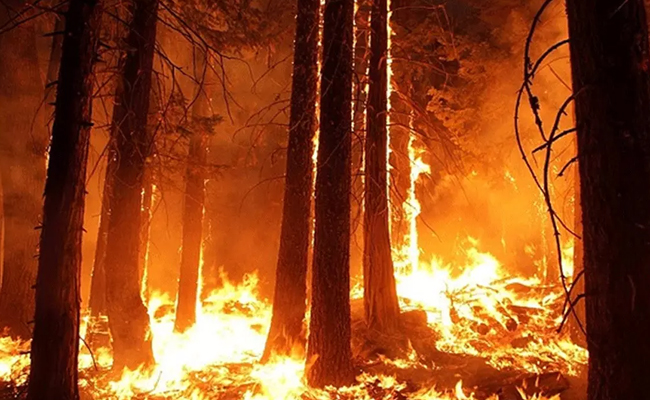
Penco (Chile) (AP): Wildfires raging across central and southern Chile on Sunday left at least 15 people dead, scorched thousands of acres of forest and destroyed scores of homes, authorities said, as the South American country swelters under a heat wave.
Chilean President Gabriel Boric declared a state of catastrophe in the country's central Biobio region and the neighbouring Nuble region, around 500 kilometres south of Santiago, the capital.
The emergency designation allows greater coordination with the military to rein in two dozen wildfires that have so far blazed through 8,500 hectares and prompted 50,000 people to evacuate, according to Chilean Security Minister Luis Cordero.
“All resources are available,” Boric wrote on X.
But local officials reported that for hours on Sunday, destruction was everywhere and help from the federal government was nowhere.
“Dear President Boric, from the bottom of my heart, I have been here for four hours, a community is burning and there is no (government) presence,” said Rodrigo Vera, the mayor of the small coastal town of Penco in the Biobio region. “How can a minister do nothing but call me to tell me that the military is going to arrive at some point?”
Firefighters were struggling to extinguish the flames, but strong winds and scorching weather hampered their efforts Sunday with temperatures topping 38 C (100 F).
Residents said that the fires took them by surprise after midnight, trapping them in their homes.
“Many people didn't evacuate. They stayed in their houses because they thought the fire would stop at the edge of the forest,” said John Guzman, 55, surveying the scene in Penco, where smoke blanketed the sky in an orange haze. “It was completely out of control. No one expected it."
Although the total number of homes burned nationwide remained unclear, one municipality of Concepcion in Biobio reported 253 homes destroyed.
“We fled running, with the kids, in the dark,” said Juan Lagos, 52, also in Penco. The fire engulfed most of the city, burning cars, a school and a church.
Charred bodies were found across fields, homes, along roads and in cars.
“From what we can see, there are people who died ... and we knew them well," said Víctor Burboa, 54. "Everyone here knew them.”
Let the Truth be known. If you read VB and like VB, please be a VB Supporter and Help us deliver the Truth to one and all.
EC can choose counting personnel, no further order needed: SC on TMC plea
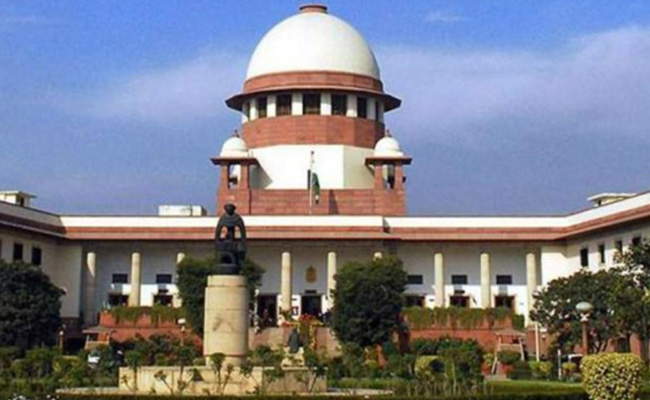
New Delhi (PTI): The Supreme Court on Saturday said no further order was necessary on the TMC's plea challenging the Calcutta High Court's dismissal of its petition against an Election Commission circular on the deployment of central government personnel for vote counting in West Bengal.
A special bench of Justices P S Narasimha and Joymalya Bagchi said the Election Commission can choose the counting personnel, and its April 13 circular, which provides for deployment of state government employees as well, cannot be said to be incorrect.
The poll body said the apprehensions of Trinamool Congress (TMC) of any wrongdoing is misplaced, as the circular very clearly states that there will be a mix of central and state government employees.
The Election Commission assured the court that the circular would be implemented in letter and spirit, and there would be state government employees also during the counting of votes on May 4.
At the outset, senior advocate Kapil Sibal, appearing for the TMC, said the circular was dated April 13, but they came to know about it on April 29.
ALSO READ: Anbumani asks PM Modi to ban sale of cigarettes for those born after 2009
He said there are four issues: One, the circular appointing Central employees was issued to DEOs on April 13, but came to their knowledge only on April 29; Two, the Election Commission says it has apprehensions of irregularity, despite having a Central nominee in the counting process; Three, the poll body already has a Central government officer at each counting table in the form of a micro observer, and four, the commission has not appointed state nominees even though the circular provides so.
Sibal submitted that the Chief Electoral Officer's communication states that there are apprehensions expressed from various quarters regarding possible irregularities in counting.
"That is like pointing a finger at the state government..." Sibal said, adding, "There must be some data. Where is (the proof of) the apprehension (raised) from each booth? They have not disclosed this. And why not tell us that they are going to have a Central government nominee?"
The bench, which held a special sitting, told Sibal that even if the Election Commission's circular had provided for the appointment of Central employees as both the counting supervisor and the counting assistant, the court could not have faulted the decision.
"The option is open for the Election Commission: whether the counting supervisor and assistant may be of the Central or the state government. When that option is open, we cannot hold that the notification is contrary to regulations. Even if the EC says that both of them can be Central government employees, we could not have faulted them. Because regulations say that either the Central government or state government officers can be appointed," Justice Bagchi told Sibal.
Sibal then submitted that the court may ask the Election Commission to follow the impugned circular in its entirety, which provides for a state government nominee.
"All we want is, in terms of the circular, the state government nominee should be there," he said.
Justice Bagchi asked if he wants compliance with the circular, then why is the TMC before the court.
Senior advocate D S Naidu, appearing for the Election Commission, submitted that the returning officer is a state government employee with overarching power to deploy personnel from any pool of government employees.
"We are saying that there will be state government employees during the counting of votes," Naidu submitted, adding that each candidate will also have their own counting agent.
"The TMC's apprehension of any wrongdoing is completely misplaced," he reiterated.
The bench then disposed of the plea, saying that no further order is necessary and reiterated that the Election Commission will follow its circular in letter and spirit.
Polling for the 294-member West Bengal Assembly was held in two phases -- April 23 and April 29. The counting of votes will be taken up on May 4.
On April 30, the Calcutta High Court dismissed the TMC's petition against the Election Commission circular, saying there was no illegality in the poll panel's decision to appoint counting supervisors and assistants from Central government and Public Sector Undertaking (PSU) employees, instead of the state government staff.
In the high court, the TMC had challenged an April 13 communication issued by the additional chief electoral officer of West Bengal that stated that at least one of the counting supervisors or assistants at each table should be a Central government or PSU employee.
The TMC's counsel had argued before the high court that the communication was issued without jurisdiction and was based on mere apprehension.
The EC's counsel had contended before the high court that the Representation of the People Act, 1951, allows delegation of the commission's functions and that the directive was valid.
The poll panel's counsel had also submitted that the communication was issued on April 13, but the petition was filed only on April 30, close to the counting date, alleging that the move was intended to stall the process.
The high court had not agreed with the TMC's allegation that its main opponent, the Bharatiya Janata Party (BJP), controls the employees of the Central government or PSUs, making them susceptible to suggestions and control by the Union government.
It had also noted that apart from the counting supervisors and assistants, micro-observers, counting agents of candidates, and other personnel would also be present in the counting hall.