Will easily win election if only 'legal votes' are counted: Trump
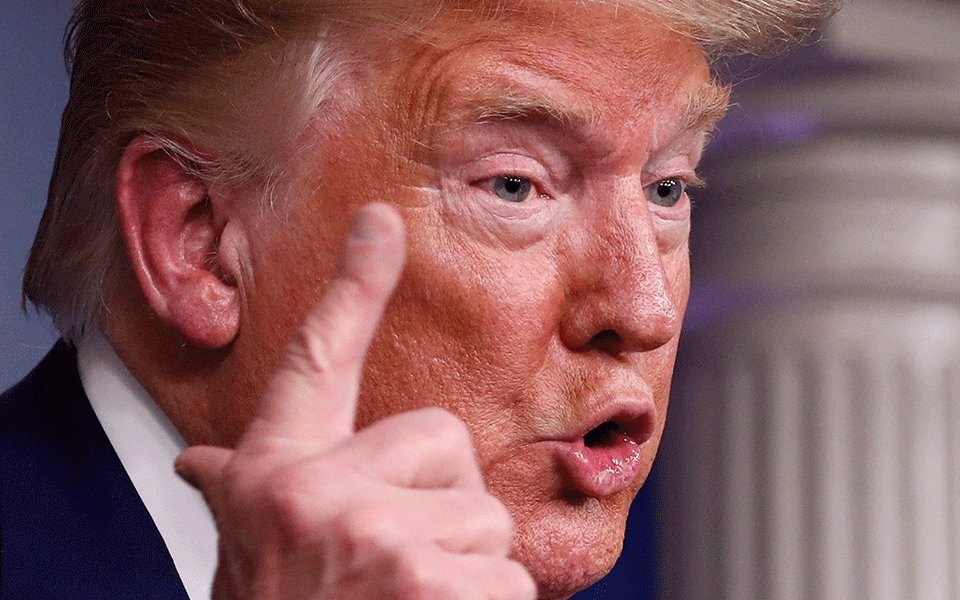
Washington: US President Donald Trump has claimed that he would easily win the election if only the "legal votes" are counted in the closely-fought presidential polls.
Addressing a news conference at the White House on Thursday, Trump indicated that the election results would finally end up on the doors of the Supreme Court as he plans to file a large number of litigations against alleged electoral malpractices.
Trump, who did not take any questions from reporters, alleged that the Democrats are trying to win and rig the 2020 presidential elections. However, he did not offer any evidence to back his claim.
As of Thursday night, Democratic presidential candidate Joe Biden was on the cusp of an electoral victory with 253 electoral college votes.
The magical number is 270 of the 538 electoral college votes. Trump has 213 electoral votes in his kitty.
"If you count the legal votes I easily win," Trump said, providing no evidence for his claim. "If you count the illegal votes, they can try to steal the election from us."
His message came as new tallies showed his lead dwindling in Georgia and Pennsylvania.
Trump said he was advocating for a halt in counting of "votes that came in late," and went on to tout races that had already been called for him.
"I've already decisively won many critical states, including massive victories," he claimed.
Democratic officials believe that they can never win this election honesty. there is tremendous corruption and fraud going on, Trump said, adding that he has a lot of evidence for this claim.
That's why they mailed out tens of millions of unsolicited ballots without any verification measures whatsoever, he alleged.
Amidst the COVID-19 pandemic, Americans have rushed to vote early, already casting nearly 92 million mail-in ballots that could take days or weeks to be counted in some crucial battleground states.
Trump has raised concerns over the use of mail-in ballots, saying there are high chances of the process getting manipulated.
Trump challenged Biden and the Democrats to clarify that they want only legal votes, that they are open and transparent, no secret count rooms, no mystery ballots, no illegal votes being cast after election day.
We want an honest election, We want an honest counting, he said.
The legitimate mail-in ballots are being counted last because that is standard procedure in certain American states. Asserting that the US cannot have an election stolen , Trump said that he thinks he will win the election very soon.
There is going to be a lot of litigation, he said, adding that there is so much evidence of electoral malpractice.
We cannot let that happen to the United States of America. It is not a question of who wins, Republican or Democrat. We cannot let that happen to our country, he said.
The President also decried on the pollsters, media and big tech companies for siding with the Democrats and accused them of suppression of voters.
Commenting on the performance of the Republican Party in the elections, Trump said that the party retained majority in the Senate and won many seats in the House of Representatives.
This was also the year of the Republican women, more Republican women were elected to Congress than ever before, he said.
After the elections, Trump asserted that the Republicans have emerged as a party of American workers.
We grew our party by four million voters, the greatest turnout in Republican Party history. Democrats are the party, the big donors, the big media, the big tech, it seems. Republicans have become the party of the American worker and that's what's happened, he said.
Let the Truth be known. If you read VB and like VB, please be a VB Supporter and Help us deliver the Truth to one and all.
4 workers die after being buried under coal slurry in Jharkhand's Dhanbad

Dhanbad (Jharkhand) (PTI): At least four workers died after being buried under coal slurry in Jharkhand's Dhanbad district on Saturday, a police official said.
The incident took place at Moonidih coal washery in the command area of Bharat Coking Coal Limited (BCCL).
"Bodies of all four workers were dug out of debris during a rescue operation," Putki police station in-charge Waqar Hussain told PTI.
The incident took place when coal slurry was being loaded into trucks by workers, during which a large chunk of slurry fell and trapped several workers underneath, officials said.
The deceased have been identified as Manik Bauri, Dinesh Bauri, Deepak Bauri, and Hemlal Gope.
Meanwhile, the family members of the deceased and local villagers placed the bodies in front of the washery gate and began a protest.
They demanded compensation, jobs for dependents and action against those responsible for the incident.
Police and administration officials are trying to pacify the protesters, an official said.