With 71 new coronavirus deaths, total number of casualties touches 2,663 in China

Beijing: Seventy-one new coronavirus deaths were reported from China, taking the total number of casualties to 2,663, even as reports suggested that the number of new cases has seen a sharp decline.
According to a daily report released by the National Health Commission (NHC) on Tuesday, the number of confirmed cases has reached 77,658, a jump of 508 cases.
The report stated that 68 deaths were reported in Hubei, two in Shandong and one in Guangdong. China's daily new confirmed cases of COVID-19 outside ground zero Hubei came down to nine, indicating a continued declining trend.
The daily number of cured and discharged patients has surpassed that of new cases for the seventh consecutive day, the NHC claimed.
Monday saw 2,589 people walking out of hospital after recovery, much higher than the new confirmed patients, state-run Xinhua news agency reported. A total of 27,323 patients have been been discharged by the end of Monday, it said.
The agency reported that Monday marked the sixth consecutive day when China's daily number of new infections remained under 1,000. Newly recovered coronavirus patients in both Hubei and Wuhan outnumbered new cases, it said.
Confirming the declining trend, Canadian epidemiologist Bruce Aylward, who headed the WHO mission to China, said the drop in the number of cases was possible due to actions taken by the Chinese government.
"I know the challenges with the statistics that come out of China, sometimes with changing numbers. What we had to do is to look very carefully at different sources of information to say confidently this is actually declining," Aylward told reporters here.
"A lot of compelling data and observations on the ground support this," he added.
Aylward headed the first WHO technical team on February 10 and later paved the way for a 12-member expert team that arrived in Beijing last Monday.
The team, along with Chinese experts, visited worst-hit Hubei province over the weekend to conduct field investigations on the virus outbreak.
Aylward said when he arrived in Beijing on February 10, China was reporting about 2,500 cases a day, which has now declined to over 400. The observation was made from the data collected from fever clinics and the availability of hospital beds, he said, stressing that the numbers dropped amid heightened awareness and the push to get oneself tested.
Secondly, doctors in Wuhan are for the first time reporting vacant beds in hospitals to accommodate new patients, he said, adding that earlier China had to build two makeshift hospitals with a capacity of 2,300 beds.
Later, officials converted stadiums and dormitories into hospitals to accommodate more patients.
"The (WHO) team wanted to be convinced. Very rapidly multiple sources of data point to the same thing that the cases are falling and they are falling because of actions that are being taken," he said, adding that the world needed the experience and expertise of China.
Elaborating further, Aylward said old approaches like suspension of travel and quarantine were used to contain the spread of the virus by the Chinese authorities.
"These significant measures could only be adopted with tremendous collective will, not only in the community but also top officials, which is rare to see," Aylward said. Liang Wannian, who headed the Chinese expert team, said the deadly virus has not significantly mutated. "The animal host has not been confirmed--a bat could be the host, but also a pangolin," Liang Wannian said.
"The transmission route is respiratory droplets. The fecal-oral route needs to be further studied," Liang said in the joint press conference with Aylward.
Liang said 3,000 medical staff, mostly in the worst-hit Wuhan, are estimated to have been infected by the virus. Ten medical staff have died.
Let the Truth be known. If you read VB and like VB, please be a VB Supporter and Help us deliver the Truth to one and all.
Karnataka launches state-led Centre of Excellence for Space Technology in Bengaluru
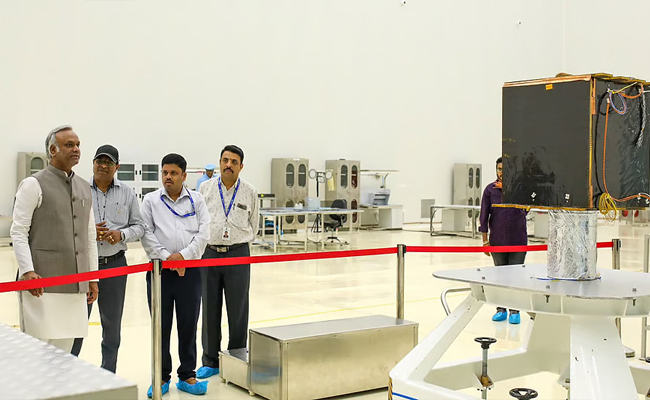
Bengaluru (PTI): In a significant boost to India’s rapidly expanding space economy, the Karnataka government on Friday launched the country’s first state-led Centre of Excellence for Space Technology here, officials said.
The initiative is aimed at strengthening India’s capabilities to translate space innovation into scalable commercial outcomes, they said.
The Centre, established by the Government of Karnataka through the Karnataka Innovation and Technology Society in collaboration with SIA (Satcom Industry Association India) -India, was inaugurated by Minister for Electronics, IT/BT, and Rural Development and Panchayat Raj, Priyank Kharge, in the presence of senior officials and industry leaders, officials said.
Speaking at the launch, Minister Kharge said that Karnataka has consistently been at the forefront of India's technology and innovation journey. With the launch of this Centre of Excellence for Space Technology, we are extending that leadership into one of the most strategic sectors of the future.
"Our focus is not just on advancing research, but on creating an ecosystem where innovation can translate into real-world applications, economic growth, and high-quality jobs. This Centre will play a critical role in positioning Karnataka as a key driver of India's space economy," he said.
According to an official statement, the CoE SpaceTech Foundation has been established under a Memorandum of Agreement between KITS and SIA-India to drive research and innovation in space technologies, industry-aligned training, startup incubation and cross-sector applications, it said.
The Centre has also formalised strategic MoUs with multiple industry and academic partners to support research in space biotech and microgravity, enable collaboration, build talent pipelines, and provide startups with training and market access, it added.