With capture of Maduro, Trump claims successful operation as he treads into uncharted territory
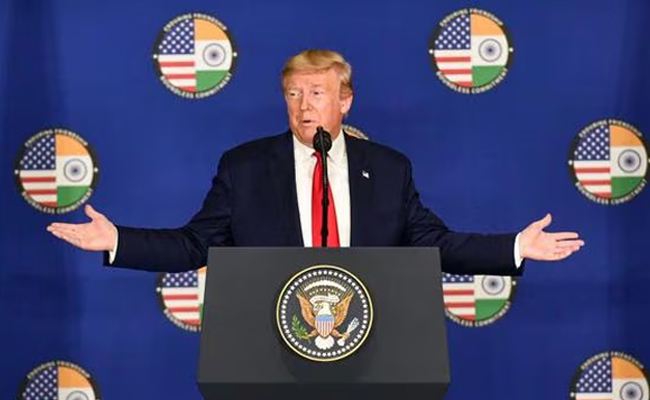
Washington (AP): With the capture of Venezuela's Nicolas Maduro, President Donald Trump and his allies are calling the audacious military operation a major success as the US leader once again demonstrated a willingness to use US forces for risky missions that come with a potential big payoff.
The operation has ousted a South American strongman blasted by Trump's administration as an “illegitimate” dictator and a “narco-terrorist," a scourge responsible for a steady of stream of illegal drugs poisoning US and Europe.
“It was a brilliant operation, actually," Trump told The New York Times shortly after US forces were cleared from Venezuelan airspace.
ALSO READ: Congress and NCP (SP) to contest separately in Nagpur civic polls
But the path ahead could certainly be treacherous as the White House faces a series of difficult questions.
Who will fill the power vacuum now that Maduro is gone? What lies ahead for a country that's endured years of hyperinflation, food and medicine shortages and brain drain despite its vast oil wealth?
What lessons will US adversaries take from Trump's decision to demonstrate American might in its sphere of influence as China's Xi Jinping vows to annex the self-ruled island of Taiwan and Russia's Vladimir Putin's has designs on neighbour Ukraine and diminishing NATO's eastern flank?
Trump takes a big risk
The operation to remove Maduro certainly marks another big moment for Trump's foreign policy in his second term, as he hasn't shied away from flexing US military might even as he has vowed to keep America out of war.
Trump has now twice used US forces to carry out risky operations against American adversaries. In June, he directed US strikes on key Iranian nuclear sites.
With the Venezuela operation, Trump followed through on a promise, spelled out in his National Security Strategy published last month, to assert US dominance in the Western Hemisphere.
More questions than answers
Retired Navy Rear Adm. Mark Montgomery said the immediate path ahead for Trump in Venezuela could be more difficult to navigate than what he faced after the Iran strikes.
“Unlike the (Iran) strikes where Trump did the action and then said fights over,' he will not have that luxury here in Venezuela,” said Montgomery, an analyst at the Foundation for Defence of Democracies, a hawkish think tank in Washington.
“He needs to stay engaged in Venezuela to make sure that Maduro's cronies — equally guilty of any crime he is — are also pushed out of power, and they may want to stay and fight as they don't have too many places to run.”
What's next for Venezuela?
European allies had expressed concern as Trump built up a massive presence of troops in the Caribbean in recent months and carried out dozens of lethal strikes on suspected drug smugglers — many that the administration claimed were effectively an arm of the Maduro government.
Maduro was hardly viewed as a choir boy by the international community. His 2018 and 2024 elections were seen as riddled with irregularities and viewed as illegitimate.
But many US allies greeted news of Maduro's capture with a measure of trepidation.
European Commission President Antonio Costa said he had “great concern” about the situation in Venezuela following the US operation.
“The EU has repeatedly stated that Mr Maduro lacks legitimacy and has defended a peaceful transition,” European Union foreign policy chief Kaja Kallas added on X. “Under all circumstances, the principles of international law and the UN Charter must be respected. We call for restraint.”
The criticism from some Democrats over Trump's military action to oust Maduro was immediate.
“This war is illegal, it's embarrassing that we went from the world cop to the world bully in less than one year.” Sen. Ruben Gallego of Arizona wrote on X. “There is no reason for us to be at war with Venezuela.”
Russia's Foreign Ministry condemned what it called a US “act of armed aggression” against Venezuela in a statement posted on its Telegram channel Saturday. The ouster of Maduro, who was backed by the Russians, comes as Trump is urging Putin to end his nearly four-year brutal war on Ukraine.
“Venezuela must be guaranteed the right to determine its own destiny without any destructive, let alone military, outside intervention,” the statement said.
ALSO READ: Congress and NCP (SP) to contest separately in Nagpur civic polls
Capture follows months of pressure
The operation was the culmination of a push inside the administration led by Secretary of State Marco Rubio and other like-minded foes of Maduro who have been urging Trump to take action against the Venezuelan leader for years dating back to Trump's first administration.
In south Florida — the epicentre of the Venezuelan diaspora opposition to Maduro that has influenced Rubio's thinking — Saturday's operation was cheered as an era-changing moment for democracy.
Rep. Carlos Gimenez, a Florida Republican, said he had spoken to Rubio and thanked Trump for having “changed the course of history in our hemisphere. Our country & the world are safer for it,” he wrote on X, comparing Maduro's ouster to the fall of the Berlin Wall.
Maduro had sought a pathway to exit from power, while saving face.
Venezuelan government officials had floated a plan in which Maduro would eventually leave office, The Associated Press reported in October.
The proposal, which was rejected by the White House, called for Maduro to step down in three years and hand over to his vice president, Delcy Rodriguez, who would complete Maduro's six-year term that ends in January 2031. Rodriguez would not run for reelection under the plan.
But the White House had rejected the proposal because the administration questioned the legitimacy of Maduro's rule and accused him of overseeing a narco-terrorist state.
Maduro earlier this week said Venezuela was open to negotiating an agreement with the United States to combat drug trafficking and work with Washington on promoting US further investment in the Venezuelan oil industry.
But Trump for months has insisted that Maduro's days in power were numbered.
Shorty after Trump announced Maduro's capture, the White House posted video on one of its social media accounts of Trump in October explicitly telling reporters that Maduro was feeling pressure from the US campaign and trying to cut a deal.
“He doesn't want to f—- around with the United States,” Trump said.
Elliot Abrams, who served as US special representative for Iran and Venezuela in the first Trump administration, said the president now must decide how invested his administration will be in shaping the next government in Caracas. Venezuela's opposition says the rightful president is the exiled politician Edmundo González.
“I think the real question is whether Trump will claim victory and be satisfied with Delcy Rodriguez making some promises or engaging in negotiations," Abrams said. “Or will he insist on Gonzalez."
Trump in an appearance on Fox & Friends on Saturday morning said he wasn't ready to commit to a certain leader but pledged his administration would be “very involved” in Venezuela.
“We can't take a chance of letting somebody else run it — just take over where (Maduro) left or left off,” Trump said.
Let the Truth be known. If you read VB and like VB, please be a VB Supporter and Help us deliver the Truth to one and all.
26-year-old youth from Andhra dies by suicide in US
Kurnool (Andhra Pradesh) (PTI): A 26-year-old youth from this district has died allegedly by suicide in Chicago, US, recently, due to distress over debt, sources said on Saturday.
The family members of the deceased have requested that the identity of their relative be withheld, noting that his parents are senior citizens suffering from medical conditions.
Reacting to the incident, Andhra Pradesh IT Minister Nara Lokesh expressed condolences and assured assistance for the repatriation of the mortal remains of the deceased.
"My heartfelt condolences to the bereaved family. I request Union Aviation Minister K Ram Mohan Naidu to ensure smooth and hassle-free transport of the mortal remains," Lokesh said in a post on X.
An NRI community member from the US posted on social media that one of their members from Kurnool on Optional Practical Training (OPT) passed away in Chicago a few days ago.
He said Telugu Association of North America (TANA) had completed all necessary documentation and formalities to send the mortal remains to India for final rites.
He further requested assistance in expediting the cargo pickup, currently scheduled for Sunday, seeking an earlier arrangement considering the urgency.
(Assistance for overcoming suicidal thoughts is available on the state’s health helpline 104, Tele-MANAS 14416.)