World Bank approves USD 1 billion emergency funds for India to tackle COVID-19 outbreak
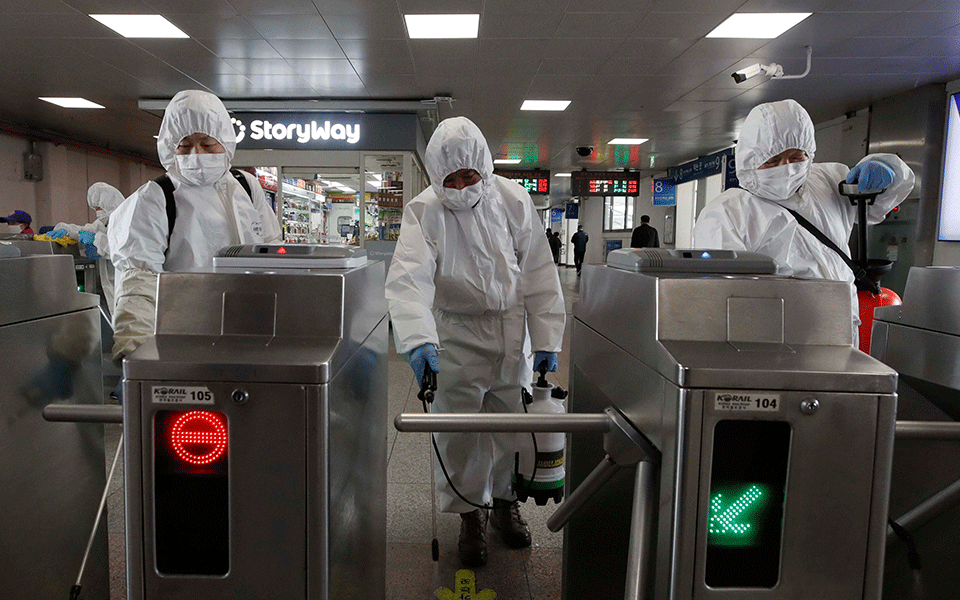
Washington: The World Bank has approved USD 1 billion emergency funding for India to help it tackle the coronavirus pandemic, which has claimed 76 lives and infected 2,500 people in the country.
The World Bank's first set of aid projects, amounting to USD 1.9 billion, will assist 25 countries, and new operations are moving forward in over 40 nations using the fast-track process, the bank said on Thursday.
The largest chunk of the emergency financial assistance has gone to India - USD 1 billion.
"In India, USD 1 billion emergency financing will support better screening, contact tracing, and laboratory diagnostics; procure personal protective equipment; and set up new isolation wards," the World Bank said after its Board of Executive Directors approved the first set of emergency support operations for developing countries around the world, using a dedicated, fast-track facility for COVID-19 response.
In South Asia, the World Bank also approved USD 200 million for Pakistan, USD 100 million for Afghanistan, USD 7.3 million for the Maldives and USD 128.6 million for Sri Lanka.
The World Bank said it was now working to grant up to USD 160 billion over the next 15 months to support measures to tackle the pandemic which will focus on the immediate health consequences and bolster economic recovery.
The broader economic program will aim to shorten the time to recovery, create conditions for growth, support small and medium enterprises, and help protect the poor and vulnerable.
There will be a strong poverty focus in these operations, with an emphasis on policy-based financing, and protecting the poorest households and the environment, it said.
"The World Bank Group is taking broad, fast action to reduce the spread of COVID-19 and we already have health response operations moving forward in over 65 countries," said World Bank Group President David Malpass.
"We are working to strengthen (the) developing nations' ability to respond to the COVID-19 pandemic and shorten the time to economic and social recovery. The poorest and most vulnerable countries will likely be hit the hardest, and our teams around the world remain focused on country-level and regional solutions to address the ongoing crisis," Malpass said.
According to the bank, USD 100 million will support Afghanistan to slow and limit the spread of COVID-19 through enhanced detection, surveillance, and laboratory systems, as well as strengthen essential health care delivery and intensive care.
In Pakistan, USD 200 million will support preparedness and emergency response in the health sector and include social protection and education measures to help the poor and vulnerable cope with the immediate impacts of the pandemic, the bank said.
Responding to widespread supply chain disruptions, the World Bank is helping countries access critically needed medical supplies by reaching out to suppliers on behalf of the governments.
The World Bank is encouraging others to provide financial support to developing countries for the COVID-19 health response, said the media statement.
A total of 1,002,159 COVID-19 cases have been reported across more than 175 countries and territories with 51,485 deaths reported so far, according to Johns Hopkins University data.
Let the Truth be known. If you read VB and like VB, please be a VB Supporter and Help us deliver the Truth to one and all.
Man arrested with Rs 2.54-crore heroin in Mumbai

Mumbai (PTI): Police have arrested a man and seized over 500 grams of heroin worth Rs 2.54 crore in the illicit market from him in Mumbai, officials said on Friday.
The police's Anti-Narcotics Cell (ANC) made the drug seizure in Santacruz in the western suburbs. The operation was conducted by the Kandivali unit of the ANC on Thursday as part of a special crackdown against drug trafficking in the area, they said.
Acting on specific inputs, an ANC team conducted a raid in Santacruz (East) and intercepted a man. During a search, the team recovered 508 grams of high-grade heroin from his possession, an official said.
The seized contraband, a highly addictive, opioid drug derived from morphine, is estimated to be worth Rs 2.54 crore in the international market, he informed.
Following the seizure, a case was registered against the man under relevant sections of the Narcotic Drugs and Psychotropic Substances (NDPS) Act, 1985, and he was formally placed under arrest in the early hours of Friday.
The police are currently investigating the source of the drug and trying to identify the intended recipients of the consignment, he said.