World fails to stop war on children: UNICEF
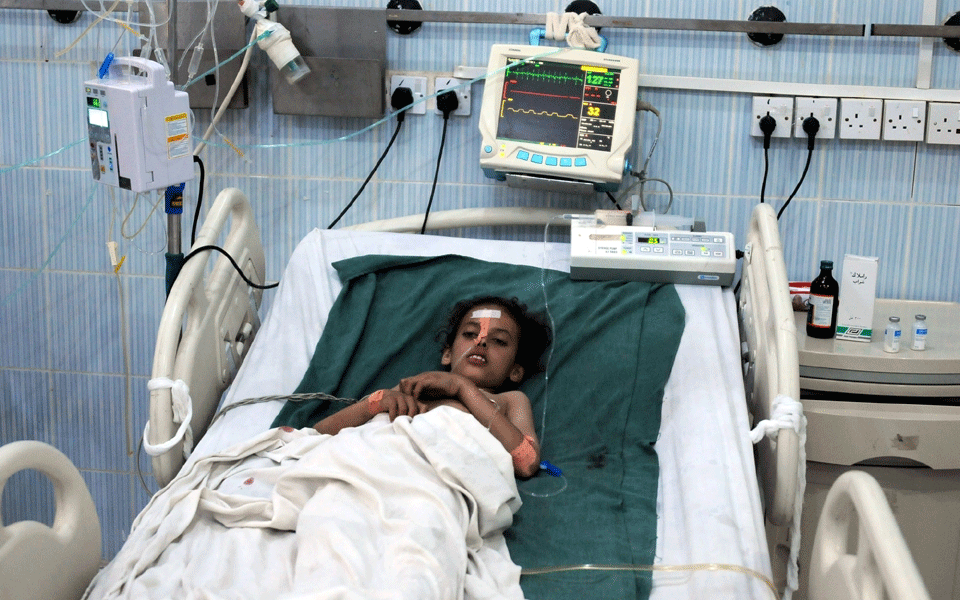
United Nations: The United Nations Children's Fund (Unicef) has said violence had a devastating toll on children, who were being killed in ongoing conflicts or suicide attacks, or freezing to death as they fled active war zones.
Describing January as "a dark month" in crisis-torn Middle East and North Africa, Geert Cappelaere, Unicef Director for the region on Monday said that "it is simply unacceptable that children continue being killed and injured every single day", Xinhua reported.
In the month of January alone, escalating violence in Iraq, Libya, the Palestine, Syria and Yemen has claimed the lives of at least 83 children.
"These children have paid the highest price for wars that they have absolutely no responsibility for. Their lives have been cut short, their families forever broken in grief," he added.
Cappelaere said that as the Syrian conflict enters its eighth year, intensifying fighting has reportedly killed 59 children in the past four weeks. Moreover, across Yemen the UN has verified the killing of 16 children in attacks and continues to receive daily reports of more killed and injured children amidst escalating fighting.
Additionally, a suicide attack took the lives of three children in Libya's Benghazi while three others died playing near unexploded ordnance, a fourth child remains in critical condition after the blast.
Turning to the old city of Mosul in Iraq, a child was killed in a booby-trapped house, and in Palestine, a boy was shot dead in a village near Ramallah.
Furthermore, 16 refugees, including four children, froze to death in a harsh winter storm in Lebanon, fleeing the war in Syria, where many more children were hospitalized with frost bite.
"We collectively continue failing to stop the war on children," Cappelaere noted.
He added that that "not hundreds, not thousands but millions more children in the Middle East and North Africa region have their childhoods stolen, maimed for life, traumatized, arrested and detained, exploited, prevented from going to school and from getting the most essential health services; denied even the basic righ t to play."
Cappelaere maintained that "we have no justification, no reason to accept this as a new normal."
"Children may have been silenced. But their voices will continue to be heard. Their message is our message: The protection of children is paramount under all circumstances, in line with the law of war," he argued.
"Breaching that law is a most heinous crime and jeopardizes the future, and not just for children," concluded the Unicef regional director.
Let the Truth be known. If you read VB and like VB, please be a VB Supporter and Help us deliver the Truth to one and all.
Three arrested for running fake Aadhaar racket in UP's Badaun

Budaun (UP), Apr 30 (PTI): The Budaun Police on Thursday busted a gang allegedly involved in preparing fake Aadhaar cards and forged documents, and arrested three of its members, officials said.
The action was carried out in the Hazratpur area, where the accused were found operating an illegal setup to generate fake identity documents, they said.
The accused have been identified as Farman Ali, a resident of Munshi Nagla, Anuj Kumar of Uprela, and Brajnandan of Sirsauli.
The police said a fingerprint scanner, three laptops, a hard disk, a scanner, a large number of Aadhaar cards and several suspicious documents were recovered from their possession.
ALSO READ: Hit by car, delivery agent dies after falling from flyover in Delhi
During interrogation, it was revealed that the gang had been involved in preparing fake identity documents for a long time, misleading people and earning money through illegal means, officials said.
Station House Officer Pushpendra Singh said the accused have been produced before a court, and efforts are underway to identify and arrest other members of the gang.
He added that further revelations are likely as the investigation progresses.