World needs coordinated fiscal response to pandemic: IMF chief
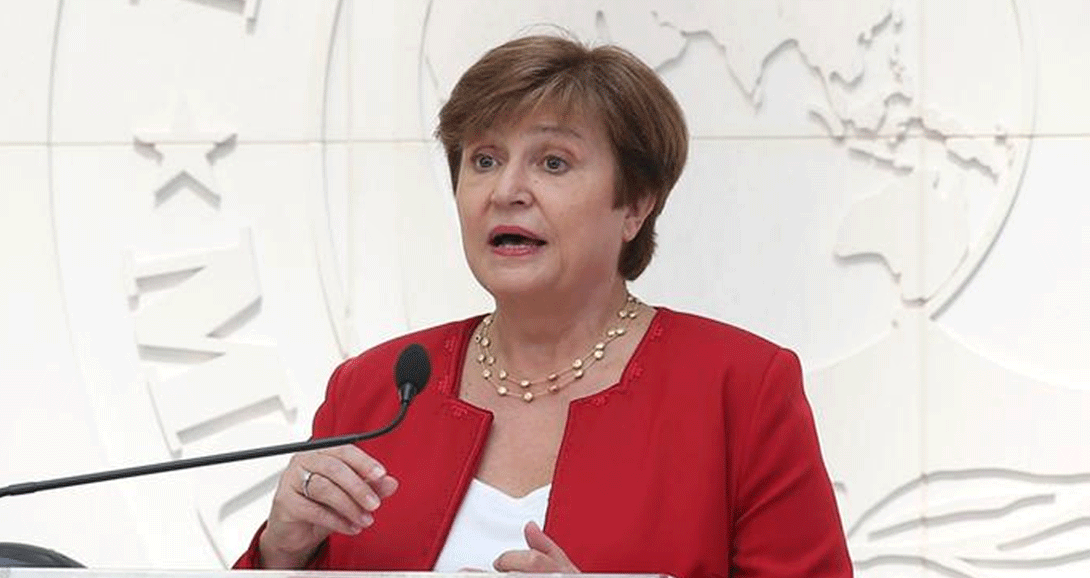
Washington: Global governments must work together to provide massive spending as in the 2008 financial crisis to help the economy withstand the damage from the coronavirus pandemic, IMF chief Kristalina Georgieva said on Monday.
Emerging markets are facing a massive outflow of cash and will need support as well, she said in a blog post.
She again pledged that the IMF "stands ready to mobilize its USD 1 trillion lending capacity to help our membership," including USD 50 billion in rapidly deployed funds for emerging and developing economies.
Governments have taken some steps, especially to address health efforts to contain the spread of COVID-19, but they "should continue and expand these efforts to reach the most affected people and businesses -- with policies including increased paid sick leave and targeted tax relief," Georgieva said.
But more is required beyond individual country actions, and "as the virus spreads, the case for a coordinated and synchronized global fiscal stimulus is becoming stronger by the hour."
In 2009 alone, countries in the Group of 20 committed two per cent of GDP, or over USD 900 billion, "So, there is a lot more work to do," she said.
Meanwhile, the US Federal Reserve joined forces on Sunday with the European Central Bank and others to provide dollar swap lines to ensure global financial markets have guaranteed access to sufficient cash to continue to operate, "steps we know have worked before," Georgieva said, adding that emerging markets likely will need support as well.
She cited data from global banking group the Institute of International Finance showing that investors have pulled nearly USD 42 billion from emerging markets since the beginning of the crisis.
"This is the largest outflow they have ever recorded," she said. "Going forward, there may be a need for swap lines to emerging market economies."
Central banks in those countries facing financial market stress can use currency market interventions as well as "capital flow management" -- a term that can refer to limits on how much cash can be removed from the country -- as a useful tool to complement other actions, she said.
Let the Truth be known. If you read VB and like VB, please be a VB Supporter and Help us deliver the Truth to one and all.
Man arrested with Rs 2.54-crore heroin in Mumbai

Mumbai (PTI): Police have arrested a man and seized over 500 grams of heroin worth Rs 2.54 crore in the illicit market from him in Mumbai, officials said on Friday.
The police's Anti-Narcotics Cell (ANC) made the drug seizure in Santacruz in the western suburbs. The operation was conducted by the Kandivali unit of the ANC on Thursday as part of a special crackdown against drug trafficking in the area, they said.
Acting on specific inputs, an ANC team conducted a raid in Santacruz (East) and intercepted a man. During a search, the team recovered 508 grams of high-grade heroin from his possession, an official said.
The seized contraband, a highly addictive, opioid drug derived from morphine, is estimated to be worth Rs 2.54 crore in the international market, he informed.
Following the seizure, a case was registered against the man under relevant sections of the Narcotic Drugs and Psychotropic Substances (NDPS) Act, 1985, and he was formally placed under arrest in the early hours of Friday.
The police are currently investigating the source of the drug and trying to identify the intended recipients of the consignment, he said.