World’s largest iceberg stuck near Antarctic island after 40-year journey
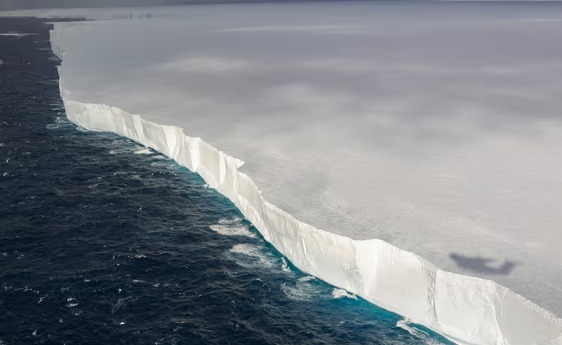
London: Iceberg A23a, the world’s biggest iceberg, has become stuck 73 km from a remote Antarctic island after drifting towards South Georgia since 2020. Measuring approximately 3,300 sq km and weighing nearly 1tn tonnes, its grounding has raised concerns about its potential impact on local wildlife, including penguins and seals.
According to The Guardian, which cited a research organisation, there were initial fears that the iceberg could collide with the island or run aground in shallow waters, making it difficult for animals to feed their young. However, British Antarctic Survey (BAS) oceanographer Andrew Meijers stated that if the iceberg remains in its current position, it is unlikely to ‘significantly affect the local wildlife.’
A23a, which calved from the Antarctic ice shelf in 1986, had remained stuck for decades before breaking free in 2020. Since late 2023, researchers have been tracking its movement via satellite. While a 19 km-long chunk broke off in January, the iceberg has not shown significant signs of disintegration along its current path.
Meijers noted that icebergs following this route through the Southern Ocean typically break up, disperse, and melt. However, concerns remain about the impact on South Georgia’s wildlife, as animals may be forced to travel further to reach feeding grounds, potentially increasing mortality among penguin chicks and seal pups.
Meanwhile, researchers have warned that a rise in global temperatures to between 1.5 and 2 degrees Celsius above preindustrial levels could accelerate the melting of frozen water, leading to significant ocean level increases.
Let the Truth be known. If you read VB and like VB, please be a VB Supporter and Help us deliver the Truth to one and all.
Efforts of party cadres will be rewarded on May 4: DMK chief Stalin
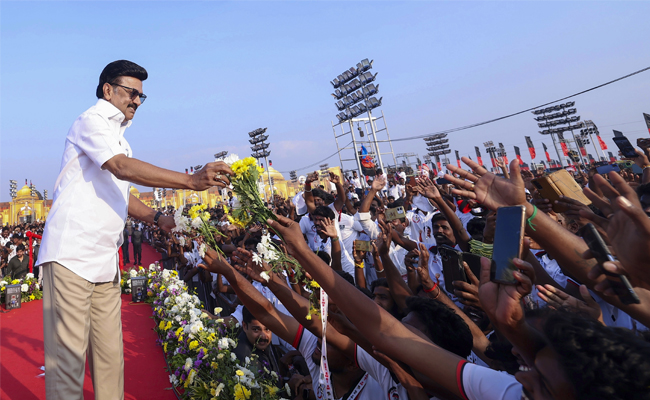
Chennai (PTI): Tamil Nadu Chief Minister M K Stalin on Friday said that the efforts made by his party cadres during the Assembly elections would be rewarded on May 4.
The counting of votes for the Assembly elections held on April 23 will be taken up on May 4.
"We are set to reap the rewards of the hard work put in by our party cadres on the coming fourth (May 4 counting day). There is absolutely no change in this and not even the slightest deviation," Stalin said at a May Day event here.
"There is no need for anyone to assume that I am speaking merely on the basis of exit polls," he added.
Stalin, who is also DMK chief, said that "good news" would come for those eagerly waiting for the election results.
Stating that the DMK governance is based on philosophy and principles, Stalin said, "This will continue."
He recalled the pivotal role of the then Chief Minister C N Annadurai, who first declared May Day as a government holiday, and subsequently, late CM M Karunanidhi, who was instrumental in extending it as a paid holiday across the nation.
"Responding to the request of Kalaingnar (Karunanidhi), the then Prime Minister V P Singh accepted the plea and declared it (May 1) a paid government holiday not merely for Tamil Nadu, but for the entire nation," Stalin said.