Worldwide virus cases top 20 million, doubling in six weeks
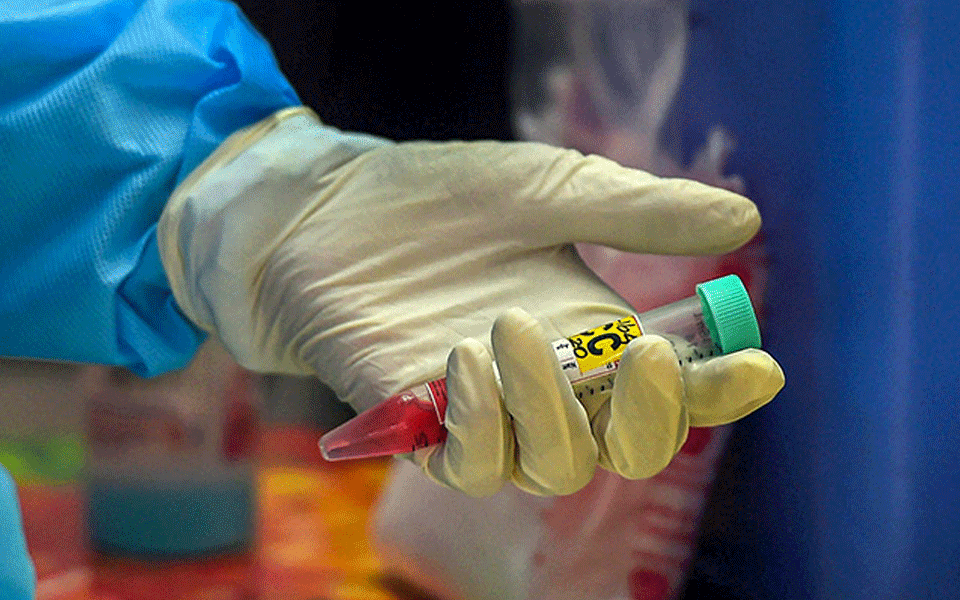
Washington: It took six months for the world to reach 10 million confirmed cases of the coronavirus. It took just over six weeks for that number to double.
The worldwide count of known COVID-19 infections climbed past 20 million on Monday, with more than half of them from just three countries: the US, India and Brazil, according to the tally kept by Johns Hopkins University.
The average number of new cases per day in the US has declined in recent weeks but is still running high at over 54,000, versus almost 59,000 in India and nearly 44,000 in Brazil.
Russia became the first country to approve a vaccine against the virus. While a proven coronavirus vaccine would be an epic medical breakthrough, the move raised alarms among scientists because the shots have not been subjected to large-scale testing in humans.
They have only been studied in dozens of people, not the thousands typically involved.
The Big Ten announced it won't play football this fall because of the virus, becoming the first of college sports' powerhouse conferences to cancel. The Big Ten includes Ohio State, Michigan, Nebraska and Penn State.
The severe and sustained crisis in the US over 5 million cases and 163,000 deaths, easily the highest totals of any country has dismayed and surprised many around the world, given the nation's vaunted scientific ingenuity and the head start it had over Europe and Asia to prepare.
South Africa, Colombia, Mexico, Peru, Argentina, Russia and the Philippines round out the list of the top 10 countries contributing the most new cases to the global tally since July 22, according to an Associated Press analysis of Johns Hopkins data through Monday.
The real number of people infected by the virus around the world is believed to be much higher perhaps 10 times higher in the US, according to the Centers for Disease Control and Prevention given testing limitations and the many mild cases that have gone unreported or unrecognised.
Some of the worst-hit nations have been those whose leaders have downplayed the severity of COVID-19, undercut the advice of health experts and pushed unproven remedies.
President Donald Trump, Brazil's President Jair Bolsonaro and Mexican President Andr s Manuel L pez Obrador, for example, all rarely wear masks and have resisted calls for strict lockdowns.
Trump and Bolsonaro have promoted the anti-malaria drug hydroxychloroquine, even though studies have shown it to be useless against the virus, with potentially deadly side effects.
In the US, Mexico and Brazil, testing has been criticised as inadequate. While the US has ramped up testing in recent months, Americans have faced discouragingly long lines and delays in getting the results.
In Mexico, 47 per cent of tests are coming back positive, suggesting that only seriously ill people are getting screened.
Contact tracing, which has helped authorities in other countries get a handle on the spread, has also been criticized as insufficient in all three countries.
The US, with about 4 per cent of the world's population, accounts for about 25 per cent of the known coronavirus infections and 22 per cent of the deaths.
Mexico has reported nearly 500,000 cases and more than 50,300 deaths, but the president's point man on the epidemic, Assistant Health Secretary Hugo L pez-Gatell, said a full lockdown would prove too costly for people with little savings and tenuous daily incomes.
We do not want a solution that would, in social terms, be more costly than the disease itself, he said. Cases have begun to rise significantly in Caracas, Venezuela, perhaps one of the world's least-prepared cities to face the pandemic.
The country has been under a lockdown since March, but limited testing, open defiance of quarantine measures and the return of tens of thousands of Venezuelan migrants from countries with higher caseloads have resulted in a steady expansion that is starting to overwhelm hospitals with scarce supplies.
What has been successful in other countries is massive testing and isolating the population that is sick, said Domingo Subero, 66, an engineer worried about the situation in Caracas.
Here, neither of those two things is happening. Elsewhere around the world, New Zealand, which has been praised for quickly getting the virus under control, reported the first cases of local transmission in the country in 102 days. Prime Minister Jacinda Ardern said four cases were discovered in a single Auckland household.
Let the Truth be known. If you read VB and like VB, please be a VB Supporter and Help us deliver the Truth to one and all.
Representative of Iran's Supreme Leader in India calls current situation 'no war, no peace'
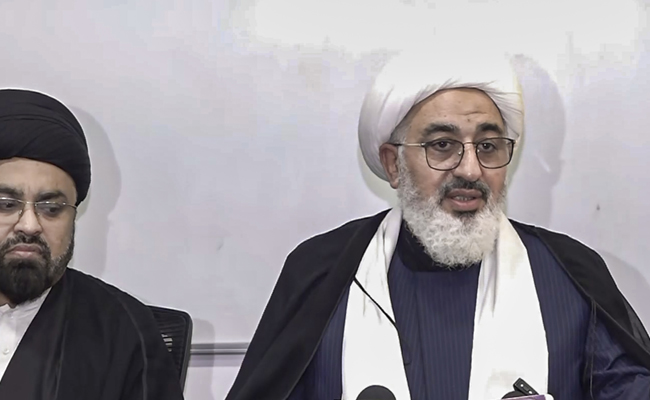
Bengaluru (PTI): Representative of Iran's Supreme Leader in India, Abdul Majeed Hakeem Ilahi on Saturday characterised the ongoing tensions between his country and the Israel-US alliance as a state of “no war, no peace”.
Calling for an immediate halt to the conflict, he said the global stability hinges on those who initiated the war.
He questioned why countries affected by the war and suffering from the energy crisis are not pressuring the US and Israel to stop the aggression.
Addressing a press conference here, Ilahi said Iran did not want the conflict, but was compelled to respond amid continued attacks, even as negotiations were expected to continue.
"Iran didn't want this war, but Iran was forced by the war and several times Iran tried to avoid this war... I don't know what is the condition of these people and these countries (US-Israel)... they want to impose on other countries what they want, and who gave them this authority?" he questioned.
Recalling the negotiations Iran held in Oman, he said talks later moved to Geneva and made progress before being disrupted by sudden attacks.
Ilahi claimed that airstrikes and missile attacks led to the deaths of Iran’s supreme leader Ayatollah Ali Khamenei, ministers, commanders and civilians.
"They killed a lot of civilians… They attacked a primary school, and they killed 175 innocent girls," he said, claiming over 4,000 deaths, more than 40,000 injuries, and widespread damage to houses, hospitals, universities and public infrastructure.
Despite these losses, he said Iran resisted calls for “unconditional surrender” and stood firm and defended itself.
"They wanted unconditional surrender. Which no one—no one can accept it. Iran said, 'Okay, we are ready to be sacrificed,' but we are not ready to submit ourselves," he added.
He argued that they (US-Israel) proposed the current ceasefire only after realising that they could not achieve any of their objectives after 40 days of conflict.
The envoy further claimed that the ceasefire is not an actual ceasefire, but a “no war, no peace” situation.
Explaining the current situation in Iran, he said conditions remain stable and people are going about their daily lives.
"They are working ....(leading) their ordinary life. They are working—they're going farming and they do everything....and they aren't scared of anything. And they are ready to defend themselves," he added.
Addressing the crisis in the Strait of Hormuz, he said the situation was stable before February 28 and all countries benefited from it.
"(For) 10,000 years, the Strait of Hormuz was open...and Iran daily yearly spent a lot for providing security in the Strait of Hormuz... so no one even complained anything about the Strait of Hormuz. Everyone was free...and even our enemies their warship was passing through the Strait of Hormuz," he said.
However, he linked the current maritime instability to the actions of the US and Israel.
"So Iran cannot do anything. Those people who initiated, created and started this war, they have to stop it. And everything will go back to normal," he said.
Criticising the mentality of the "great powerful country", Ilahi said, "they think they have the right to do whatever they want. It should change."
He sought to know why the countries affected by the conflict are not exerting pressure on the US and the "Zionist" regime to halt the war.
"Why are they not asking them? This crisis and problem by which a lot of countries are affected was created by them. A lot of factories are closed and even working days in some countries reduced... A lot of restaurants are closed," he said.
Seeking fairness and justice, Ilahi said instead of asking Iran, all those nations should ask those who initiated this war to stop it, by telling them, "we are suffering."
To a query on international mediation, Ilahi, referring to the US, asked, "Is it acceptable and reasonable that one country orders all countries -- you should not deal with this country, You should not purchase from this country. You should not have business with this country. You should not buy from this country."
Ilahi also highlighted Iran's long-standing ties with India and said, "It is a great country and we respect India and Indians."
"We have 5,000 years relationship and friendship. We are connected to India by education, by philosophy, by culture, by civilisation and by the economy," he said.
According to him, the bilateral cooperation remains strong, citing diplomatic engagement.
"At the moment also, our relationship, collaboration, cooperation with India is very good," he said, adding Iran allowing Indian ships to pass through Strait of Hormuz reflects the ties.
"Iran allowed Indian ships to pass through the Strait of Hormuz. Why? A lot of countries couldn't get this permission?... The relationship between Iran and India is very good," he added.
He expressed confidence that in future too, the ties between Iran and India will be strong.