Your turban does not mean terrorism: NYC Mayor Adams says amid recent attacks on Sikhs
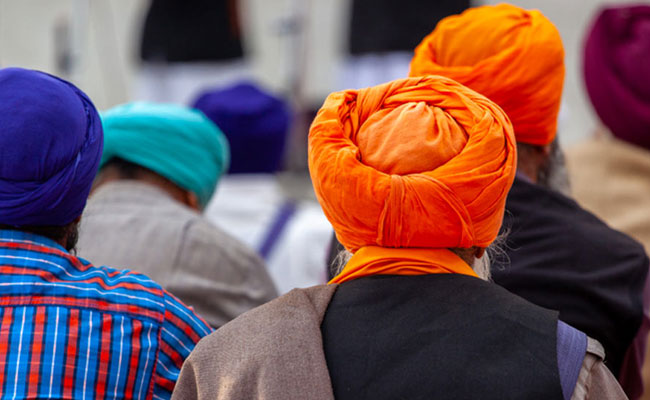
New York (PTI): The Sikh turban does not mean terrorism but symbolises faith, New York City Mayor Eric Adams said, as he described the recent attacks and hate crimes against the community as a "stain" on the country and vowed to protect its members.
He also gave a clarion call for educating people about Sikhism.
"You are not about terror; you are about protector. That is what needs to be taught throughout this entire city. Our young people need to know that, our adults need to know that," Adams said while addressing members of the Sikh community at the Baba Makhan Shah Lubana Sikh Center in the Queens neighbourhood of South Richmond Hill.
Describing the Sikh community as an "anchor" in the Richmond Hill neighbourhood, Adams said: "Your turban does not mean terrorism. It means protecting, it means community, it means family, it means faith, it means city, it means us coming together. We will change the dialogue and narrative with you. We can do it together."
Adams and New York State Assemblywoman Jenifer Rajkumar met and addressed members of the Sikh community here Sunday, in the wake of recent incidents of hate crime and assault against Sikhs.
On October 15, a 19-year-old Sikh boy was attacked by Christopher Philippeaux, 26, while he was riding the bus in Richmond Hill. Philippeaux punched the Sikh teenager in the back of the head, tried to knock off his turban and told him "We don't wear that in this country." Philippeaux has been charged with assault as a hate crime and aggravated harassment, Queens District Attorney Melinda Katz said.
Within days of this assault, 66-year-old Jasmer Singh was attacked when his car collided with another vehicle. The driver of the other car, 30-year-old Gilbert Augustin, allegedly punched the elderly Sikh man three times in the head and face and Singh later succumbed to his injuries.
Describing the attack against Singh as a "violent senseless act," Adams said "Jasmer should still be with us. He should still be with his son. He should still be living out the American dream, watching his son, who's now an immigration attorney.
"He should still be part of this community. That dream turned into a nightmare the other day when his life was taken from us prematurely," Adams said, flanked by Singh's son Subeg Singh Multani and other members of the Sikh community.
Describing Sikhs as "protectors" of society, Rajkumar asserted that the hateful targeting of Sikhs is "not acceptable" and perpetrators of such violence will be prosecuted to the fullest extent of law.
"For the first time, we are going to use the levers of government to end hate crimes against Sikh Americans. For the first time, we are going to come together and educate New York State, the United States and the entire world about who the Sikh people truly are so we are not attacked and misunderstood," Rajkumar, the first Indian-American woman elected to New York State Office and who described herself as a "daughter of Punjab", said.
Rajkumar said this was not the first time she had visited the Gurudwara and had spoken out against hate crimes. "But it is the last time I want to be standing here speaking out against hate crimes. Starting now we are going to end the hateful targeting of Sikhs," she said.
On behalf of herself and the Sikh community, Rajkumar presented the Mayor with a Kirpan', a mandatory article of faith in Sikhism. The sword, engraved with the words "New York City Mayor Adams is our protector", is "to embolden you in your fight for our Sikh community," Rajkumar said to Adams, amid slogans of Bole So Nihaal, Sat Sri Akal'.
Adams said the sword is a symbol of how as the mayor, he must be the protector of the Sikh community. "And when a member of your community is harmed, I take full responsibility (for) that."
Multani, who became emotional and choked up as he addressed the gathering, said his father came from India to the US in the early 1990s with the American dream in his eyes. "We didn't know that the dream would be shattered the way it has shattered" on October 19 in this "great" and diverse city of New York.
Multani said his father lived in Richmond Hill all his life because he considered the neighbourhood his home. Multani "pleaded" that the Mayor and city officials take "strong measures" to ensure the safety of the Sikh community so that no other person suffers the loss he is enduring.
"We love everyone, we love every other minority. But why we are being targeted? That is the question. We are law-abiding citizens of the United States. We love this country as much as others do," Multani said.
Multani said he is constantly in contact with the Queens District Attorney and officials regarding the case. He called on members of the Sikh community to accompany him when Augustin is arraigned on October 31.
"I am requesting everyone to join me that day," he said, adding that with their turbans on, "we will show solidarity and unity" to the judge. "We can show them this is a hate crime. This case must be pursued as a hate crime."
Adams said that to lose a member of the Sikh community in this magnitude is a "stain on our entire city and nation, because the hate we are seeing because your symbol of faith is not only localised to New York City, we are seeing similar acts across the entire country."
He recalled that after 9/11, Sikhs were "under attack over and over again because of the lack of understanding of what your turban represents."
Rajkumar noted that the recent attacks against Sikhs are part of a nationwide trend: in 2021, the most recent year for which data is available, documented hate crimes against the Sikh community increased 140% across
the country. Hate crimes have been frequent in the Richmond Hill area, her office noted.
Rajkumar demanded that incidents of hate against Sikhs must be stopped. "This is our fight for civil rights. This is our demand. Stop the targeting of Sikh Americans and see the Sikhs for who we really are - the protectors of society, proud Americans with generous hearts."
Adams said there must be a "full frontal assault on ending hate What plays out across the globe by other doers is being attached to your community. We need to clearly educate people about what this community stands for and what you represent."
He recalled how the Sikh community, during the Covid-19 pandemic, had fed millions of people without asking about their backgrounds, economic status or religion.
"I came here and watched in awe as you opened your doors when the hearts of many were closed. You were truly protectors during the most difficult time. It is our obligation to join you as you protect your community," Adams said.
Let the Truth be known. If you read VB and like VB, please be a VB Supporter and Help us deliver the Truth to one and all.
Hindus have consolidated, BJP will cross 135 seats in WB: Suvendu Adhikari after early trends
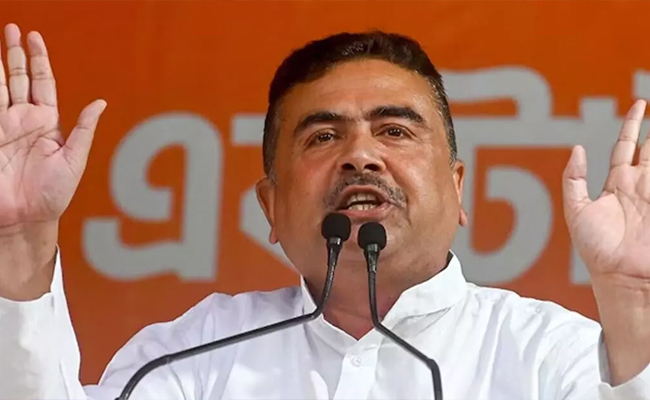
Kolkata: Suvendu Adhikari on Monday said he was confident that the Bharatiya Janata Party would form the government in West Bengal as early counting trends began to emerge.
Speaking after initial trends in the ongoing vote counting, Adhikari said the party was expecting to win more than 135 seats in the state.
He also claimed that Hindu votes had consolidated in favour of the BJP, which, according to him, would translate into victory for the party.
Counting of votes is currently underway, and official results are awaited.