Zaila Avant-garde becomes first African American to win 2021 Spelling Bee
Indian-Americans come 2nd and 3rd
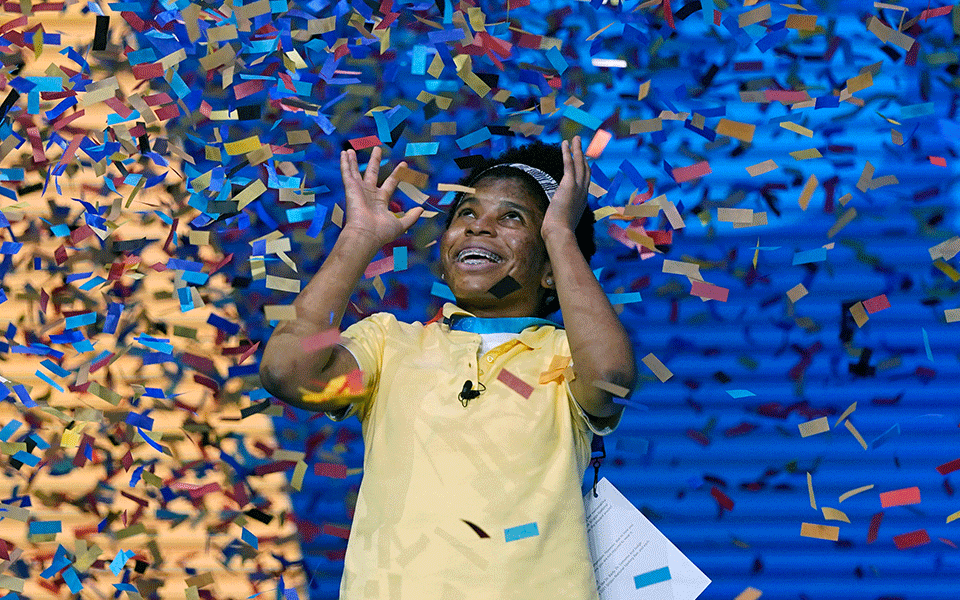
Washington: Zaila Avant-garde, a 14-year-old basketball prodigy, has won the 2021 Scripps National Spelling Bee, becoming the first African American contestant to win in 93 editions of the prestigious competition.
Indian-Americans, who have been dominating the National Spelling Bee for years, had to be satisfied with the 2nd and 3rd positions. Chaitra Thummala, a 12-year-old from San Francisco and Bhavana Madini, 13, from New York won the second and third place at the keenly-fought competition, which was attended by US First Lady Jill Biden.
Avant-garde correctly spelt Murraya - a genus of tropical Asiatic and Australian trees having pinnate leaves and flowers to win the competition and USD 50,000 prize money on Thursday.
"It was the smile and twirls for us! After tying for 370th place in 2019, #Speller133 Zaila Avant-garde wins the 2021 Scripps National Spelling Bee. Congrats to all of our spellers. We're proud of everyone's poise and courage in facing the dictionary. #SpellingBee #TheBeeIsBack," Scripps National Spelling Bee tweeted after the competition, which was not held last year due to the raging COVID-19 pandemic.
Avant-garde outlasted a field of 11 finalists, including Indian-Americans, to win the 2021 Scripps National Spelling Bee title and the first-place prize of USD 50,000 at the ESPN Wide World of Sports Complex in Orlando, Florida.
The 8th-grader also became the first Louisiana resident and the first African-American to win the title in the competition's 93-year history.
The only Black winner before was Jody-Anne Maxwell, representing Jamaica in 1998, CNN reported.
A basketball prodigy, Avant-garde holds three Guinness World Records for her ability to dribble multiple basketballs at a time.
She hopes to one day play in the Women's National Basketball Association.
Avant-garde previously competed in 2019, according to her bio on the bee's website.
She is an avid reader who demonstrated a strong interest in words from a very early age. Beyond her love for words and language, she enjoys learning new things, playing basketball, listening to music and podcasts, and hanging out with her family, it said.
The National Bee is a high-profile, high-pressure endurance test as much as a nerd spelling match and spellers spend months preparing for it.
Jill Biden congratulated Avant-garde on her historic win.
"Congratulations Zaila!!!," she tweeted.
Jill, a community college educator, previously attended the 2009 Scripps National Spelling Bee finals when it was held in Washington, DC.
Over the past 20 years, Indian-Americans have been dominating the Spelling Bee contest even though they comprise only about 1 per cent of the US population.
It was the first time since 2008 that at least one champion or co-champion of the Scripps National Spelling Bee was not of South Asian descent, the Associated Press reported.
The Bee was cancelled in 2020 - for the first time since World War II - due to the coronavirus pandemic. But there were eight co-champions in 2019, seven of whom were Indian-Americans, bringing the total number of Indian-American champions since 1999 to 26.
Let the Truth be known. If you read VB and like VB, please be a VB Supporter and Help us deliver the Truth to one and all.
Two injuries, one DNF, a DQ as India end messy World Relays campaign
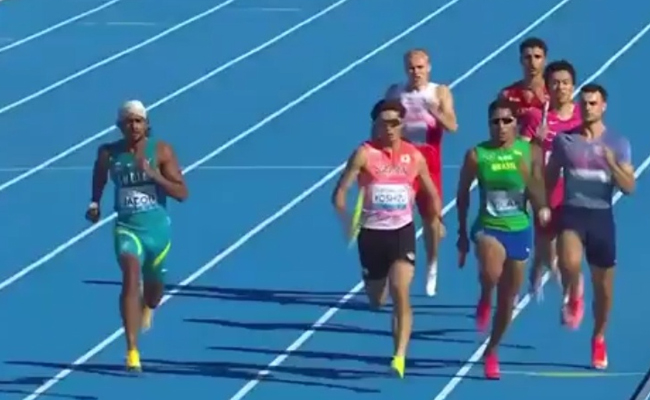
Gaborone (Botswana) (PTI): Amoj Jacob and Ragul Kumar got injured during the men's 4x400m and 4x100 races respectively as India ended their World Athletics Relays campaign in disappointment on the second day of competitions here on Sunday.
The Indian camp had high hopes of making the 2027 World Championships in the men's 4x400m relay but the team did not finish (DNF) the race as Jacob suffered cramps and pulled out of the race after taking the baton from the first leg runner Dharamveer Choudhary. Rajesh Ramesh and Vishal TK were to run in the third and fourth legs.
Those teams which could not qualify for the 2027 Beijing World Championships by reaching the final round of each of the six relay events on Saturday were given another chance in the second qualification round on Sunday.
The top two teams in each of the two heats (in all six relay events) booked the Beijing ticket on Sunday.
India will now have to try and qualify for the World Championships through the Top Lists of the World Athletics, which is a long and tedious process.
In the men's 4x100m race, third leg runner Ragul Kumar fell down the track after failing to hand over the baton inside the exchange zone to fourth leg runner Gurindervir Singh, which clearly showed the lack of coordination among the runners.
Harsh Santosh Raut and Animesh Kujur ran the first two legs.
The Indian quartet was disqualified and Kumar was seen being taken away from the Field of Play with the help of the volunteers.
It was a comedy of errors in the case of the women's 4x100m race, which saw the baton being dropped during an exchange between first leg runner Tamanna and second runner Nithya Gandhe, though the Indians finished the race in 53.09 seconds.
Gandhe started running quite a distance, but after realising that the baton was not in her hand, she turned and ran back to pick it up.
The only silver-lining for the Indian contingent was the national record time in the mixed 4x100m relay race, though the quartet of Ragul Kumar, Nithya Gandhe, Animesh Kujur and Sneha SS finished sixth in heat number two with a time of 41.35 seconds, bettering the previous national mark of 42.30 seconds set in March in Chandigarh.
The mixed 4x400m relay quartet of Theerthesh P Shetty, Kumari Saloni, Nihal William and Rashdeep Kaur ended at fifth in heat number one with a time of 3 minutes and 19.40 seconds.
On Saturday, all the five Indian relay teams had failed to make it to the respective final rounds and thus missed out on the 2027 World Championships berths.