Zelenskyy says Putin wants rest of Ukraine's Donetsk region as part of ceasefire
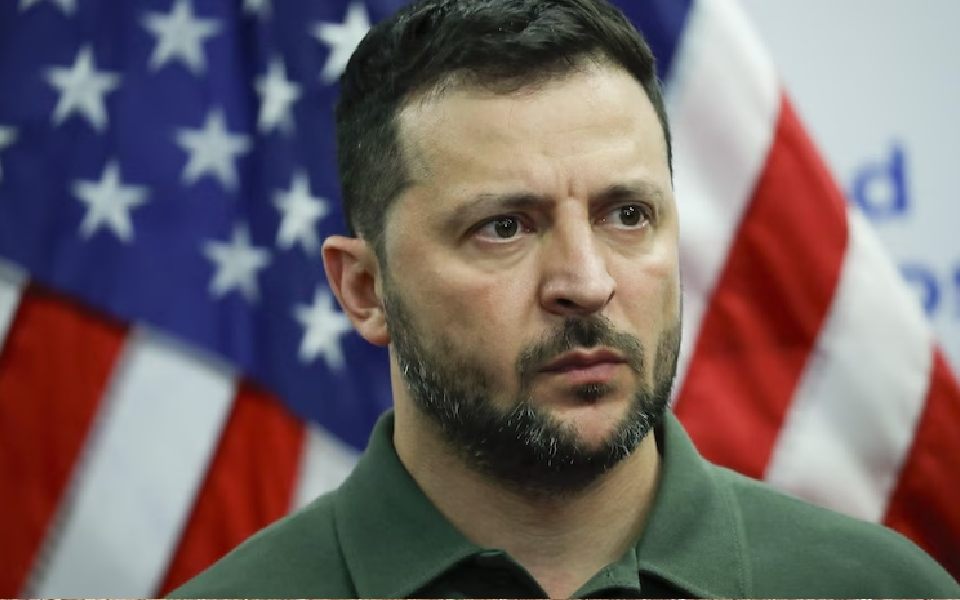
Brussels, Aug 12 (AP): Ukrainian President Volodymyr Zelenskyy said Tuesday that Russian President Vladimir Putin wants Ukraine to withdraw from the remaining 30 per cent of the Donetsk region that Ukraine controls as part of a ceasefire deal.
Zelenskyy said Russia's position had been conveyed to him by US officials ahead of a summit Friday between Putin and US President Donald Trump in Alaska on the war in Ukraine.
Zelenskyy reiterated that Ukraine would not withdraw from territories it controls, saying that would be unconsitutional and would serve only as a springboard for a future Russian invasion.
It remained unclear whether Ukraine would take part in the Friday summit. European Union also has been sidelined from the meeting, and they appealed to Trump on Tuesday to protect their interests.
Zelenskyy said at a news briefing in Kyiv that Putin wants the remaining 9,000 square kilometres of Donetsk under Kyiv's control, where the war's toughest battles are grinding on, as part of a ceasefire plan. He said the Russian position was conveyed to him by US officials.
Doing so would hand Russia almost the entirety of the Donbas, a region comprising Ukraine's eastern industrial heartland that Putin has long coveted.
Zelenskyy was offering new details on the call he held with Trump and special envoy Steve Witkoff, after the latter's bilateral meeting with Putin. Witkoff told Zelenskyy that Russia was ready to end the war and that there should be territorial concessions from both sides. Some European partners were also part of the call.
“And that, probably, Putin wants us to leave Donbas. That is, it didn't sound like America wants us to leave,” he said, recounting the call. Further meetings at the level of National Security Advisors further clarified what Russia actually wanted, Zelenskyy said.
Meanwhile, Russian forces on the ground have been closing in on a key territorial grab around the city of Pokrovsk, potentially to use as leverage in any peace negotiations.
Seeking Trump's ear before the summit
Trump has said he wants to see whether Putin is serious about ending the war, now in its fourth year. The US president has disappointed allies in Europe by saying Ukraine will have to give up some Russian-held territory. He also said Russia must accept land swaps, although it was unclear what Putin might be expected to surrender.
The Europeans and Ukraine are wary that Putin, who has waged the biggest land war in Europe since 1945 and used Russia's energy might to try to intimidate the EU, might secure favourable concessions and set the outlines of a peace deal without them.
European countries' overarching fear is that Putin will set his sights on one of them next if he wins in Ukraine.
Their leaders said Tuesday they “welcome the efforts of President Trump towards ending Russia's war of aggression against Ukraine.” But, they underlined, “the path to peace in Ukraine cannot be decided without Ukraine” and “international borders must not be changed by force.”
The Europeans on Wednesday will make a fresh attempt to rally Trump to Ukraine's cause at virtual meetings convened by German Chancellor Friedrich Merz. Trump did not confirm whether he would take part but did say “I'm going to get everybody's ideas” before meeting with Putin.
Russia holds shaky control over four of the country's regions, two in the country's east and two in the south.
Mykhailo Podolyak, an adviser to the chief of Zelenskyy's office, said anything short of Russia's strategic defeat would mean that any ceasefire deal would be on Moscow's terms, erode international law and send a dangerous signal to the world.
'A profoundly alarming moment for Europe'
Trump's seemingly public rehabilitation of Putin — a pariah in most of Europe — has unnerved Ukraine's backers.
The summit in Alaska is a “profoundly alarming moment for Europe,” said Nigel Gould-Davies, senior fellow at the International Institute for Strategic Studies in London.
According to Gould-Davies, Putin might persuade Trump to try to end the war by “accepting Russian sovereignty” over parts of Ukraine, even beyond areas that it currently occupies. Trump also could ease or lift sanctions which are causing “chronic pain” to the Russian economy.
That would provoke a “really serious split in the transatlantic alliance," he said.
The war isn't about Russia's territorial expansion but about Putin's goal of subordinating Ukraine, which would create the opportunity to threaten other parts of Europe, Gould-Davies said.
It was unclear whether the Europeans also were unsettled by Trump mistakenly saying twice he would be traveling to Russia on Friday to meet Putin. The summit is taking place in the U.S. state of Alaska, which was colonized by Russia in the 18th century until Czar Alexander II sold it to the U.S. in 1867.
Tuesday's European joint statement was meant to be a demonstration of unity. But Hungarian Prime Minister Viktor Orbán, who is Putin's closest ally in Europe and has tried to block EU support for Ukraine, was the only one of the bloc's 27 leaders who refused to endorse it.
Russia closes in on Pokrovsk
Russia appeared close to taking an important city in the Donetsk region, Pokrovsk.
Military analysts using open-source information to monitor the battles said the next 24-48 hours could be critical. Losing Pokrovsk would hand Russia an important victory ahead of the summit. It also would complicate Ukrainian supply lines to the Donetsk region, where the Kremlin has focused the bulk of military efforts.
“A lot will depend on availability, quantity and quality of Ukrainian reserves,” Pasi Paroinen, an analyst with the Finland-based Black Bird Group, wrote on social media late Monday.
Ukraine's military said its forces are fending off Russian infantry units trying to infiltrate their defensive positions in the Donetsk region. The region's Ukrainian military command on social media Monday acknowledged that the situation remains “difficult, unpleasant and dynamic.”
Elsewhere in Ukraine, a Russian missile attack on a military training facility left one soldier dead and 11 others wounded, the Ukrainian Ground Forces posted on social media. Soldiers rushing to shelters were hit with cluster munitions, according to the Ukrainian Ground Forces.
Let the Truth be known. If you read VB and like VB, please be a VB Supporter and Help us deliver the Truth to one and all.
Indian startup's 'Drishti' satellite launched aboard SpaceX rocket
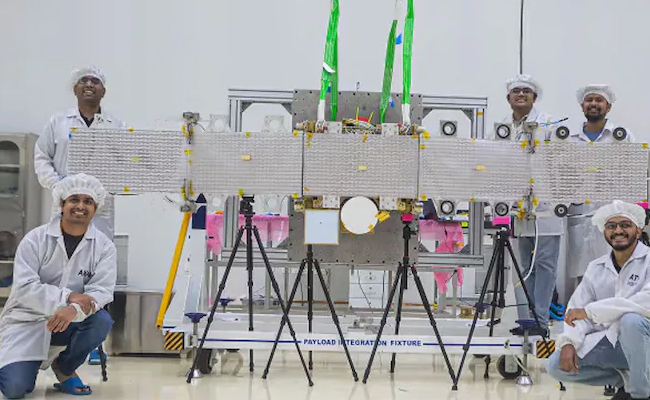
New Delhi (PTI): Bengaluru-based space start-up GalaxEye's Mission Drishti satellite was launched on Sunday aboard SpaceX's Falcon 9 rocket from California.
Mission Drishti is the world's first OptoSAR satellite, integrating electro-optical (EO) and synthetic aperture radar (SAR) sensors into a single operational platform, according to the company.
While EO sensors capture high-resolution images during sunlight and clear skies, SAR sensors provide all-weather and all-time images, using radar pulses.
In a statement, Suyash Singh, founder and CEO of GalaxEye, said, "With the satellite (Mission Drishti) now successfully in orbit, our immediate focus is on completing its commissioning. As we move through this phase, we are already witnessing strong global interest in the differentiated datasets enabled by our OptoSAR payload."
The satellite will help address long-standing limitations of conventional systems and enable more reliable and consistent data acquisition across diverse environmental conditions, the company said.
As a dual-use Earth observation satellite, the mission will support use cases across defence, agriculture, disaster management, maritime monitoring, and infrastructure planning.
The satellite is also expected to complement India's broader initiatives, including the 29 active Earth Observation satellites outlined in ISRO's recent annual report.
The launch came after five years of indigenous research and development, and extensive environmental testing and performance validation of the Mission Drishti.
In a statement, Lt Gen AK Bhatt (Retd), director general of Indian Space Association (ISpA), said, "GalaxEye has achieved what only a few global players have, which is seamlessly combining optical and SAR capabilities on a single platform to enable persistent, all-weather intelligence."
What stands out is not just the technology, but its broader impact on how downstream applications will increasingly define value in the space economy, particularly in Earth observation, where timely, decision-grade insights are critical," he added.
ISpA is the premier industry association of space and satellite companies in the country.
Union Minister Jitendra Singh also took note of the Mission Drishti launch, saying the development marked a significant milestone in India's space journey.
In a post on X, the minister said, "The successful launch of the world's first OptoSAR satellite, and the largest privately-built satellite in the country, reflects the immense potential of our young innovators driving nation-building."
GalaxEye aims to scale up Mission Drishti to a constellation of 10 satellites by 2030, developing a robust and sovereign Earth observation infrastructure for India.