Bengaluru: Police arrest man roaming around masjid with hatchet
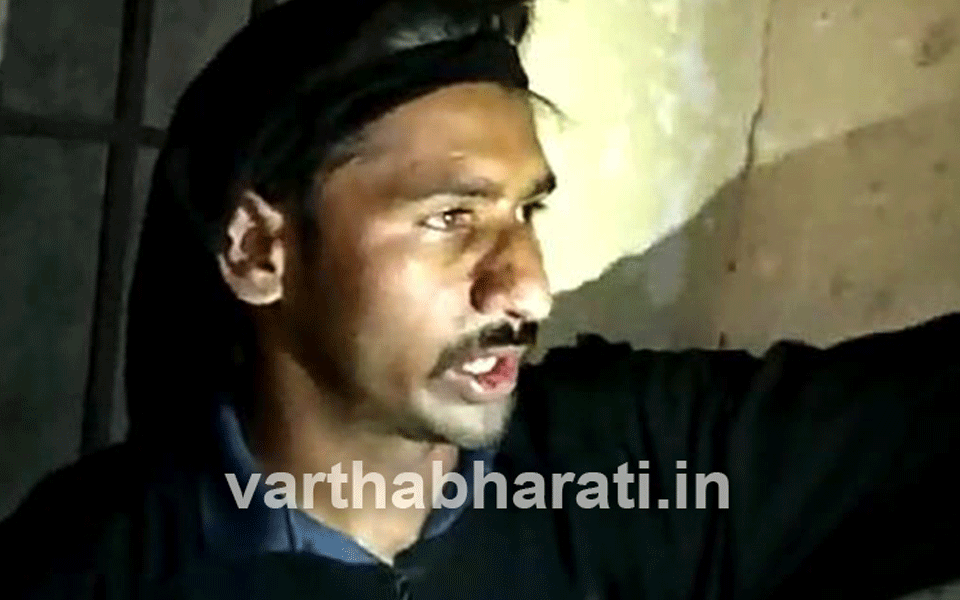
Bengaluru, May 29: General public have caught a person who was roaming near a masjid with a hatchet in his hand and wearing burka and handed over to the police at KG Halli in Bengaluru on Tuesday. The arrested is identified as Shivaraj (25).
It is said that the accused has been wandering near the masjid at HRBR layout of KG Halli on Monday night with the hatchet in his hand. As he wore slippers, the suspected people removed the burka and confirmed that the person is not a woman, but a man. When verified him, people found a hatchet.
It is said that the accused is belonged to Raichur. He has borrowed a loan from his friend. When his friend forced him to return the loan amount, he has planned to threaten him with the hatchet. So, he was waiting for his friend near the masjid by wearing the burka.
Local people have lodged a complaint that Shivaraj has conspired to murder his friend by wearing the burka. KG Halli police have been investigating.
Let the Truth be known. If you read VB and like VB, please be a VB Supporter and Help us deliver the Truth to one and all.
Board meet to appoint Neville Tata on Sir Ratan Tata Trust as trustee cancelled

New Delhi (PTI): A proposed board meeting of the Sir Ratan Tata Trust (SRTT), which was supposed to take up the appointment of Neville Tata, son of Tata Trusts Chairman Noel Tata, as a trustee on Saturday is understood to have been cancelled due to lack of quorum.
The cancellation of the meeting comes over two months after the failure of the first attempt to induct Neville Tata on the board of SRTT, which holds 23.6 per cent in Tata Sons, the promoter holding firm of the over USD 180 billion Tata Group.
"All trustees could not attend, which is a requirement for trustee appointment," a person with direct knowledge of the development said.
The meeting could be rescheduled in the next few days, the person added.
However, others said the cancellation could be to take more time for discussion among the trustees to reach a consensus on the appointment.
Query to Tata Trusts remained unanswered.
The trustees of SRTT are Noel Tata, Venu Srinivasan, Vijay Singh Jimmy N Tata, Jehangir HC Jehangir and Darius Khambata.
In November last, Neville Tata and former group company leader Bhaskar Bhat were appointed to the Sri Dorabji Tata Trust (SDTT), which owns 28 per cent in Tata Sons. However, they couldn't be appointed to the SRTT, which holds 23.6 per cent in Tata Sons. Other Tata-affiliated trusts own 13.8 per cent in Tata Sons.
It was apparently because of an objection raised by Venu Srinivasan.
Srinivasan, who was unanimously made lifelong trustee in October 2025, had to witness his appointment revisited "in compliance with legal and regulatory requirements".
The Maharashtra government had in September 2025 amended the Maharashtra Public Trusts Act, thereby limiting the number of lifetime trustees to one-fourth of the board strength and mandated fixed terms where trust deeds are silent.