15th Finance Commission submits report to President
New Delhi: The 15th Finance Commission on Monday submitted its recommendations on the ratio in which taxes are to be divided between the Centre and states over the next five years.
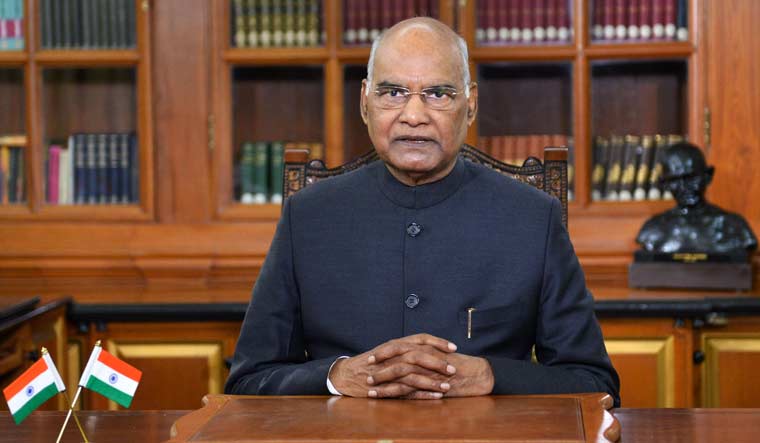
The panel, headed by former bureaucrat N K Singh, submitted its report titled 'Finance Commission in Covid Times' to President Ram Nath Kovind, an official statement said.
Finance Commission is a constitutional body that gives suggestions on Centre-state financial relations.
The 15th Finance Commission submitted two reports - the first report consisted of recommendations for the financial year 2020-21 and the final report - submitted on Monday - with recommendations for 2021-26.
While the 14th Finance Commission had recommended that states be given 42 per cent of all taxes, the present Commission had for 2020-21 recommended a total devolution of Rs 8,55,176 crore to states, which is 41 per cent of the divisible pool of taxes.
The recommendations of the 15th Finance Commission for period 2021-22 to 2025-26 haven't been disclosed as the report is yet to be tabled in Parliament.
It is likely that the report along with an action-taken report is presented in the ensuing session of Parliament.
The 14th Finance Commission had increased states' share by 10 percentage points to 42 per cent and it remains to be seen what its successor would do considering the Centre is hard-pressed for funds at a time when it is looking to boost the economy through expenditure.
Singh along with other members of the Commission - Ajay Narayan Jha, Anoop Singh, Ashok Lahiri and Ramesh Chand - presented the report to the President.
The "15th Finance Commission led by Chairman N K Singh, today submitted its report for the period 2021-22 to 2025-26 to the Hon'ble President of India," an official statement said.
As per the terms of reference (ToR), the Commission was mandated to give its recommendations for five years from 2021-22 to 2025-26.
The Commission was asked to give its recommendations on wide-ranging issues. Apart from the vertical and horizontal tax devolution, local government grants, disaster management grant, it was also asked to examine and recommend performance incentives for states in many areas like power sector, adoption of direct benefit transfer, solid waste management etc.
The Commission was also asked to examine whether a separate mechanism for funding of defence and internal security ought to be set up and if so how such a mechanism could be operationalised.
The Commission has sought to address all its ToRs in this report to the Union government, the statement added.
This report has been organised in four volumes. Volume I and II, as in the past, contain the main report and the accompanying annexes.
Volume III is devoted to the Union Government and examines key departments in greater depth, with the medium-term challenges and the road map ahead. Volume IV is entirely devoted to states.
The Commission has analysed the finances of each state in great depth and has come up with state-specific considerations to address the key challenges that individual states face, the statement added.
The report would be made public after it is tabled in Parliament by the government. The cover and title of the report are also unique and the use of scales on the cover indicates the balance between the states and the Union, it said.
Let the Truth be known. If you read VB and like VB, please be a VB Supporter and Help us deliver the Truth to one and all.
Human skeletal remains found in Bengaluru outskirts
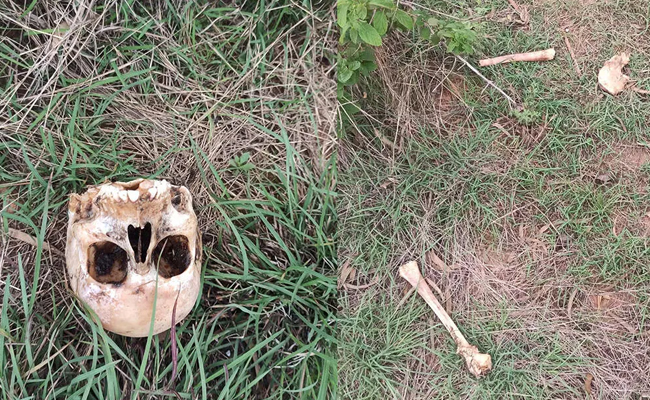
Bengaluru (PTI): Human skeletal remains, including a skull, suspected to be that of a woman were discovered in and around a lake on outskirts of the city, police said on Saturday.
The matter came to light after shepherds spotted the remains near the lake at Mugalur near Sarjapur while grazing cattle in the area and alerted the police, they said.
During the inspection, investigators found bones scattered across the dried lake bed and nearby areas, a senior police officer said, adding there was suspicion that the remains must be at least three months old.
Police suspect the victim may have drowned in the lake earlier, with the skeletal remains surfacing after water levels receded significantly during the summer.
Officials also suspect stray dogs could have dragged some of the remains to surrounding areas after the lake dried up further.
With pieces of a saree recovered from the spot, police suspect that it could have been of a woman.
Forensic experts and the Scene of Crime Officer team visited the spot and collected the skeletal remains and other evidence for examination.
A case has been registered and the remains, along with other evidence, have been sent for forensic analysis, the police officer said.
The identity of the deceased and the exact cause of death are yet to be established, he added.