Asian shares mark moderate gains in face of anxiety over Trump's trade war
Tokyo (AP): Asian shares mostly rose Thursday, despite the continued fretting over President Donald Trump's trade war, with all eyes on negotiations that just began between the administration and Japan.
Japan's benchmark Nikkei 225 gained 0.7% to 34,142.86 in morning trading.
Honda stock price jumped 1.7% after the Japanese automaker said it plans to move its production of the five-door Civic hybrid electric vehicles for the US market from Japan to the company's plant in Indiana.
Honda Motor Co didn't say the move was in response to Trump's tariff policies but stressed it moves production to where there is demand. Production of the U.S.-bound five-door Civic HEV began at the Yorii plant outside Tokyo in February. So far 3,000 vehicles have been produced there for the US market.
Trump joined Treasury Secretary Scott Bessent and Commerce Secretary Howard Lutnick in the talks with the Japanese delegation in Washington. “Hopefully something can be worked out which is good (GREAT!) for Japan and the USA!” Trump wrote in a social media post ahead of the meeting.
Australia's S&P/ASX 200 gained 0.3% to 7,781.00. South Korea's Kospi edged up 0.5% to 2,459.46. Hong Kong's Hang Seng added 0.5% to 21,165.70, while the Shanghai Composite slipped 0.2% to 3,270.47.
U.S. stocks fell Wednesday after Nvidia warned new restrictions on exports to China will chisel billions of dollars off its results. The S&P 500 sank 2.2% after falling as much as 3.3% earlier. Such an amount would have vied for one of its worst losses in years before the historic, chaotic swings that have upended Wall Street in recent weeks.
The Dow Jones Industrial Average dropped 699 points, or 1.7%, and the Nasdaq composite sank a market-leading 3.1%.
Many investors are bracing for a possible recession because of Trump's tariffs, which he has said he hopes will bring manufacturing jobs back to the United States and trim how much more it imports from other countries than it exports. A survey of global fund managers by Bank of America found expectations for recession are at the fourth-highest level in the last 20 years.
The World Trade Organization said Wednesday it expects tariffs to cause a 0.2% decline in the volume of world merchandise trade for 2025. That's if the tariff situation remains as it was on Monday. Trade could shrink by 1.5% this year if conditions worsen, the WTO said.
All told, the S&P 500 fell 120.93 points to 5,275.70. The Dow Jones Industrial Average dropped 699.57 to 39,669.39, and the Nasdaq composite sank 516.01 to 16,307.16.
Treasury yields eased in the bond market, taking a leg lower following the comments from the Fed's chair. The yield on the 10-year Treasury fell to 4.28% from 4.35% late Tuesday and from 4.48% at the end of last week.
In energy trading, benchmark US crude rose 35 cents to $62.82 a barrel. Brent crude, the international standard, gained 23 cents to $66.08 a barrel.
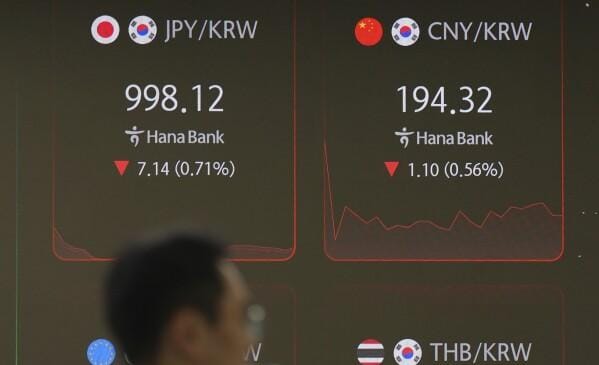
In currency trading, the U.S. dollar rose to 142.75 Japanese yen from 141.74 yen. The euro cost $1.1360, down from $1.1401.
Let the Truth be known. If you read VB and like VB, please be a VB Supporter and Help us deliver the Truth to one and all.
Assam Police at Pawan Khera's residence in national capital, Delhi Police assisting

New Delhi (PTI): An Assam Police team on Tuesday is at the Delhi residence of Congress leader Pawan Khera for questioning in connection with a case linked to allegations made against Assam Chief Minister Himanta Biswa Sarma and his family, official sources said.
The team formally informed Delhi Police upon arrival, following which a local police team joined and is assisting in the proceedings, the source said.
The development comes amid a political tussle after Sarma alleged that the Congress used "false information" sourced from a Pakistani social media group to level charges against his wife regarding multiple passports and overseas assets. He termed the allegations an attempt to influence the Assam elections and a punishable offence.
Khera had recently sought clarifications on Sarma's wife's alleged foreign assets, prompting a complaint and subsequent police action.