Work underway on 'One Nation, One Election'; positive discussions ongoing: Modi
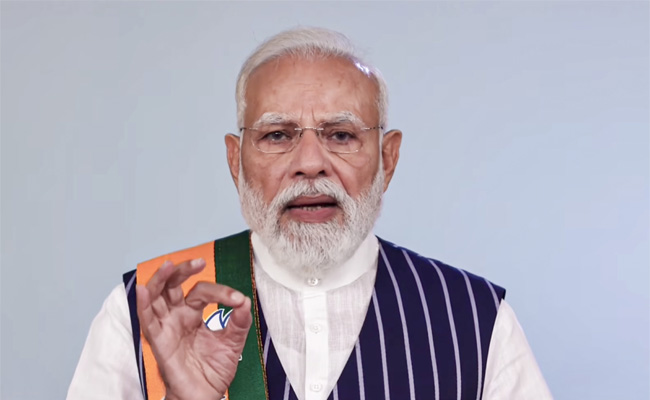
New Delhi (PTI): Prime Minister Narendra Modi on Monday said the "mission is still ongoing" for implementing the BJP's two key agendas, the Uniform Civil Code (UCC) and 'One Nation, One Election', with serious discussions underway and positive progress made.
Virtually addressing an event marking the BJP's 47th Foundation Day, Modi also said it was the saffron party that first raised the issue of women's reservation in 1994. He added that the current BJP-led central government is fully committed to ensuring that the Women's Reservation Act -- which would provide 33 per cent reservation for women in the Lok Sabha and state assemblies -- is implemented in the 2029 general elections.
Targeting the Congress, he said BJP workers endured many hardships -- such as the Emergency and oppression -- under the grand old party's rule. Many BJP workers even sacrificed their lives, he said, citing states such as West Bengal and Kerala "where violence has been turned into a political culture".
"Our mission is still ongoing. On Uniform Civil Code, 'One Nation, One Election' and other issues, serious discussions are taking place in the country, and we have achieved tremendous progress on those fronts," Modi said.
He said the BJP aims to make the country developed and self-reliant, and will continue to march in that direction.
Under the 'One Nation, One Election' system, the Modi government proposes to conduct simultaneous elections to the Lok Sabha and state assemblies. The UCC seeks to create the same set of laws for everyone across the country, irrespective of religion, especially with regard to marriage and adoption.
Modi said the BJP is sincerely striving to face every challenge.
ALSO READ: 2 Indian nationals accused of drug trafficking arrested in Nepal
"There are countless works that were the result of the BJP's honest efforts, such as the repeal of hundreds of black laws from the British era, the construction of a new Parliament building, 10 per cent reservation for the poor in the general category, triple talaq ban, the Citizenship Amendment Act, the construction of the Ayodhya Ram temple," he said.
The prime minister said the BJP had first proposed women's reservation in 1994 in Vadodara.
"We had also decided that we would encourage women in our party organisation as far as possible. When we came to power, we fulfilled that promise. Now we are fully dedicated to ensuring that the Nari Vandan Adhiniyam (Women's Reservation Act) is implemented in the 2029 general elections," he said.
Referring to the ongoing West Asia conflict, Modi said the BJP believes in the idea of 'Vasudhaiva Kutumbakam' (the world is one family) even in times of war.
He said there was a time when India took pride in maintaining equal distance from every country, but now it is moving ahead by keeping close relations with each country.
Highlighting that the BJP-led National Democratic Alliance (NDA) has completed 25 years of existence, Modi said it is the only coalition that has been working in the country's interest and for public welfare.
"The BJP has set an example in coalition politics. The consistent expansion of the NDA is proof that it is an all-inclusive coalition. It works by prioritising regional aspirations," he said.
Modi said people have seen dynastic politics, which is still prevalent in some parts of the country, and the Left governance model, but the BJP's governance model is unique.
"Under our governance model, policies and governments are stable," he said.
Modi said the BJP has its own agenda and aims, and besides handling the current crisis, the party-led government is preparing the country for the future.
"Works are ongoing on issues such as the demographic change, infiltration, corruption, dynastic politics, and freeing people from a colonial mindset. The BJP has to make the country free from all these challenges. This responsibility can be fulfilled only by the BJP," he said.
Referring to the abrogation of Article 370 (which gave special status to Jammu and Kashmir) in 2019, Modi said that for decades, the law was a hurdle in fully integrating Jammu and Kashmir with the rest of the country.
"People thought it was impossible to scrap Article 370, but we had promised to abrogate it. We have completed the task," he said.
He said the BJP has been maintaining a consistent stand on issues like national security and terrorism, and now new technologies are being installed for border security, border villages are being developed, and the backbone of Naxalism has been crushed.
He said under the "vast and sacred banyan tree" of the Rashtriya Swayamsevak Sangh, the BJP was inspired to step into politics with good intentions and integrity.
"In the initial few decades, we devoted our energy to setting policies for the organisation," he said, adding that the BJP cannot forget that in 1984, the Congress won a record number of seats, but the country also witnessed how they betrayed the people.
"This increased people's trust in the BJP, and slowly we began to win seats. At that time, two types of political ideologies existed: one was power-driven, and the other was service-oriented.
"The politics that prioritised power gradually declined, and service-oriented politics gained massive public support. Today, we are proud that through our conduct, we have established a new principle in Indian politics: the principle of nation first," he said.
Earlier, in an X post, Modi greeted BJP workers on the party's foundation day. The BJP was formed on April 6, 1980.
"Our party has always been at the forefront of serving society, guided by the principle of India First. Our 'karyakartas' are known for their selfless service, unwavering dedication and a deep passion towards good governance. They have worked tirelessly at the grassroots, ensuring maximum people are connected to our ideology and work.
"We also remember the countless workers whose dedication, sacrifice and perseverance have shaped the party's growth over decades," he said.
Modi said the BJP stands as a party that places the well-being of people at the centre of its vision, and this is reflected in the work at the Centre and in various states.
"BJP remains committed to building a Viksit Bharat. May our collective resolve continue to drive this vision forward and take India to new heights of progress and prosperity," he said.
Let the Truth be known. If you read VB and like VB, please be a VB Supporter and Help us deliver the Truth to one and all.
Background of Delhi Assembly breach accused under scanner, booked for attempt to murder
New Delhi (PTI): The man behind the security breach at the Delhi Assembly on Monday is believed to be a supporter of the 2020-21 farmers' agitation with some history of mental health issues, with sources saying his background has raised multiple lines of inquiry for investigators.
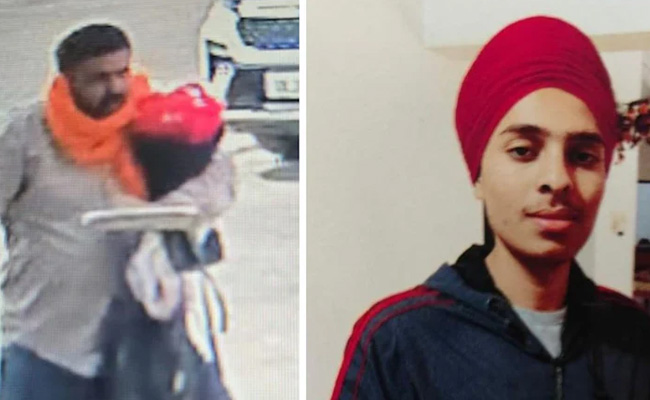
Sarabjeet Singh, a 37-year-old resident of Pilibhit in Uttar Pradesh, was apprehended two hours after he drove an SUV through one of the boundary gates of the assembly and placed a flower bouquet in the speaker's vehicle parked on the porch. He has been booked forattempt to murder, among other charges.
According to preliminary findings, Sarabjeet left his home on April 1 and remained largely untraceable for five days before the incident. In this period, he contacted his family only once and did not disclose his location or travel plans.
"He travelled to Bareilly on April 2 and subsequently reached Delhi on the day of the breach," the source said.
ALSO READ: Nine-judge SC bench hears pleas on discrimination against women at religious places
He also said that his family members told police that he becomes "difficult to control during such periods of illness" and that he often does not respond to family members during such episodes.
However, police said the exact state of his mental health is still being assessed as part of the ongoing probe and a medical examination is awaited.
The source said Sarabjeet was an active supporter of the farmers protest and had shared multiple posts on social media expressing solidarity with farmer leaders who died during the agitation. Several of these posts and videos were later deleted.
Investigators are also examining videos in which he is allegedly seen driving the same SUV at extremely high speeds, reportedly exceeding 150 kmph on empty roads. The vehicle, bearing a Uttar Pradesh registration number, was purchased recently in February.
On the day of the incident, Sarabjeet is believed to have acted alone. He drove the SUV at a high speed, rammed through Gate No. 2 of the assembly premises to enter the complex. He then allegedly placed a bouquet and garland inside the official vehicle of Speaker Vijender Gupta and briefly sat inside the car before fleeing through the same gate.
Police said the accused has not yet disclosed the motive behind his actions. His movements, call records and digital footprint are being analysed to determine whether he was influenced by any person or group.
He was eventually apprehended along with two other persons from a police picket near a nala in the Roop Nagar area after an alert was issued across the city.
"All individuals are currently being questioned, and further investigation is underway," read the statement.
Delhi Police, in a statement, said that at around 2.10 pm, a white SUV forcefully entered the premises of the Delhi Assembly through Gate No. 2. "One individual, alighted from the vehicle and proceeded towards the porch area carrying a bouquet and a garland (mala) of marigold flowers. It is pertinent to mention that the Vidhan Sabha was not in session at the time," read the statement of the Delhi Police.
The accused drove the vehicle in a dangerous manner with apparent intent to run over security personnel on duty, thereby endangering their lives, a senior police officer said. When security staff tried to catch Sarabjeet, he fled.
A case has been registered at Civil Lines under appropriate sections of law, including attempt to murder, criminal trespass with preparation to commit offence, use of criminal force against a public servant, and Section 3 of the Prevention of Damage to Public Property Act, along with other relevant provisions pertaining to obstruction of public servants in discharge of duty.