In 100 days of Modi Govt. 2.0, Rs. 12.5 lakh crore of Investors' wealth wiped out
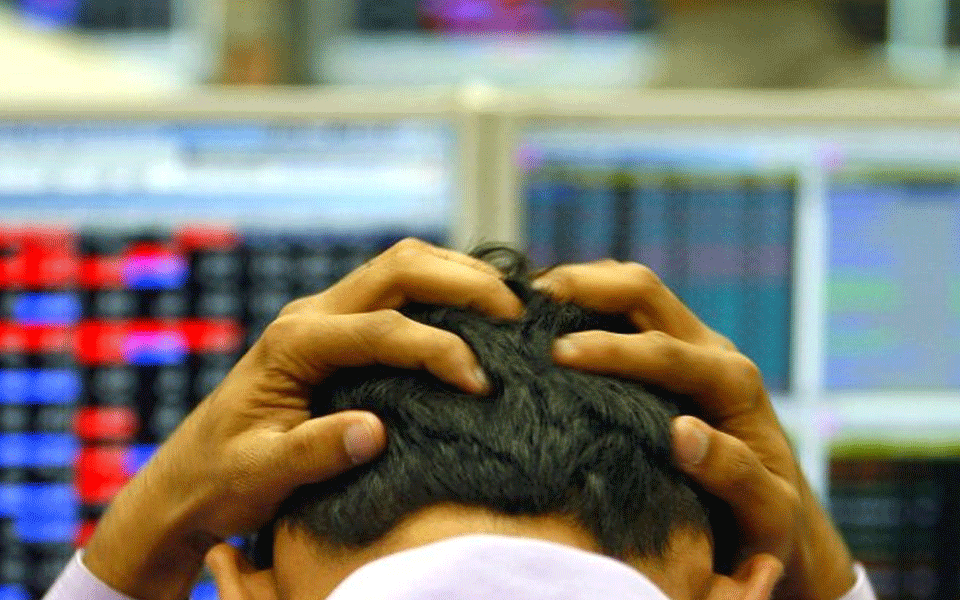
Investors' wealth worth Rs. 12.5 lakh crore has been wiped out in the first 100 days since the second term of Prime Minister Narendra Modi's government started on May 30. At yesterday's closing, the market capitalisation or market value of companies listed on BSE stood Rs. 1,41,15,316.39 crore as against market capitalisation of Rs. 1,53,62,936.40 crore a day before PM Modi's government came to power.
The Sensex has slumped 5.96 per cent or 2,357 points and the NSE Nifty 50 index has dropped 7.23 per cent or 858 points since May 30. Slowing economic growth, along with outflow of foreign funds and weak corporate earnings, are some of the reasons for the slump in equity markets, say analysts.
Foreign investors have been net sellers in the Indian markets. The pressure to sell increased after Finance Minister Nirmala Sitharaman introduced the super-rich tax on foreign investors in the first Budget of second NDA government, which was rolled back a month later.
Since the formation of government, foreign portfolio investors have sold shares worth Rs. 28,260.50 crore, data compiled by National Securities Depository Limited (NSDL) showed.
"The slowdown in the markets started way before the Prime Minister Modi's second term in power. The introduction of long term capital gains tax and dividend distribution tax in February 2018 budget led to the start of fall in equity market valuations and the slump in markets accelerated in the aftermath of the IL&FS crisis," AK Prabhakar, head of research at IDBI Capital, told NDTV.
"A lot of mid- and small-cap companies have corrected big and are at reasonable valuations. IL&FS crisis had a cascading effect on markets and the things are likely to recover from here on," added Mr Prabhakar.
All sector gauges compiled by National Stock Exchange except the Nifty Information Technology index have given negative returns over the last 100 days, with Nifty PSU Bank index dropping 26 per cent. Last month, the government announced mega mergers of state-run banks in which number of government-owned banks will be reduced to 12.
Metal index dropped 20 per cent in the wake of increased trade frictions between US and China. Analysts say despite the anti-dumping duty, China is selling cheap steel which is hurting the domestic metal companies.
Nifty Auto index has slumped 13.48 per cent as auto industry faces its worst slowdown in two decades. "We saw massive rise in autos in the last five years so the slowdown is also visible now. We never saw runaway sales in four wheelers. The way Maruti Suzuki has grown in the last 5 years has been amazing," Mr Prabhakar said.
courtesy: ndtv.com
Let the Truth be known. If you read VB and like VB, please be a VB Supporter and Help us deliver the Truth to one and all.
Meghalaya 34-year-old woman found dead in Bengaluru room; police suspect suicide

Bengaluru: A 34-year-old woman from Meghalaya was found dead in her rented accommodation in north Bengaluru on Thursday evening. Police suspect it to be a case of suicide, though the exact cause of death is yet to be confirmed.
The deceased has been identified as Kong Agatha Ba Ithianghun Khongwet, a native of Tangmang village in Meghalaya. She has been residing with her partner, a Manipur man identified as Nawaz Sharif, for the past three years at Sanjeevini Nagar in Hebbal under the jurisdiction of the Kodigehalli police station.
Police said she was found dead between 7 pm and 7.30 pm. “We are awaiting the autopsy report for further procedure. An investigation is ongoing,” a police officer said.
According to police, the couple frequently argued, allegedly over trust issues and suspicions regarding Sharif’s phone conversations. On the day of the incident, the couple is said to have had an argument after Khongwet suspected him of speaking to another woman while he was on a call with his mother. Following the altercation, Sharif reportedly left the house. The police suspect that Khongwet died by suicide during this time.
The Khasi Students’ Union (KSU), Bengaluru unit, expressed condolences and said the circumstances remain unclear. In a statement, the union said that while the case is being treated as a suspected suicide, other possibilities cannot be ruled out. Members of the organisation visited the spot and extended support to her friends, urging a fair investigation.
A case of Unnatural Death Report (UDR) has been registered at Kodigehalli police station. “We are questioning Nawaz Sharif. Further investigation is underway to ascertain the exact cause of death, and we are awaiting the post-mortem report,” the police said.
(Assistance for overcoming suicidal thoughts is available on the state’s health helpline 104, Tele-MANAS 14416.)