India’s Q2 GDP contracts by 7.5 %, after record slump 23.9% in last quarter
New Delhi, Nov 27: India's economy recovered faster than expected in the September quarter as a pick-up in manufacturing helped GDP clock a lower contraction of 7.5 per cent and held out hopes for further improvement on consumer demand bouncing back.
The gross domestic product (GDP) had contracted by a record 23.9 per cent in the first quarter of 2020-21 fiscal (April 2020 to March 2021) as the coronavirus lockdown pummelled economic activity.
The second straight quarter of contraction pushed India to its first technical recession.
The GDP contraction of 7.5 per cent in July-September compared with a growth of 4.4 per cent in the same quarter last year, according to data released by the statistics ministry on Friday.
With the gradual opening up from June, the economy picked up momentum. Manufacturing clocked a surprise 0.6 per cent growth in July-September after it had shrunk by a massive 39 per cent in the preceding quarter.
Continuing its good showing, the agriculture sector grew by 3.4 per cent, while electricity and gas expanded 4.4 per cent.
Financial and real estate services shrank 8.1 per cent in the second quarter of FY21 from a year ago, while trade, hotels, transport and communication declined 15.6 per cent.
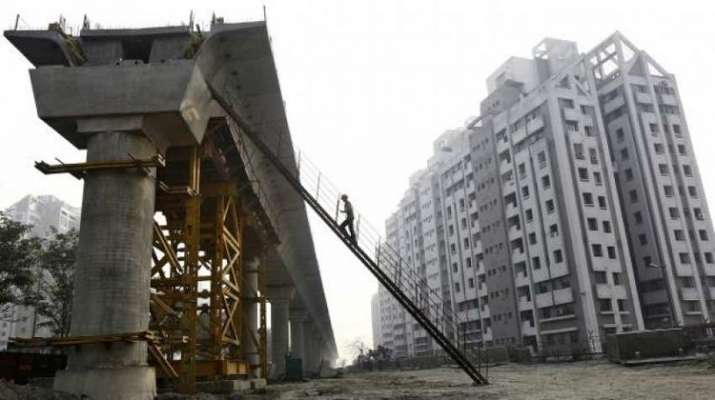
The construction sector, which is the second-largest employer in the economy, contracted only 8.6 per cent in Q2 versus (-) 50 per cent in Q1.
Public spending was down 12 per cent.
Analysts and economists, who have projected the economy shrinking for the full fiscal, had expected a wider contraction in Q2.
China's economy grew by 4.9 per cent in July-September this year, faster than the 3.2 per cent growth in April-June 2020.
Chief Economic Adviser Krishnamurthy Subramanian said the GDP numbers were "quite encouraging" given the pandemic and compared with the previous quarter's performance.
Giving outlook for the near future, he said, "We should be cautiously optimistic and the caution is warranted because the economic impact is primarily due to the pandemic."
Rumki Majumdar, economist, Deloitte India said recent high-frequency data possibly suggest a quicker rebound ahead.
"The possibility of a release of several highly effective vaccines soon gives us hope that there is an end date to the pandemic, even if it may not be immediate," Majumdar said.
Stating that the numbers are surely not as gloomy as was being anticipated, Mayur Dwivedi of Religare Enterprises said it now remains to be seen whether this momentum is sustained in the remaining two quarters of FY21.
In the first half, India's GDP contracted by 15.7 per cent compared to a growth of 4.8 per cent in the same period last fiscal.
Though the contraction in July-September pushed India into its first technical recession, based on records going back to 1996, a sharp recovery held out hopes for the economy turning around before the end of the fiscal year.
Analysts said the recovery was 'V' shaped.
Reserve Bank of India (RBI) Governor Shaktikanta Das had on Thursday stated that the recovery from the lockdown has been stronger than expected and the economy could show growth in the fourth quarter.
Post Q2, there has been a pick-up in consumer demand for autos, non-durables and rail freight during the festival season as prospects grew for COVID-19 vaccines to be launched early next year.
But there are downside risks as some states reimposed curbs to fight a second wave of infections, which could possibly slow the pace of recovery in the next two or three months, as well as heightening the risk of inflation.
India's tally of infections has crossed 93 lakh -- the second-highest globally after the US -- with more than 1.35 lakh deaths.
The improvement in the economy came ahead of next week's interest rate decision by the RBI.
"GDP at Constant (2011-12) Prices in Q2 of 2020-21 is estimated at Rs 33.14 lakh crore, as against Rs 35.84 lakh crore in Q2 of 2019-20, showing a contraction of 7.5 percent as compared to 4.4 percent growth in Q2 2019-20," the National Statistical Office (NSO) said in a statement.
"With a view to contain the spread of the Covid-19 pandemic, restrictions were imposed on the economic activities not deemed essential during Q1.
"Though the restrictions have been gradually lifted, there has been an impact on economic activities. In these circumstances, some other data sources such as GST, interactions with professional bodies, etc. were also referred to for corroborative evidence and these were clearly limited," it added.
Most rating agencies had projected that the fall in India's GDP for the second quarter of 2020-21 would be arrested to single digits.
Niti Aayog Vice Chairman Rajiv Kumar said the economic recovery was a 'pleasant surprise'.
"Manufacturing shows a positive growth which is the confirmation of a rebound of demand led recovery," he tweeted.
Vedanta Chairman Anil Agarwal said the Q2 GDP numbers show that economy is recovering. "Government's efforts on stimulus and reform are showing results. Hopefully, we will have positive growth in H2 FY21 and double digit growth in FY22."
India Ratings and Research said much would depend on the sustainability of the consumption demand seen in October.
"If it sustains then a faster recovery is possible. But with rising COVID-19 cases and some states hinting that they may have to impose some kind of lockdown could be a spoiler in the growth recovery process," it said.
Separate official data showed that April-October 2020 fiscal deficit at Rs 9.53 lakh crore was 119.7 per cent of the FY21 target.
Fiscal deficit has been budgeted at Rs 7.96 lakh crore for FY21.
Let the Truth be known. If you read VB and like VB, please be a VB Supporter and Help us deliver the Truth to one and all.
KKR took a bit too long in figuring out right people in right positions, admits Green

Kolkata (PTI): All-rounder Cameron Green has admitted Kolkata Knight Riders took a bit too long in figuring out the right players for right roles after the three-time IPL winners mounted a spirited comeback to remain in contention of the playoffs.
KKR outgunned the second-placed Gujarat Titans in a high-scoring contest here on Saturday moving to the seventh position and keeping their hopes alive after a poor start to IPL 2026.
KKR's win over GT by 29 runs here at the Eden Gardens was their fifth victory in last six outings.
Green, whose unavailability to bowl at the start of the season had caused some additional headache to KKR especially after the squad was hit by a spate of injuries to key bowlers, said his side has eventually cracked the right balance.
“There was no panic behind closed doors. I think it just took us a while, maybe a bit too long, to figure out the right roles and get the right people in the right positions,” Green told JioHotstar.
“I like to think I can bat in a few positions, but it’s about what is best for the team. Ajinkya Rahane has been awesome at the top for us, and the same goes for Angkrish (Raghuvanshi), our youngster at No. 3.”
“So, it’s just about where I fit into the team, and No. 4 seems to be it. We’ve found that now, so we’re giving ourselves a little chance here,” he said.
Green, who scored an unbeaten 52 off 28 balls (3 fours, 4 sixes) in KKR’s huge total of 247 for two batting first, did not read much into picking GT spinner Rashid Khan.
“Rashid is a quality bowler and I’m sure we’ll have many battles in the future. No, I don’t think I’m picking Rashid better than most. It’s just kind of how it has happened,” he said.
“I had a couple of good opportunities to take it deep against GT and, obviously, when you walk out to bat after a really good partnership, you can just keep that momentum going. The guys before me batted beautifully,” Green added.