Nandini set to sponsor 2024-25 Indian Super League football tournament
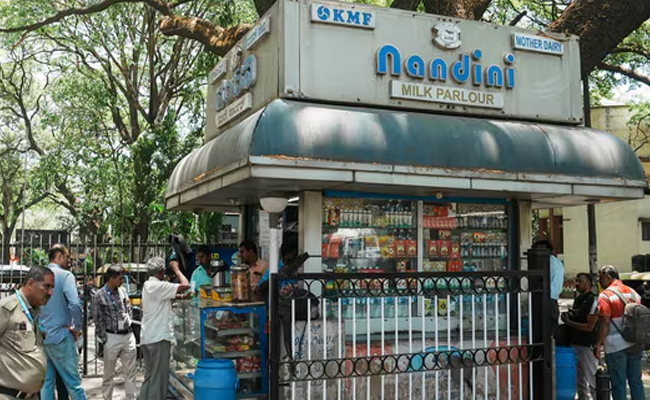
Bengaluru: Nandini, the popular dairy brand owned by Karnataka Milk Federation (KMF), is gearing up to sponsor the upcoming season of the Indian Super League (ISL) for 2024-25. This move by the state’s renowned dairy cooperative is aimed to promote its brand during the six-month-long sports event.
The 11th season of the ISL, scheduled to run from September 2024 to March 2025, will feature 163 football matches, with thirteen teams competing. According to a report by Money Control, KMF has recently floated a tender for firms to manage and promote the Nandini brand throughout the tournament.
KMF Managing Director M.K. Jagadish revealed that the cooperative is aiming for central sponsorship of the ISL, incorporating brand promotions on LED boards, presentation backdrops, dugout areas, and kiosks at all match venues. Additionally, Nandini will gain 300 seconds of exposure on television and OTT platforms, along with social media management throughout the ISL season, Jagadish added.
In a bid to expand its market reach, Nandini has also launched its whey-based energy drink, ‘Nandini Splash,’ in the U.S., making it available during the World Cup. KMF's MD highlighted that this move is part of a broader strategy to establish Nandini as a global brand.
Expanding further, a senior KMF official mentioned that Nandini is set to introduce its dairy products, including milk, curd, butter, and ghee, in the Delhi market. As part of a trial, these products were transported to Delhi by road, a journey of 56 hours, with the quality remaining unaffected.
Nandini has already made headlines by sponsoring the Scotland and Ireland cricket teams during the T20 World Cup, marking a milestone as the first Indian dairy brand to sponsor international cricket teams. This achievement gained widespread attention during the Karnataka Assembly elections in 2023.
The brand's prominence in Karnataka became a talking point ahead of the state elections when Amul announced plans to sell curd in Bengaluru. Former Chief Minister Basavaraj Bommai clarified that Amul would not replace Nandini in Karnataka, assuring that both brands would coexist in the state's market.
Let the Truth be known. If you read VB and like VB, please be a VB Supporter and Help us deliver the Truth to one and all.
Karnataka makes teenage pregnancies audit mandatory

Bengaluru (PTI): The Karnataka government on Tuesday issued an order mandating an audit of all adolescent pregnancy cases across the state, aiming to systematically track, review and address the underlying causes of pregnancies among girls aged 10 to 18 years.
The order makes adolescent pregnancy audit mandatory by the Taluk Health Officer (THO) for all pregnancies occurring among girls aged 10 to 18 years across the state.
The move is intended to strengthen early identification, counselling and preventive interventions by integrating efforts across health, education and social welfare departments, while leveraging existing programmes such as the National Health Mission (NHM) and Rashtriya Kishor Swasthya Karyakram (RKSK).
“Adolescent pregnancy remains a significant public health and social concern with implications for maternal health, neonatal outcomes, and socio-economic development,” the order said.
It noted that pregnancies among girls aged 10 to 18 years are associated with increased risks of maternal complications, adverse birth outcomes, school dropout and social vulnerability.
According to the order, all adolescent pregnancies identified in the state must be compulsorily reported by both government and private healthcare institutions on the Reproductive and Child Health (RCH) platform.
The audit framework will examine multiple socio-medical factors, including age at marriage, educational status, awareness of reproductive health, access to contraception, and family vulnerabilities.
It will also assess linkages with schemes such as RKSK, Integrated Child Development Services (ICDS) and school health programmes to identify service delivery gaps.
At the Taluk level, a dedicated audit committee will be constituted under the chairmanship of the Taluk Health Officer. Its members will be drawn from primary health centres, field health staff, Anganwadi services and schools.
The government further directed that counselling services, including those through Sneha Centres, access to contraceptives, and targeted outreach to vulnerable adolescent groups—such as school dropouts, migrants and socially disadvantaged households—must be strengthened.
“The audit shall examine age at marriage, educational status, awareness on reproductive health, access to contraception and counselling services, socio-economic and family vulnerabilities,” the order said.
The order mandates strict confidentiality in handling all cases, in compliance with child protection laws, while also ensuring adherence to legal reporting requirements.