Sensex, Nifty end lower as renewed global trade concerns weigh on sentiments
Mumbai, Jun 2 (PTI): Benchmark equity indices Sensex and Nifty on Monday ended marginally lower, following sluggish trends in global markets amid renewed global trade concerns.
Besides, the Russian-Ukraine conflict, sharp jump in Brent crude oil prices and foreign fund outflows dented investors' sentiment, experts noted.
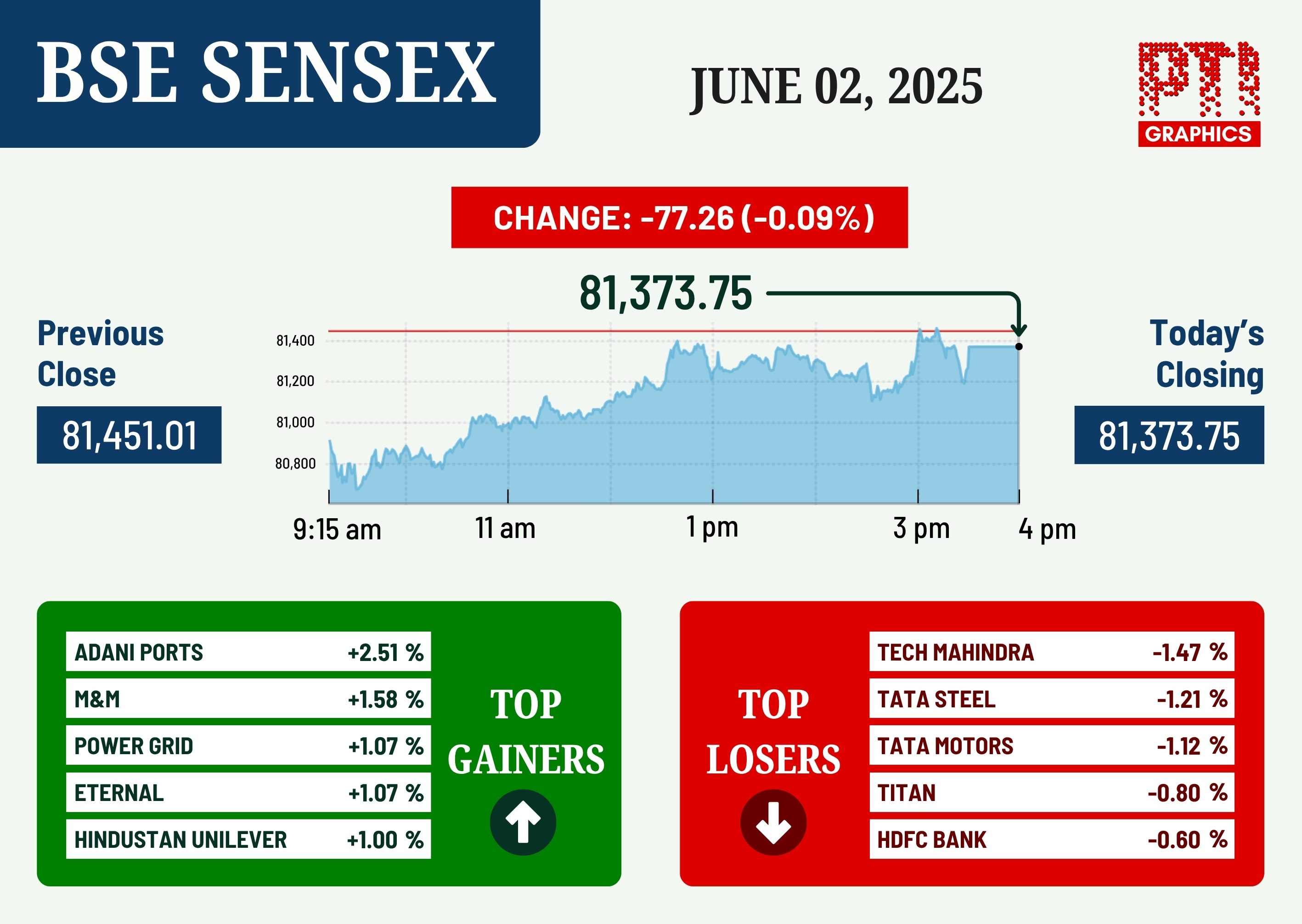
After tumbling 796.75 points or 0.97 per cent to 80,654.26 in intra-day trade, the 30-share BSE Sensex witnessed volatile trends and later ended 77.26 points or 0.09 per cent lower at 81,373.75.
The NSE Nifty dipped 34.10 points or 0.14 per cent to settle at 24,716.60. During the day, it dropped 224.55 points or 0.90 per cent to 24,526.15.
"Benchmark indices closed lower with marginal losses in a volatile start to June. Markets started the week on a cautious, range-bound note, with Nifty-50 sharply lower at open on fresh trade tensions after the US announced the doubling of steel and aluminium tariffs to 50 per cent. Despite positive domestic cues after surprisingly strong GDP growth in the January-March 2025 quarter, markets were dragged lower in the morning on worsening global headlines ranging from trade to war.
"US and China traded barbs with each other over the weekend while Russia Ukraine conflict worsened after drone attacks. Markets soon staged a strong recovery erasing the sharp morning losses, as investors look forward to RBI meet and widely expected rate cut," Satish Chandra Aluri, Analyst, Lemonn Markets Desk, said.
From the Sensex firms, Tech Mahindra, Tata Steel, Tata Motors, Titan, HDFC Bank, IndusInd Bank, Infosys and Kotak Mahindra Bank were among the biggest laggards.
On the other hand, Adani Ports, Mahindra & Mahindra, Power Grid, Eternal and Hindustan Unilever were among the gainers.
The BSE midcap gauge jumped 0.58 per cent and smallcap index went up by 0.36 per cent.
Among sectoral indices, BSE Focused IT dropped 0.70 per cent, metal (0.58 per cent), teck (0.45 per cent), consumer durables (0.40 per cent), commodities (0.18 per cent) and oil & gas (0.13 per cent).
Realty surged 2.38 per cent, services (1.20 per cent), FMCG (0.65 per cent), utilities (0.57 per cent) and power (0.35 per cent).
In Asian markets, Japan's Nikkei and Hong Kong's Hang Seng settled lower, while South Korea's Kospi ended in positive territory. Markets in China were closed for a holiday.
European markets were trading lower in mid-session deals. US markets ended on a mixed note on Friday.
Foreign Institutional Investors (FIIs) offloaded equities worth Rs 6,449.74 crore on Friday, according to exchange data.
US President Donald Trump on Friday said he would double tariffs on steel and aluminium to 50 per cent.
"The domestic market continued its consolidation phase for the third consecutive week, influenced by renewed concerns over a potential tariff war and escalating geopolitical tensions between Russia and Ukraine.
"While global uncertainties have led investors to adopt a risk-averse approach, the Indian market has demonstrated resilience, underpinned by robust institutional inflows and selective sectoral strength like FMCG, real estate, and financial stocks," Vinod Nair, Head of Research, Geojit Investments Limited, said.
Meanwhile, India's manufacturing sector growth fell to a three-month low in May, restricted by inflationary pressures, softer demand and heightened geopolitical conditions, a monthly survey said on Monday.
The seasonally adjusted HSBC India Manufacturing Purchasing Managers’ Index (PMI) fell from 58.2 in April to 57.6 in May, highlighting the weakest improvement in operating conditions since February.
Supportive domestic macro indicators include a potential RBI rate cut, a better monsoon, Q4 GDP data and better GST collection, Nair added.
Indian economy expanded at a faster pace than expected in the last quarter of the 2024-25 fiscal, helping clock a 6.5 per cent growth rate in the year that elevated its size to USD 3.9 trillion and held promise of crossing the world's fourth-largest economy Japan in FY26.
The Indian economy grew at 7.4 per cent in January-March - the fourth and final quarter of April 2024 to March 2025 fiscal (FY25) - reflecting a strong cyclical rebound that was helped by a rise in private consumption and robust growth in construction and manufacturing.
Gross GST collections remained above the Rs 2 trillion mark for the second straight month, rising 16.4 per cent in May to over Rs 2.01 lakh crore.
Global oil benchmark Brent crude jumped 3.28 per cent to USD 64.84 a barrel.
On Friday, the BSE Sensex declined by 182.01 points or 0.22 per cent to settle at 81,451.01. The Nifty dipped 82.90 points or 0.33 per cent to 24,750.70.
Let the Truth be known. If you read VB and like VB, please be a VB Supporter and Help us deliver the Truth to one and all.
At UN, India flags concerns over targeting of vessels in Strait of Hormuz
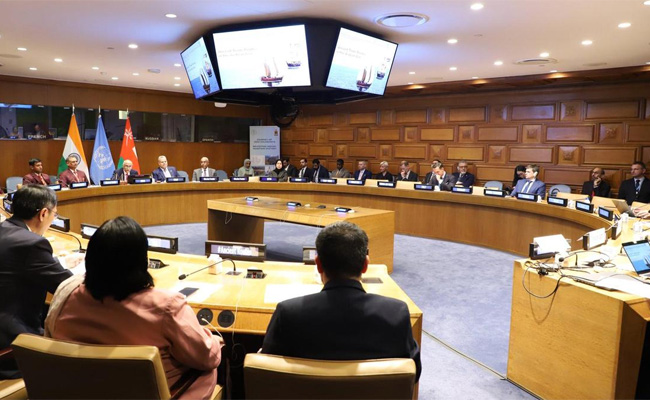
United Nations (PTI): Targeting commercial shipping, endangering civilian crew and impeding freedom of navigation in the Strait of Hormuz is "unacceptable", India’s Permanent Representative to the UN Parvathaneni Harish has said.
Harish's remarks at a special meeting of the United Nations Economic and Social Council (UNECOSOC) on safeguarding energy and supply flows came days after an India-flagged commercial vessel came under attack off the coast of Oman.
Omani authorities rescued all 14 crew members of the vessel sailing from Somalia, but it was not immediately known who carried out the strike.
In a post on X on Sunday, Harish said that at the UNECOSOC meeting, he shared India's approach to the recent energy and fertiliser crisis caused by the West Asia conflict.
"A combination of short-term and structural measures alongside international cooperation are essential to respond to the crisis," he said.
"Reiterated that targeting of commercial shipping, endangering civilian crew and impeding freedom of navigation in the Strait of Hormuz, are unacceptable. International law in this regard must be fully respected," he added.
The attack on the India-flagged vessel on May 13 took place amid the fragile situation in the Strait of Hormuz, a narrow waterway close to the coast of Oman through which roughly one-fifth of the world's energy supplies pass.
It has been severely disrupted by the conflict in West Asia that started on February 28, with the US and Israel launching joint attacks on Iran, triggering retaliatory strikes.
Earlier, India had described the attack as "unacceptable".
At least two other Indian-flagged ships have been attacked since the conflict broke out.
According to the UNECOSOC website, the meeting, which took place on Friday, focused on “Safeguarding energy and supply flows: Supporting global development through international cooperation”.