Stock markets snap 3-day decline on buying in banking shares; Sensex jumps 410 pts
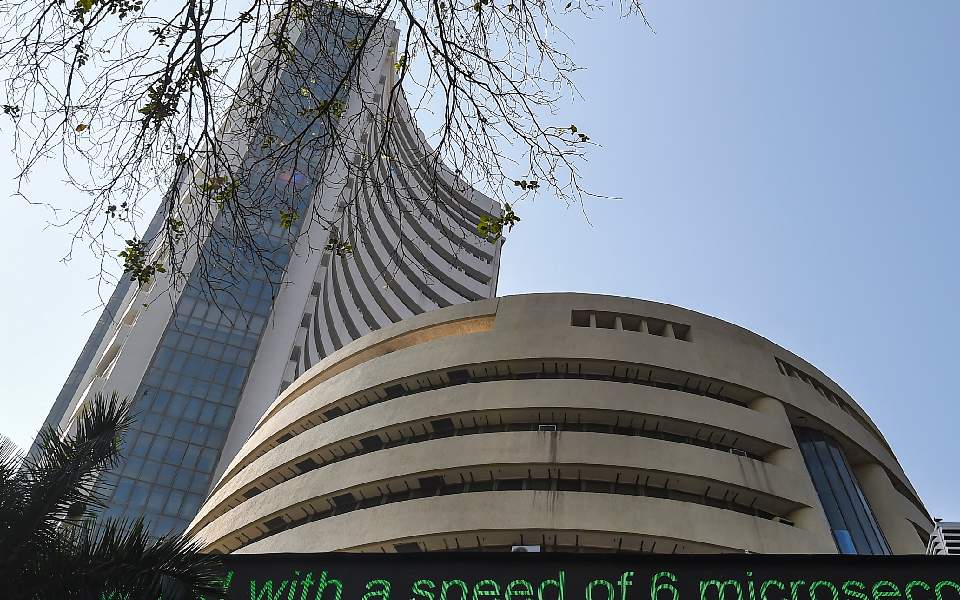
Mumbai, May 21 (PTI): Benchmark stock indices Sensex and Nifty rebounded on Wednesday, snapping their three-day falling streak on the back of buying in blue-chips HDFC Bank and ICICI Bank and a firm trend in Asian peers.
The 30-share BSE Sensex jumped 410.19 points or 0.51 per cent to settle at 81,596.63 with 24 of its constituents ending higher and six ending lower. During the day, it surged 835.2 points or 1.02 per cent to a high of 82,021.64.
The NSE Nifty climbed 129.55 points or 0.52 per cent to 24,813.45.

Among Sensex firms, Bajaj Finserv rose the most by 2.02 per cent. Tata Steel, Sun Pharma, Tech Mahindra, Bajaj Finance, NTPC, Nestle, Tata Motors, Hindustan Unilever and Mahindra & Mahindra also advanced.
IndusInd Bank fell the most by 1.39 per cent. Kotak Mahindra Bank, Power Grid and ITC were among the laggards.
Moody's Ratings said on Wednesday said India is well-positioned to deal with the negative effects of US tariffs and global trade disruptions as domestic growth drivers and low dependence on exports anchor the economy.
In a note on India, the agency said government initiatives to boost private consumption, expand manufacturing capacity and increase infrastructure spending will help offset the weakening outlook for global demand.
The BSE midcap gauge advanced 0.90 per cent and smallcap index by 0.51 per cent.
Among sectoral indices, capital goods (1.65 per cent), realty (1.58 per cent), industrials (1.35 per cent), healthcare (0.93 per cent) and teck (0.81 per cent) were the gainers.
Consumer durables emerged as the only laggard.
As many as 2,292 stocks advanced while 1,685 declined and 138 remained unchanged on the BSE.
Among Asian markets, South Korea's Kospi, Shanghai's SSE Composite index and Hong Kong's Hang Seng in settled in the positive territory while Japan's Nikkei 225 index ended lower.
Markets in Europe were trading in the negative territory. US markets ended lower on Tuesday.
"Markets exhibited a broadly positive undertone today; however, overall sentiment remained confined within a narrow range, indicating risk of 'sell on rallies' strategy in the near future amid escalating uncertainty around India - US trade negotiations," Vinod Nair, Head of Research, Geojit Investments Limited, said.
Global oil benchmark Brent crude jumped 1.19 per cent to USD 66.16 a barrel.
Foreign Institutional Investors (FIIs) offloaded equities worth Rs 10,016.10 crore on Tuesday, according to exchange data.
Sensex tanked 872.98 points or 1.06 per cent to settle at 81,186.44 while Nifty tumbled 261.55 points or 1.05 per cent to 24,683.90.


Let the Truth be known. If you read VB and like VB, please be a VB Supporter and Help us deliver the Truth to one and all.
Ordinance issued to increase number of Supreme Court judges from 34 to 38
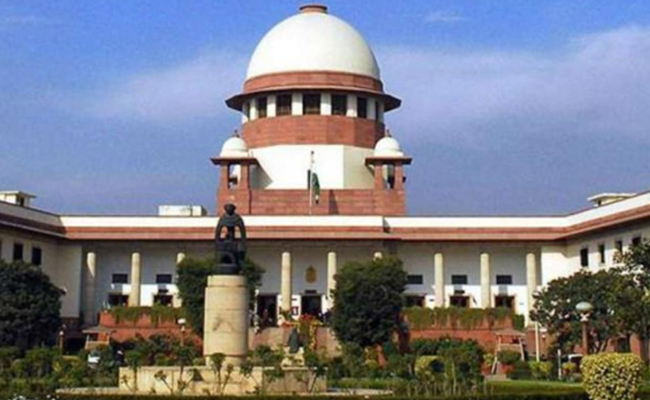
New Delhi (PTI): The government has promulgated an ordinance to increase the strength of the Supreme Court from the present 34 judges to 38, including the Chief Justice of India.
The law ministry notified the ordinance on Saturday, which amended the Supreme Court (Number of Judges) Act, 1956, to increase the sanctioned strength of the top court.
So far, the sanctioned strength of the top court was 34, including the Chief Justice of India (CJI). Now, the number of judges has been increased by four, taking the sanctioned strength to 38.
The top court will now have 37 judges, other than the CJI.
With the apex court having two vacancies at present, and the ordinance coming into force immediately, the Supreme Court Collegium will now have to recommend six names for appointment as judges in the top court.
A bill will be brought in the Monsoon Session of Parliament to convert the ordinance – an executive order – into a law passed by Parliament.
The Union Cabinet had cleared a draft bill on May 5 to increase the number of apex court judges.
The strength of the Supreme Court was last increased from 30 to 33 (excluding the CJI) in 2019.
The Supreme Court (Number of Judges) Act, as originally enacted in 1956, put the maximum number of judges (excluding the CJI) at 10.
This number was increased to 13 by the Supreme Court (Number of Judges), Amendment Act, 1960, and to 17 by another amendment to the law.
The Supreme Court (Number of Judges) Amendment Act, 1986, augmented the strength of judges from 17 to 25, excluding the CJI.
A fresh amendment in 2009 further increased the strength from 25 to 30.
Article 124(3) of the Constitution lists the qualifications required to become a Supreme Court judge.
An Indian citizen who has either served as a high court judge for at least five years, or as an advocate for 10 years, or is a distinguished jurist, can be appointed to the top court.
The strength of the Supreme Court is increased based on the recommendations of the CJI, who writes to the Union law minister. After consulting the finance ministry, the Department of Justice under the law ministry moves the Cabinet with a draft bill.