Immoral Cops Question Police Morals

Wherever the police system is weak, crooks rule. All communal riots in the country have taken place due to the inaction of the police. Be it in Gujarat, Mumbai, or the riots that took place in Delhi recently, reports point to the police department’s failure and inaction. It has been alleged that while in some cases it was sheer police inaction during the riots, elsewhere it was the police who were directly involved in the riots. If the police take stringent action and perform their duties with utmost sincerity, no one will dare to riot.
Of late, moral policing has reared its head in several parts of the state including Mangalore. Ironically, the miscreants involved in moral policing are those who are ‘close’ to the cops. These miscreants who were earlier involved in rowdyism, robbery, and illegal activities and thus were ‘guests of police’ are now shining in the state with their ‘moral policing’ acts These people are taking decisions about who should move around with whom and to whom should farmers sell their cattle and when. People are alleging that the ‘soft stance’ adopted by the police towards ‘moral policing’ is responsible for the increasing number of such incidents in the state. While politicians are making flamboyant speeches that the undivided Dakshina Kannada district will play a significant role in the development of the state, these miscreants are trying to hijack the law and order situation in Dakshina Kannada district with the help of these politicians.
Politicians without realizing that development and anarchy cannot go hand in hand are inadvertently becoming huge obstacles in shaping the district’s future. In the undivided Dakshina Kannada district and Malnad districts, miscreants are wearing masks of ‘protectors of culture’ and ‘protectors of cattle.’ Any criminal activity performed wearing these facades get covert approval of the law. By wearing a specific colour shawl and taking advantage of the political support, they are wielding the authority of stopping any bus or any vehicle and conducting an inquiry as to who is travelling with whom and why. After the moral policing team completes the interrogation, innocent commuters or youth are taken to the police station where the police conduct an inquiry. This is the modus operandi. The police should first question these miscreants and ask them who gave them the authority to stop the bus, if the government has given them the license to interrogate young women, and also the jurisdiction under which the ‘moral policing’ department falls under and take action against them. Action can be taken against innocent commuters only when it is proved that they illegal or unlawfully committed any act. Tragically, police have been taking action against innocent people who have been subjected to moral policing.
Since last January, in Dakshina Kannada district alone, more than 12 incidents of moral policing have been reported. Common people are analyzing these incidents in several ways. It is said that the reason for the increase in the number of such incidents is that the police are treating the miscreants involved in moral policing with kid gloves knowing fully well that they have criminal background. Another argument is that the police are hands in glove with Sangha Parivar. The main objective of these miscreants is to spread hatred against a particular community and instill fear in them. This is not limited to miscreants of Sangh Parivar alone. Recently, in Bangalore, members of an organization stopped a man on the bike and attacked him for travelling with a Muslim girl. Such incidents have taken place in coastal areas also. However, what is special is that the police are more than enthusiastic in taking action against the miscreants of a particular community while they take their own sweet time in acting against the miscreants of Sangha Parivar.
There is not much of a difference between ‘fake cow protectors’ and ‘moral policing’. Fake cow protectors are taking decisions on the streets regarding a farmer selling the cattle he has reared. And the police seem to have given their approval covertly to attack cattle owners or the drivers of the vehicles used to transport cattle, regardless of whether they are being transported legally or illegally. Sometimes they rob the driver of cash and other valuables like cell phones. Though several such cases have been reported, the police are filing cases only against the victims and not against fake cow protectors. How can the number of incidents of moral policing not increase when protectors of culture and fake cow protectors are allowed to roam around freely despite attacking innocents?
Due to such parallel policing by miscreants in Mangalore and other districts in the state, a situation has been created where students, industrialists, women, farmers and others are unable to roam around freely. Parents are scared to send students to educational institutions to these districts. Industrialists are hesitating to invest in coastal districts. Some time ago, an RSS leader had proclaimed Ullal as ‘Pakistan.’ It won’t be surprising if this area is branded as ‘Taliban-occupied area’ by outsiders if the law and order is taken over by miscreants. Before such a situation arises, the police department should understand its responsibilities, carry out its duties, and save its professional dignity. The coastal districts should be immediately saved from the clutches of miscreants.
Let the Truth be known. If you read VB and like VB, please be a VB Supporter and Help us deliver the Truth to one and all.
Lt Gen NS Raja Subramani to be India's next Chief of Defence Staff
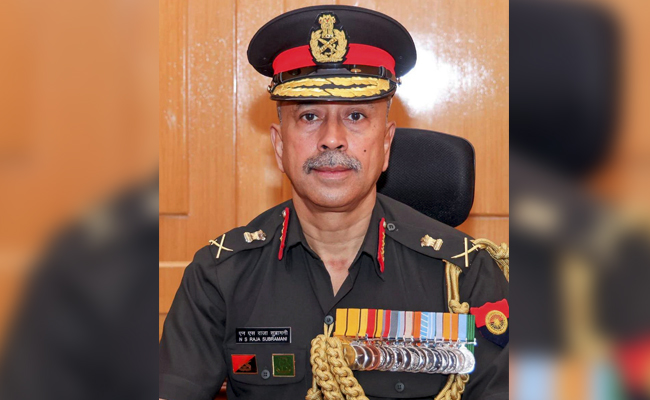
New Delhi (PTI): Lt Gen NS Raja Subramani will be India's new Chief of Defence Staff (CDS) and his key task is set to be to implement the ambitious theaterisation plan that seeks to ensure tri-services synergy.
He will succeed Gen Anil Chauhan whose tenure will come to an end on May 30.
Gen Chauhan, a former Eastern Army Commander, took charge as the country's senior-most military commander in September 2022, over nine months after the first CDS, General Bipin Rawat, died in a helicopter crash in Tamil Nadu.
The government has appointed Lt Gen NS Raja Subramani (Retd) as the Chief of Defence Staff, who will also function as the secretary of the Department of Military Affairs, the defence ministry said on Saturday.
Lt Gen Subramani is currently serving as the military adviser to the National Security Council Secretariat.
Prior to that, he was the Vice Chief of the Army Staff from July 1, 2024 to July 31, 2025, and was General Officer Commanding-in-Chief of the Central Command from March 2023 till June 2024.
As Chief of Defence Staff, Lt Gen Subramani's primary task will be to implement the theaterisation model to bring in tri-services synergy by rolling out integrated military commands.
The officer is a graduate of the National Defence Academy and the Indian Military Academy. He was commissioned into the eighth battalion of the Garhwal Rifles on December 14, 1985.
Lt Gen Subramani is an alumnus of Joint Services Command Staff College, Bracknell (UK), and the National Defence College, New Delhi. He holds a Master of Arts degree from King's College London and an MPhil in defence studies from Madras University.
In his illustrious career spanning over 40 years, Lt Gen Subramani has served across a wide spectrum of conflict and terrain profiles and tenanted a host of Command, Staff and Instructional appointments.
He commanded the 16 Garhwal Rifles in Counter-Insurgency operations in Assam as part of Operation Rhino, the 168 Infantry Brigade in Jammu and Kashmir, and the 17 Mountain Division in the Central Sector, all during a challenging operational environment.
He also has the distinction of commanding two Corps, including the Indian Army's premier strike Corps on the Western Front.