Reservation for upper castes: Another jumla in making
With elections fast approaching, PM Modi has inaugurated another ‘bullet train’ in unforeseen hurry. He has said his government will offer 10% reservation to upper caste people from lower economic backgrounds. If this is implemented, Brahmins, Thakur, Jat, Martha and Baniyas will reap the benefits of reservation.
There is no doubt that this self-contradictory declaration at many levels, is a big jumla because the government cannot implement this in the time before the term ends. By the time the bill is tabled and discussed in both houses, and then reaches the President, NDA government would have finished its term.
Modi has lost the faith of lower class with hisanti-farmer and anti-labour decisions that have mostly helped the corporates and private sector. BJP is securing less vote share in rural areas. Along with this, Jat and Maratha communities had taken to streets seeking reservation and had shown visible dissatisfaction against Modi.
The PM has made this announcement with the only reason that he needs to clinch upper class votes for his party. But this declaration has once again brought the focus back on caste system in this country. BJP as a party that said the country shouldn’t have caste based reservation, has gone and taken this decision. This has embarrassed marginalized communities that have identified with the party.
At the same time, even the parameter that has been fixed for the ‘reservation deserving category’ has also come under scanner because it is capped at Rs 8 lac per annum. Those earning almost Rs 65,000 per month, with five acres of land and or a 1000 sq ft flat as possessions, are considered poor. This could be some kind of a cruel joke?
Just when the creamy layer discussion is happening in the context of reassigning reservation desirability, how can an upper caste person be given such leeway in accessing the benefits of reservation?
Of course there are people who are very economically disadvantaged among the upper castes who need help. How can this policy help THAT person? This reservation benefit will not reach that category at all because this policy is aimed at pleasing the upper class upper caste people only. Hence, the government continues to remain poor in perceiving poverty whether rural or urban.
More than anything else, Ambedkar’s reservation is not aimed at making the poor into rich. There are schemes for all impoverished people in this country including BPL card, one kilo rice, government school schemes – almost everything is aimed at caste poverty people. Reservation is aimed at upliftment of those people who are backward in accessing education and education aided benefits such as jobs etc.
Someone who is poor today may be rich tomorrow and his perception of his personality may undergo huge change later. But a dalit today cannot become a Brahmin tomorrow and lead a life with new identity and renewed prestige. We need to remember that no matter how rich the person is, his caste will define the privileges he’ll enjoy. We also need to remember the incident of the President of India having been forced to stay out of Sanctum Sanctorum of a famous temple because he came from lower caste background?
When this is the case, how can ordinary Dalits even think of leading a life normally? An upper caste man may feign his income for the certificate, but a Dalit can never get a caste certificate to announce him a Brahmin, and lead a life of changed identity.
The government had the opportunity to get a report on the statistics relating to the number and income of Brahmins in upper castes before arriving at the parameter to fix many scales. Brahmins, Rajputs, Jats and Marathas have been using reservation since the last 50 years based on economic background.
When this is compared to that of the lower caste people who have used reservation for economic betterment, one would realize reservation hasn’t even been properly implemented in this country.
Only upper caste people have political dominance in the country and they are also economically much well off. Hence, what is the need to boost them? To provide impetus to them would mean that we push the lower castes further. This is like adding an extra set of incisors to conventional set of teeth.
Now the rich upper caste people already have reservation in the form of ‘payment seat’. Are they not using it owing to bad grades but high potential to buy the seat? Those who can earn Rs 60,000 per month can make their kids self sufficient without having to seek aid.
If India has to see comprehensive development, the lives of Dalits, Shudras and Muslims has to change. We need to understand how effectively reservation has been implemented into their lives and how many members are capable of earning Rs 60,000 per month among them. If the situation has remained as it was before, then the government needs to take stock of how reservation can be effectively implemented.
Millions of young boys and girls from lower caste are Modi fans. They are the ones who are used as pawns in communal riots in coastal Karnataka. The Billavas, Mogaveeras and others have been brainwashed that reservation is damaging to the nation. Now the very government who did that, is all set to offer reservation to upper castes. With this, Modi has let down those who trusted him.
Let the Truth be known. If you read VB and like VB, please be a VB Supporter and Help us deliver the Truth to one and all.
Rickelton's ton in vain as SRH beat MI by 6 wickets
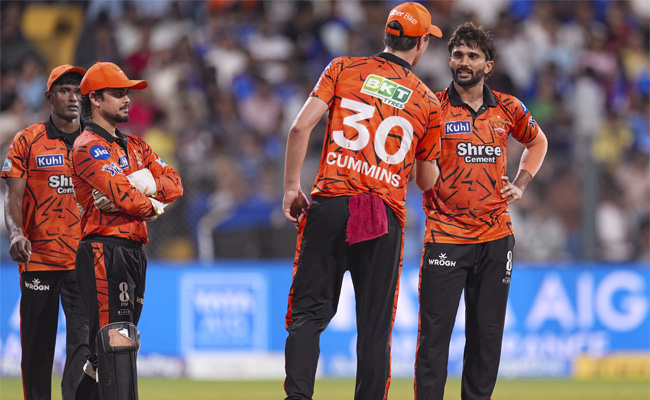
Mumbai (PTI): Ryan Rickelton's whirlwind unbeaten ton was overshadowed by Heinrich Klaasen's unbeaten 65 as Sunrisers Hyderabad defeated Mumbai Indians by six wickets in an IPL match here on Wednesday.
Chasing an imposing 244-run target, Travis Head (76 off 30) and Abhishek Sharma (45 off 24) shared 129 runs for the opening wicket to set the platform for SRH.
Klaasen (65 not out off 30 balls) then displayed his all-round hitting abilities to guide SRH home with the help of Nitish Kumar Reddy (21) and Salil Arora (30 not out off 10) in 18.4 overs.
Earlier, Rickelton's knock powered MI to 243 for five.
MI rode on a 93-run stand between Rickelton (123 not out off 55 balls) and Will Jacks (46 off 22) in 7.1 overs for the opening stand to power the side.
MI skipper Hardik Pandya scored a valuable 31 off 15 balls before being dismissed.
Praful Hinge (2/54), Eshan Malinga (1/29), Sakib Hasan (1/39) and Nitish Kumar Reddy (1/31) were the wicket-takers for SRH.
Brief Scores:
Mumbai Indian: 243 for 5 in 20 overs (Ryan Rickelton 123 not out; Praful Hinge 2/54).
Sunrisers Hyderabad: 249 for 4 in 18.4 overs (Travis Head 76, Heinrich Klaasen 65 not out; AM Ghazanfar 2/51).