Rohit Vemula is alive

Today is the third death anniversary of Rohit Vemula, who tried his best to fight against casteist forces in Hyderabad University, and ended his life unable to put up with the mammoth political pressure that was exerted on him. Though wide protests and demonstrations happened over his death and the circumstances that forced him to take that decision, the situation in the country remains unchanged. In some ways, the situation of marginalised castes has worsened in some ways. All those accused of abetting Vemula's suicide are still well nestled within the university. All those politicians and the VC of the University, none of them have been held accountable for this death. Cases have been filed in progressive and humanitarian forces that had stood by Vemula.
Kanhaiya and his friends who took the incident across the country are facing sedition cases that have been foisted against them. Social activists that spread his voice across the country are being branded Urban Naxals. Renowned thinkers like Anand Teltumbde have begun to fear for their life and safety at the hands of police who, in all probability, may finish him off. This is how bad the situation has turned into. On the other hand, efforts are on to weaken the democracy. While a dalit student Vemula fought for his rights and committed suicide since the system failed him, the government is preparing to offer reservation to upper caste students. The dalit leaders and politicians are not even in the position to raise their voice against this. Ironically, leaders like Ram Vilas Paswan are supporting this bill.
We need to go over the realities that led to Vemula's suicide. The clash that he had with ABVP leader led to his isolation, denial of education and then subsequently his suicide. False cases and allegations were made against him. Head of the institution harassed him to no end. His fellowship was withheld. The university did not pay heed though he sat alone on a peaceful protest with Ambedkar picture by his side outside the University. He then wrote a letter to the VC that they better give a rope to dalit students who join the university for studies. Vemula was thrown out of the University owing to the pressure exerted by the MP. Media reports have told us that a union minister had also seconded this.
But we need to remember one thing. It was not just the system that drove him to suicide. No secular or other organisations stood with him when the elements of Sangh Parivar and union government harassed a very talented dalit student, highly intelligent one at that who had secured a seat in general category with his hard work without using the reservation. When he was protesting against the authorities for days and nights the only things that have him company were portraits of Ambedkar and Savitri Bai Phule only. He was a comrade to Dalits. Even the comrades didn't want to be identified with him. Because Vemula faced the allegation of having raised a voice of support towards Yakub Memon when he was hanged.
No lions or tigers attack wild buffaloes. When buffaloes move in herds, tigers and lions run away from them. They come back to attack only when the buffalos are alone. This was what exactly happened in Vemula's case. If the leftist organisations had stood by Vemula or if Dalit outfits staged a Hyderabad chalo, the injustice meted out to Vemula would have been a topic or national debate. That would have given him confidence and strength as well. Authorities would have been scared into acting on the complaints at least owing to the mounting pressure. Rohit had noticed that his protest was turning into a wild cry that didn't wake up anyone. He was disappointed with his own people as much as he was, with the system around him. His suicide note carried shades of depression. His note does not blame anyone for his death, but speaks a lot about dispassion, philosophy and disappointment that his life had turned out to be.
Sangh Parivar and dalit outfits came together to kill him. We also need to understand why the BSP steered clear of the protest in support of Vemula. Not just that, when team Kanhaiya was preparing to protest to seek justice for Vemula's death, Mayawati spoke against Kanhaiya and his friends. She may have spoken later in support of Vemula in the Parliament. But she failed to consolidate dalit organisations and get justice for Vemula. But a ray of optimism has begun to shine through with Vemula's sacrifice. The Dalit identity and has turned prominent among the young dalit students. The leftists who has kept caste identity away, began to speak for the dalits.
Vemula's death showed that blue and red had to come together. Youngsters like Kanhaiya and Jignesh rose in politics. Leaders like Narendra Modi who would take pride in the fact that there is no strong opposition party, had to resort to cheap tricks of attempting to silence student leaders such as Shehla Rashid, Kanhaiya and Jignesh. Those who pushed Vemula into suicide may still be roaming free. But Vemula is still alive and is consolidating people across the country. None of the young boys and girls should face the fate as Vemula. If a student from dalit or any other marginalised community faces discrimination against the hands of higher authorities, he has to be supported irrespective of his political preference. Only then the system would pay heed to lesser forces. In the same manner, all parties and outfits across ideologies have to bolster the confidence and support timeless thinkers such Anand Teltumbde.
Let the Truth be known. If you read VB and like VB, please be a VB Supporter and Help us deliver the Truth to one and all.
Rickelton's ton in vain as SRH beat MI by 6 wickets
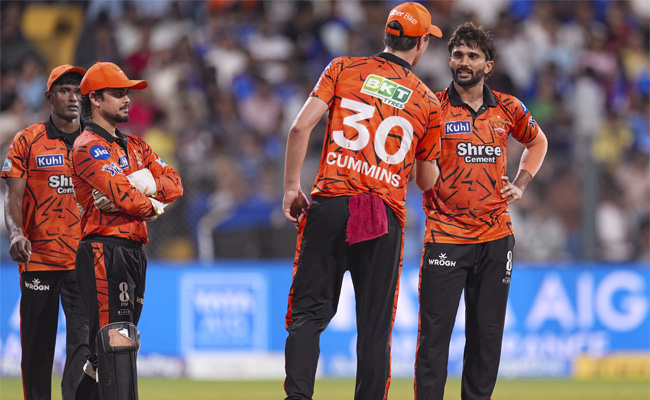
Mumbai (PTI): Ryan Rickelton's whirlwind unbeaten ton was overshadowed by Heinrich Klaasen's unbeaten 65 as Sunrisers Hyderabad defeated Mumbai Indians by six wickets in an IPL match here on Wednesday.
Chasing an imposing 244-run target, Travis Head (76 off 30) and Abhishek Sharma (45 off 24) shared 129 runs for the opening wicket to set the platform for SRH.
Klaasen (65 not out off 30 balls) then displayed his all-round hitting abilities to guide SRH home with the help of Nitish Kumar Reddy (21) and Salil Arora (30 not out off 10) in 18.4 overs.
Earlier, Rickelton's knock powered MI to 243 for five.
MI rode on a 93-run stand between Rickelton (123 not out off 55 balls) and Will Jacks (46 off 22) in 7.1 overs for the opening stand to power the side.
MI skipper Hardik Pandya scored a valuable 31 off 15 balls before being dismissed.
Praful Hinge (2/54), Eshan Malinga (1/29), Sakib Hasan (1/39) and Nitish Kumar Reddy (1/31) were the wicket-takers for SRH.
Brief Scores:
Mumbai Indian: 243 for 5 in 20 overs (Ryan Rickelton 123 not out; Praful Hinge 2/54).
Sunrisers Hyderabad: 249 for 4 in 18.4 overs (Travis Head 76, Heinrich Klaasen 65 not out; AM Ghazanfar 2/51).