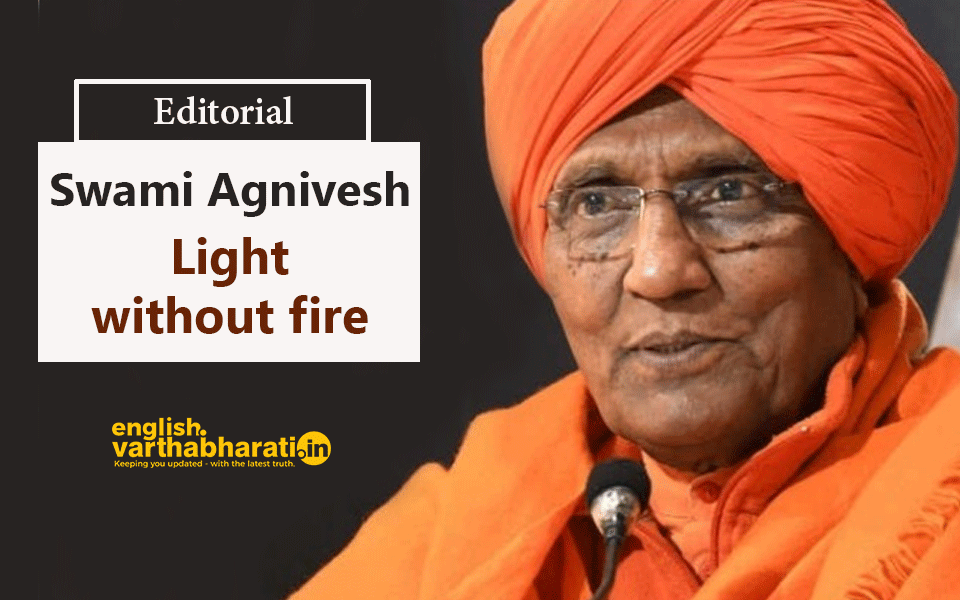
Swami Agnivesh: Light without fire
If Swami Vivekananda were to be alive today, he would have been termed as ‘anti-Hindu’, attacked, or simply called ‘urban naxal’ by the government and sent to jail. The Sangha Parivar would not have definitely tolerated Swami Vivekananda who raised his voice against orthodoxies, and upper caste atrocities. When Swami Vivekananda visited Kerala and saw the caste practices of Namboodiris, he had burst out angrily that ‘this is a mental asylum’. When the country was in drought and the priestly class sought funds to protect cows, he rebuked them for doing so. He minced no words in criticizing the discrimination in the name of caste. Today, if saffron robes have got some dignity, it is due to the social reforms of Swami Vivekananda. But unfortunately, groups that use Swami Vivekananda’s photographs as a front but oppose his reforms have emerged. Those who try to implement Swami Vivekananda’s thoughts are labelled as ‘anti-Hindu’ and are beaten down. The same forces mounted an attack on Swami Agnivesh and are now publicly celebrating his death.
It is very easy to abuse religion and beliefs. Religions are born to reform societies but many use religions to exploit people. No religion is free of this, but Hindu religion has been especially abused in this way. Anyone can term himself as a seer. Playing some tricks, one can become a self-proclaimed godman. At one time, several seers had revolted against caste discrimination in Hinduism. If great souls such as Narayana Guru and Swami Vivekananda were not born, the society today would not have been so harmonious. However, several fake seers continue to exploit people. While the priestly class are robbing devotees of property and wealth, political leaders are enjoying power preaching lawlessness.
In the midst of all this, Agnivesh chose to wear saffron robes, identified many problems in the Hindu society, and fought against them by launching agitations. Though he was affiliated with Arya Samaj, he did not identify himself with it fully but remained a wandering monk. He travelled extensively for a progressive Hindu society. For someone clad in saffron, the extent of work he did and the issues he took up is simply mind blowing. Identifying himself as a seer, he responded to political developments in the country boldly. For a short period, he was also part of a political party and became a minister. He launched a major agitation against bonded labor in 1981 and mobilized people against female infanticide, alcohol, sati, and several such social evils. Perhaps, Agnivesh is the lone saffron-clad monk in post-independent India who identified himself actively with social movements. Agnivesh obtained several international awards for his social service. He was attacked several times by miscreants for opposing the politics of conservative, hardline Hindus, and the governments’ anti-people policies.
There are a few instances where Agnivesh faltered as well. Although he was part of the Anna Hazare movement, he distanced himself from it when he realized the political agenda behind the movement. He was mocked at for being seen in ‘Big Boss’ and courted controversy for his phone conversations with Kapil Sibal. Agnivesh’s prejudice against non-vegetarianism was a subject of intense debate. When he was organizing a movement against liquor, he had issued a statement like a Sangh Parivar leader that “gender atrocities increase due to consumption of liquor and non-vegetarian food…and this has been proved by research”. Undoubtedly, liquor harms our mind and sanity, but liquor and meat are not the same. Meat is the food of a majority of people, but liquor is not a type of food. Agnivesh’s statement suggested that all rapes were committed by people who eat meat. But if the country’s history pages are gleaned through, what one sees are instances of atrocities and rapes committed by those who are vegetarians against those who are meat eaters. It is not that Agnivesh was not aware of this but his statement against meat eaters was prejudiced perhaps due to the fact that he was born in a brahmin family. But for this, there is no doubt that Agnivesh had strong commitment to the country’s plurality.
Dayananda Saraswathi who founded the Arya Samaj was poisoned and killed. Similarly, Agnivesh, who associated himself with Arya Samaj was, in a way, killed by the priestly class. Agnivesh took seriously ill after an armed attack on him two years ago. He was battered emotionally and physically. The government did not take any action against the miscreants who attacked him because attacks took place with the covert support of the government. And today, a former official who worked in the top-most investigating agency of the country celebrated his death on Twitter. What then is to expect from the common people? The celebration of the death of a seer who spent his entire life working to realize the dreams of Gandhi and Vivekananda for the Hindu religion is not just the tragedy of the Hindu religion but reflects the extent of decay of the country’s moral compass.
Let the Truth be known. If you read VB and like VB, please be a VB Supporter and Help us deliver the Truth to one and all.
Lt Gen NS Raja Subramani to be India's next Chief of Defence Staff
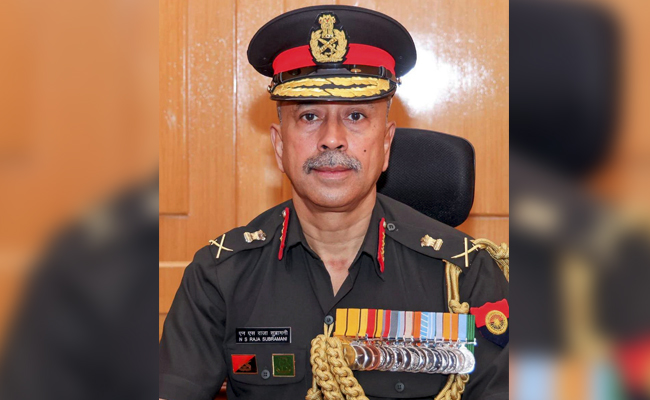
New Delhi (PTI): Lt Gen NS Raja Subramani will be India's new Chief of Defence Staff (CDS) and his key task is set to be to implement the ambitious theaterisation plan that seeks to ensure tri-services synergy.
He will succeed Gen Anil Chauhan whose tenure will come to an end on May 30.
Gen Chauhan, a former Eastern Army Commander, took charge as the country's senior-most military commander in September 2022, over nine months after the first CDS, General Bipin Rawat, died in a helicopter crash in Tamil Nadu.
The government has appointed Lt Gen NS Raja Subramani (Retd) as the Chief of Defence Staff, who will also function as the secretary of the Department of Military Affairs, the defence ministry said on Saturday.
Lt Gen Subramani is currently serving as the military adviser to the National Security Council Secretariat.
Prior to that, he was the Vice Chief of the Army Staff from July 1, 2024 to July 31, 2025, and was General Officer Commanding-in-Chief of the Central Command from March 2023 till June 2024.
As Chief of Defence Staff, Lt Gen Subramani's primary task will be to implement the theaterisation model to bring in tri-services synergy by rolling out integrated military commands.
The officer is a graduate of the National Defence Academy and the Indian Military Academy. He was commissioned into the eighth battalion of the Garhwal Rifles on December 14, 1985.
Lt Gen Subramani is an alumnus of Joint Services Command Staff College, Bracknell (UK), and the National Defence College, New Delhi. He holds a Master of Arts degree from King's College London and an MPhil in defence studies from Madras University.
In his illustrious career spanning over 40 years, Lt Gen Subramani has served across a wide spectrum of conflict and terrain profiles and tenanted a host of Command, Staff and Instructional appointments.
He commanded the 16 Garhwal Rifles in Counter-Insurgency operations in Assam as part of Operation Rhino, the 168 Infantry Brigade in Jammu and Kashmir, and the 17 Mountain Division in the Central Sector, all during a challenging operational environment.
He also has the distinction of commanding two Corps, including the Indian Army's premier strike Corps on the Western Front.