What is Sedition?
More than 70 years after the country got freedom, the country’s democracy is in danger. We are in a period where the Central Government is run by a party that believes that there should not be any objection to its policies and where dissidence is deemed as sedition. A period where we need to analyze the significance of the word ‘nation’ and what is meant by ’conspiring against nation’. According to the Centre, supporting peaceful protests that are taking place in the country amounts to sedition. It is a crime for citizens to raise voices against injustice and inequality. For committing this ‘crime’, 21-year old environmental activist Disha Ravi has been arrested and taken into custody by the Delhi police. Her crime was putting together a ‘toolkit’ that describes how to support the farmers’ agitation that is against the three recent farm laws. This ‘tool kit’ has been shared by global environmental activist Greta Thurnberg and other celebrities.
While Disha Ravi is arrested and taken into custody for the toolkit that was shared by Greta and others (there is no information whether permission from the Karnataka police was obtained for this), at the same time, former DySP Davinder Singh facing charges of terrorism walks out of jail on bail. Hundreds of such instances can be provided. A Saadhvi who is arrested on charges of terrorism and bomb blast is released and then elected to the Lok Sabha and continues to retain her seat even after supporting the assassination of Mahatma Gandhi. In the absence of official pronouncement of Emergency, this country has witnessed incidents where famous poet Varavara Rao, eminent thinker and author of several books on Ambedkar Anand Teltumbe, leader of human rights activists and lawyer Sudha Bharadwaj have been jailed and facing false cases of sedition while forged documents have been and planted in the mobile phone and personal computer of activist Rona Wilson.
The peaceful protests of farmers in New Delhi for the past two and a half months against the farm laws that seek to push the country’s farm markets into the arms of corporates have received support both nationally and internationally. All attempts and conspiracies to defeat the protests have failed. The conspiracy to defame farmers by making them responsible for the action of a few miscreants who were allowed to hoist the flag on the Red Fort on Republic Day came a cropper. Over the past few months, the country has witnessed how farmers were invited for talks while at the same time they were ridiculed or how those who supported the farmers’ agitation were arrested and imprisoned. The arrest of Disha Ravi, carried out only to make sure that the country’s citizens, especially youth, do not support the farmers’ agitation, reflects the government’s frustration and its dictatorial attitude.
Now, the country is not in an Emergency. But those who claim they fought Emergency in 1975 are in power. By trying to repeatedly muzzle differences and resistance, the government is resorting to authoritarian ways even without imposing Emergency. As the Constitutional bodies have also become inert, justice seems a mirage for innocent people. It appears that the huge corporate lobby has control over the government. The way people are being arrested, the whole country might turn into a prison soon. But this will not continue for long. We have many examples of countries where people’s voices are muzzled through policies of repression but it cannot be forgotten that such governments pay a heavy price. The government must immediately stop its dictatorial methods and respond to the farmers’ peaceful protests by meeting their demands, and releasing the young environmental activist.
A situation has been created in the country where everyone other than those in power have to bear the allegations of sedition. Not only Disha Ravi. They have not spared persons of the likes of popular journalist Rajdeep Sardesai and MP Shashi Tharoor. Questioning the act of selling public sector undertakings at throwaway price is an act of sedition. Opposing demonetization is sedition. Condemning atrocities against Dalits is sedition. Supporting farmers agitation is sedition. Not just this, in their view, Gandhi is a traitor. Nehru is a traitor. Who then is a patriot? Those who kill innocents on the pretext of transporting cattle, those who worship the assassin of Gandhi, those who raid and attack places of worship of the minorities and those who sponsor such events are seen as patriots. Such an autocratic repressive regime on the likes of Hitler’s will not continue for long. It is high time the government rectified its mistakes and provided governance that is appropriate for a democracy.
Let the Truth be known. If you read VB and like VB, please be a VB Supporter and Help us deliver the Truth to one and all.
Lt Gen NS Raja Subramani to be India's next Chief of Defence Staff
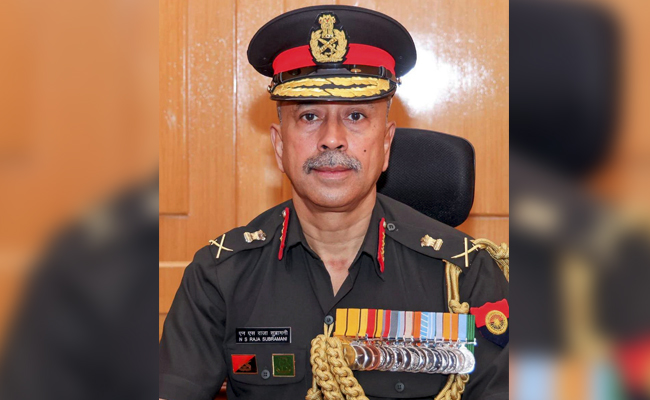
New Delhi (PTI): Lt Gen NS Raja Subramani will be India's new Chief of Defence Staff (CDS) and his key task is set to be to implement the ambitious theaterisation plan that seeks to ensure tri-services synergy.
He will succeed Gen Anil Chauhan whose tenure will come to an end on May 30.
Gen Chauhan, a former Eastern Army Commander, took charge as the country's senior-most military commander in September 2022, over nine months after the first CDS, General Bipin Rawat, died in a helicopter crash in Tamil Nadu.
The government has appointed Lt Gen NS Raja Subramani (Retd) as the Chief of Defence Staff, who will also function as the secretary of the Department of Military Affairs, the defence ministry said on Saturday.
Lt Gen Subramani is currently serving as the military adviser to the National Security Council Secretariat.
Prior to that, he was the Vice Chief of the Army Staff from July 1, 2024 to July 31, 2025, and was General Officer Commanding-in-Chief of the Central Command from March 2023 till June 2024.
As Chief of Defence Staff, Lt Gen Subramani's primary task will be to implement the theaterisation model to bring in tri-services synergy by rolling out integrated military commands.
The officer is a graduate of the National Defence Academy and the Indian Military Academy. He was commissioned into the eighth battalion of the Garhwal Rifles on December 14, 1985.
Lt Gen Subramani is an alumnus of Joint Services Command Staff College, Bracknell (UK), and the National Defence College, New Delhi. He holds a Master of Arts degree from King's College London and an MPhil in defence studies from Madras University.
In his illustrious career spanning over 40 years, Lt Gen Subramani has served across a wide spectrum of conflict and terrain profiles and tenanted a host of Command, Staff and Instructional appointments.
He commanded the 16 Garhwal Rifles in Counter-Insurgency operations in Assam as part of Operation Rhino, the 168 Infantry Brigade in Jammu and Kashmir, and the 17 Mountain Division in the Central Sector, all during a challenging operational environment.
He also has the distinction of commanding two Corps, including the Indian Army's premier strike Corps on the Western Front.