Had Congress Lost Closely-Fought MLA Seats (1960-2000), India Would’ve Seen 11% More Communal Riots
Says study by former Yale political science research scholars
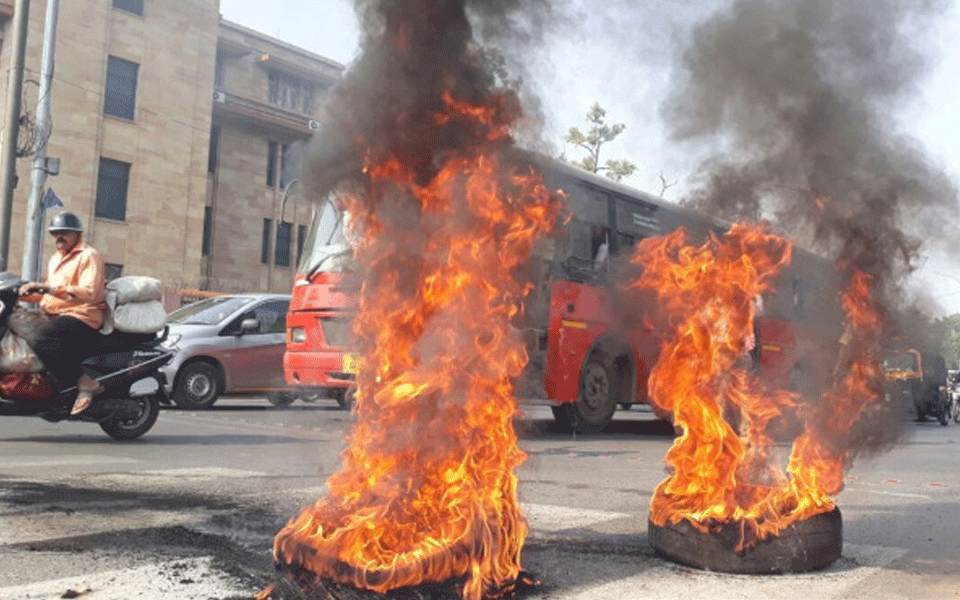
Mumbai: Congress members of legislative assemblies (MLAs) forestall communal violence in their constituencies due to their reliance on Muslim votes and their multi-ethnic electoral prospects, a study by former Yale political science research scholars said.
The study cited data that show that in places where the Congress narrowly wins in state elections, Hindu-Muslim riots are much less likely to occur and lead to fewer casualties when they do.
If the Congress had lost all the elections it narrowly won at the district level between 1960 and 2000, India would have experienced 11% more Hindu-Muslim riots (1,114 instead of 998) and 46% more riot casualties (43,000 instead of 30,000), according to the study published in the Quarterly Journal of Political Science in 2016, an abridged version of which has recently been published in Ideas for India, a platform for discussion on policy issues.
If the Congress had won all the local elections it had narrowly lost, riots would have reduced by 10% (or 103 fewer riots), the study said, adding that Congress MLAs exerted the same downward effect on the incidence of rioting whether or not the state chief minister was a Congressperson.
The findings of the study underscore the wisdom of electoral rules that encourage multi-ethnic parties to form and prosper, the study’s authors, Gareth Nellis, Steven Rosenzweig and Michael Weaver, suggested. Nellis is now the Evidence in Governance and Politics postdoctoral fellow at the University of California, Berkeley; Rosenzweig is an Assistant Professor of Political Science at Boston University and Weaver is a Collegiate Assistant Professor and Harper-Schmidt Fellow at the University of Chicago.
“It [the study] also suggests a need to insulate police from political pressures, and to increase levels of police professionalism, so that their decision to step in to quell attacks on minorities won’t be swayed by which political party happens to be in power at the time,” Weaver told IndiaSpend in an email interview.
Local-level leadership can curb communal riots
A number of researchers have suggested that secular nationalist parties, and especially those relying on minorities for electoral support, play an important role in consolidating democracy and maintaining peace between different ethnic and religious groups, Weaver told IndiaSpend, “[W]e wanted to put this theory to the test, using the case of India.”
Finding thin evidence to back claims that the avowedly secular Congress had used its position of dominance in the early post-Independence years to curb communal conflict, the authors observed that the bulk of research thus far had focussed on the role of the central government, even though maintaining law and order is the responsibility and charge of state governments.
With a newly compiled data-set from the Election Commission of India, and geocoded data on Hindu-Muslim riots recorded in the Varshney-Wilkinson dataset created by scholars Ashutosh Varshney and Steven Wilkinson, the authors of the Yale study carried out quantitative research experiments to assess how the election of Congress versus non-Congress MLAs had affected the probability of riots breaking out. They studied data from 315 districts for the period from 1962 to 2000. The Congress controlled the state governments for a full 58% of the state-years analysed.
The study focused on district-level MLA constituencies where a Congress candidate won or lost by a margin of 1%, contending that such election outcomes are as random as a coin-flip, dependent on unpredictable factors such as the weather on voting day. (In such places, the electorate would be equally distributed across party lines, so that the effect of the MLA’s role in curbing communal tensions would be most visible.)
For a deeper analysis, the study also split the study sample of districts into those under Congress state governments and those under other parties’ rule.
“Our findings show that MLAs have historically been able to make a difference in reducing riots,” Weaver said. “In today’s context, the results might suggest that if voters insist on action by the state to stop or prevent violence, politicians may do more.”
Acknowledging that the findings would surprise some political analysts, the researchers emphasised that the study does not address the impact of Congress incumbency on conflict stemming from other religious, caste, or economic cleavages, which may be governed by other factors.
They also noted that their work assessed the probabilistic outcome of Congress incumbency. “While Congress politicians have, at times, instigated Hindu-Muslim violence, our contribution is to show that this represents an aberration from the norm,” the researchers wrote. They added that the result is specifically true for state legislators. “[W]e cannot be sure whether an equivalent pattern holds for politicians at other tiers of government.”
The findings withstand numerous checks for robustness, the researchers said, “making it, to our knowledge, the most watertight empirical finding yet uncovered about the causes of Hindu-Muslim violence in India”. The study calls for a reappraisal of Congress party’s post-independence legacy, “and, more speculatively, the promise of multiethnic parties in divided societies worldwide”.
Electoral incentives explain why Congress incumbents discourage communal violence
Reliance on Muslim votes and multi-ethnic electoral prospects are the likely reasons why Congress MLAs forestall communal violence in their constituencies, the study further found.
In constituencies with higher-than-average Muslim populations, the dampening effect of Congress incumbency was found to be stronger, or the likelihood of riots breaking out was lower, the study found. This gives evidence to claims that the Congress is heavily reliant on Muslim votes to win elections.
As the primary victims of communal violence, Muslim voters often care deeply about electing politicians who will protect them from attacks, the researchers observed. “To maintain the support of this key voting bloc, Congress politicians have needed to take strong action to quell Hindu-Muslim riots–mostly, we suspect, by instructing the police to quickly put down disturbances before they escalate.”
The researchers did not separately look into areas with higher Hindu populations, they told IndiaSpend. “But given that districts with more Muslims would generally be expected to have fewer Hindus, we would expect to see that Congress did less to prevent riots in areas with larger Hindu populations,” Weaver told IndiaSpend.
Keeping all multi-ethnic groups happy is particularly important because the Muslim minority vote alone cannot win elections, the study surmised. Parties with a multi-ethnic voter base such as the Congress may also be motivated to forestall ethnic violence to avoid polarisation, which weakens their own electoral prospects while benefiting competitor parties that rely on ethnic votes.
How communal riots affect electoral outcomes in India
In the year preceding a state assembly election, the outbreak of each riot was linked to a 1.3-percentage-point decline in Congress vote share, on average. In contrast, the Bharatiya Jan Sangh/Bharatiya Janata Party (BJP) recorded a 0.8-percentage-point increase in their vote share, on average.
When interreligious trust declines, the Congress loses the support of some religious groups, notably the Hindus, the researchers wrote.
A study by Cambridge research scholars Sriya Iyer and Anand Shrivastava, who analysed the effect of Hindu-Muslim riots on state government elections in 16 Indian states between 1981 and 2001, echoed these findings.
If a riot occurred in the year preceding an election, it specifically led to a 5-7-percentage-point increase in the BJP’s vote share thereafter, according to Iyer and Shrivastava’s 2015 paper published by the IZA Institute of Labor Economics in Bonn, Germany.
“The most important implication of our work is that it provides a basis for the argument that the majority identity party has a clear incentive to incite ethnic tensions or even to cause riots,” Iyer and Shrivastava said, adding, “Recent events in India have shown that this was used as a strategy in western Uttar Pradesh.”
Emphasising that their research had focused on the effects on electoral results of exogenously caused riots (as opposed to politically engineered ones), Iyer and Shrivastava said the results showed that a party that systematically benefits from riots may have a clear incentive to cause riots for electoral benefit.
The Yale researchers also studied the possibility that Congress politicians incited riots after losing close elections. Their analysis of data found this to be “implausible” as riots reduced the Congress’ vote share in subsequent elections, creating the possibility of a “feedback loop”.
“The outbreak of Hindu-Muslim violence seems to cause Congress to lose votes and seats, which in turn leads to more riots, and so on in a downward spiral–one that could threaten democracy itself,” the researchers said. “Congress’ decades-long dominance may therefore have been pivotal in forestalling this possibility.”
The researchers also separately examined the effect of the Congress narrowly winning or losing only against parties that embrace a more multiethnic platform. “We were surprised to see that even in these cases, there were fewer riots when Congress won, and that the size of this effect was similar to that seen when Congress won against explicitly ethnic parties,” Weaver said. “This led us to conclude that Congress politicians had more specific incentives to prevent riots.”
This sheds new light on the puzzle of how democratic institutions have endured in India, the world’s largest democracy, against challenging odds, the study concluded, adding, “Democratic stability in divided societies depends not just on institutions or the nature of social cleavages, but on which parties citizens choose to vote into power.”
(Saldanha is an assistant editor with IndiaSpend.)
Courtesy: www.indiaspend.com
Let the Truth be known. If you read VB and like VB, please be a VB Supporter and Help us deliver the Truth to one and all.
Dakshina Kannada: Two girls drown while bathing near Kolyadakatta dam in Kadaba

Mangaluru: Two girl students drowned while bathing near the Kolyadakatta dam area of the Gundya river on Friday evening here in the Kadaba Taluk of the district.
The deceased have been identified as Arpita (15) and Sunita (21), both residents of Vimalagiri in Kutrupadi village.
According to reports, five girl students had visited the river along with their friends as it was a holiday. While bathing in the river, the two students reportedly entered a deeper portion of the water without realising the depth and began drowning.
Those accompanying them tried to rescue the duo, but were unsuccessful, leading to the tragedy.
After receiving information about the incident, Kadaba Police Station personnel visited the spot and conducted an inspection. The bodies were later recovered with the help of local residents.