The Four-km stretch that terrifies rivals: Inside India’s highway runways
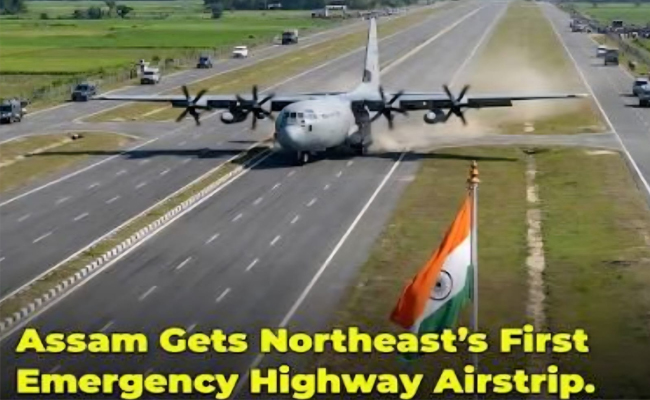
Prime Minister Narendra Modi landed his aircraft on a special highway in Moran, Assam, on February 14th, but this was no ordinary road. This highway strip was specially prepared to land fighter jets and military aircraft. Sounds unusual, right? Let us understand what exactly happened and why this is so important for our country's security and common people like us.
Our Prime Minister arrived in a special military aircraft called C-130J Super Hercules. But instead of landing at a regular airport, he landed on a 4.2-kilometre stretch of National Highway-37 near Moran. This highway is located very close to our border with China, just a few hundred kilometres away from the Line of Actual Control, which is like a boundary line between India and China.
This is not any normal highway. The National Highways and Infrastructure Development Corporation Limited, which is responsible for building our roads, worked together with the Indian Air Force to transform this simple road into what is called an Emergency Landing Facility or ELF. This is the first such facility in Northeast India. Before this official landing, fighter jets like Rafale, Sukhoi, and Tejas had already practiced landing on this highway to make sure everything would work perfectly.
The work was done with special engineering techniques. They reinforced and strengthened the highway surface so it could handle the weight of very heavy military aircraft. The entire project cost around 100 crore rupees, which is a huge investment. The runway can support fighter aircraft weighing up to 40 tonnes and large transport aircraft weighing up to 74 tonnes. To give you an idea, most cars weigh around 1.5 tonnes, so you can imagine how heavy these military planes are.
The most important thing is that this emergency runway can be used quickly for both civilian and military purposes. During normal times, it remains a regular highway where common people and vehicles can travel. But during emergencies or national security issues, it can be converted into a military runway within hours.
Let us think practically. Imagine if our main airport gets damaged or becomes too crowded during an emergency. We need backup options. This highway runway provides exactly that. It is located very strategically because China is only about 300 kilometres away, and Myanmar is around 200 kilometres away. This means our military can quickly send fighter jets and transport aircraft to these border areas if needed.
During the 1962 war with China, our country faced serious problems because Assam plains had poor roads and limited air support. History should not repeat itself. This emergency runway fixes exactly that weakness. If war happens, our aircraft will have multiple locations to operate from instead of depending only on one main airbase. This keeps our air force safer because the enemy cannot damage all our bases at once.
This emergency facility is not only for war situations. During natural disasters like floods or earthquakes, medical supplies, relief materials, and rescue teams can land quickly. In the recent past, we have seen many floods in Northeast India. Imagine how quickly help could arrive using this facility. Evacuation of people from dangerous areas becomes faster. Helicopter rescue missions become easier. Common people benefit directly from such infrastructure.
You might think this is only for the military and government, but it affects your safety and security. This development shows that our country is preparing for challenges and thinking ahead. It also creates employment opportunities during construction and ongoing maintenance. The infrastructure improvement helps connectivity in the region, which means better roads, better transport, and better connectivity for everyone.
Recently, tensions between India and China remain high after the 2020 clash in Galwan Valley. China has built many airbases near our border. India must also strengthen its defence capabilities. This emergency runway is one such important step. Many more such facilities are being built across the country, in Uttar Pradesh, Rajasthan, and other regions.
This highway runway in Assam represents India's determination to be prepared and strong. It is not about starting conflict but about being ready to protect our nation and people. When we see fighter jets landing on our highways, it reminds us that our country is constantly working to ensure safety and development. This is modern India—using existing infrastructure smartly to serve multiple purposes. As one local person said, "We never thought fighter jets would land on our highway. Now we feel proud." This pride comes from knowing our country is prepared for the future.
(Girish Linganna is an award-winning science communicator and a Defence, Aerospace & Geopolitical Analyst. He is the Managing Director of ADD Engineering Components India Pvt. Ltd., a subsidiary of ADD Engineering GmbH, Germany)
Disclaimer: The views and opinions expressed in this article are solely those of the author. They do not necessarily reflect the views, policies, or position of the publication, its editors, or its management. The publication is not responsible for the accuracy of any information, statements, or opinions presented in this piece.
Let the Truth be known. If you read VB and like VB, please be a VB Supporter and Help us deliver the Truth to one and all.
Lebanon PM accuses Israel of ‘war crime’ after rescue workers killed in strikes

Beirut: Lebanon’s Prime Minister Nawaf Salam on Tuesday accused Israel of committing a “war crime” after five people, including three civil defence personnel, were killed in twin air strikes in southern Lebanon.
According to Lebanon’s Ministry of Health, the strikes targeted a building in the town of Majdal Zoun, where rescue workers had arrived following an initial attack. A second strike hit the same location, killing those involved in relief operations.
Salam said targeting emergency responders carrying out humanitarian duties amounted to a serious violation of international humanitarian law. He added that the government would raise the matter at international forums and seek action to halt such incidents.
A spokesperson for the Lebanese Civil Defence was quoted by AL Jazeera that the rescuers were trapped under debris after the second strike and later confirmed dead.
The Lebanese army said two of its personnel were also injured in the attack, which reportedly struck a military patrol escorting the rescue team along with civilian equipment.
Lebanon’s President Joseph Aoun also condemned the incident, stating that it was part of a pattern of attacks affecting relief workers and civilians.
Despite a US-mediated ceasefire between Israel and Lebanon, cross-border hostilities have continued, with frequent air strikes reported in southern and eastern parts of the country.
Lebanese authorities said at least eight people were killed in separate incidents on Tuesday, while the overall toll from Israeli strikes since early March has crossed 2,500, with thousands injured.