The Sejjil Debuts: Iron Dome’s Nightmare
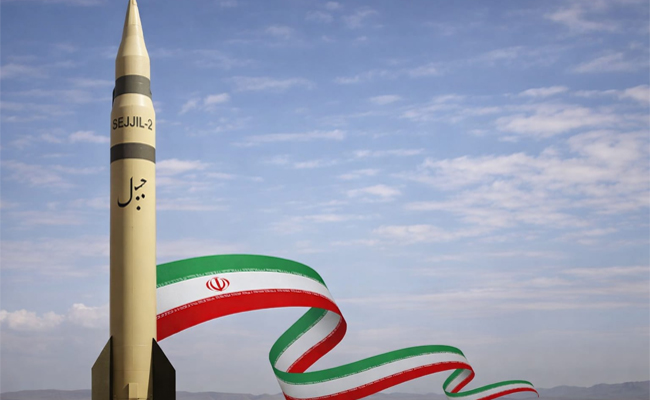
On Sunday, 15 March, Iran fired several advanced missiles at Israeli and American positions. One missile in particular caught the world's attention — the Sejjil. Iran used this missile in battle for the very first time since the war began on 28 February. So what exactly is this missile, and why is everyone talking about it?
The Sejjil is a ballistic missile, meaning it is launched upward into space and then comes crashing down on its target at terrifying speed. Think of it like throwing a stone high into the sky — except this "stone" weighs over 23,000 kilograms, travels faster than a bullet, and can carry a warhead of up to 1,000 kilograms.
What makes the Sejjil special is that it runs on solid fuel, just like a rocket firecracker — ready to light and go. Older Iranian missiles like the Shahab series ran on liquid fuel, which takes time to fill before launch, like pouring petrol into a car. The Sejjil needs no such preparation. It can be launched very quickly, giving the enemy almost no time to react.
The missile is two-stage, meaning it has two engine sections that fire one after the other — the first pushes it out of the atmosphere, and the second guides it toward the target. It can travel nearly 2,000 kilometres, which means it can easily reach Israel from Iranian soil.
Now here comes the most fascinating part — why it is nicknamed the "dancing missile." During its final approach, the Sejjil can move and change direction at very high altitude. Imagine trying to catch a ball that suddenly zigzags just before reaching you. That is exactly what happens with air defence systems like Israel's famous Iron Dome. The missile's unpredictable movement makes it extremely difficult to shoot down.
It flies at over Mach 13 — that is roughly 17,000 kilometres per hour, more than thirteen times the speed of sound. At that speed, even the most advanced defence systems have very little time to respond.
Iran began developing this missile back in the early 1990s. The first test was in 2008, when it flew around 800 kilometres. Since then, six tests have been conducted. In the sixth test, it reportedly flew nearly 1,900 kilometres, reaching all the way to the Indian Ocean.
Iran has also developed an upgraded version called the Sejjil-2, with improved navigation systems. Some reports claim it can hit a target with less than 10 metres of error — roughly the size of a small room — though this has not been officially confirmed.
In simple words, the Sejjil is fast, hard to stop, quick to launch, and built entirely inside Iran. Its use on 15 March marks a serious escalation, and the world is now watching very closely to see what comes next.
(Girish Linganna is an award-winning science communicator and a Defence, Aerospace & Geopolitical Analyst. He is the Managing Director of ADD Engineering Components India Pvt. Ltd., a subsidiary of ADD Engineering GmbH, Germany.)
Disclaimer: The views and opinions expressed in this article are solely those of the author. They do not necessarily reflect the views, policies, or position of the publication, its editors, or its management. The publication is not responsible for the accuracy of any information, statements, or opinions presented in this piece.
Let the Truth be known. If you read VB and like VB, please be a VB Supporter and Help us deliver the Truth to one and all.
Belagavi’s Basavaraj Kempawad tops UPSC Indian Forest Service exam

Belagavi: Basavaraj Kempawad of Belagavi district has secured the first rank in the Indian Forest Service (IFS) examination conducted by the Union Public Service Commission.
Basavaraj, a native of Savadi village in Athani taluk of Belagavi district, achieved All India Rank 1 in the prestigious examination, marking a significant accomplishment.
His achievement has drawn widespread appreciation, with congratulatory messages pouring in from various organisations, public representatives and prominent personalities.