Why did Cong MLA Nayana Motamma share stage with Muthalik? Political move or ideological betrayal?
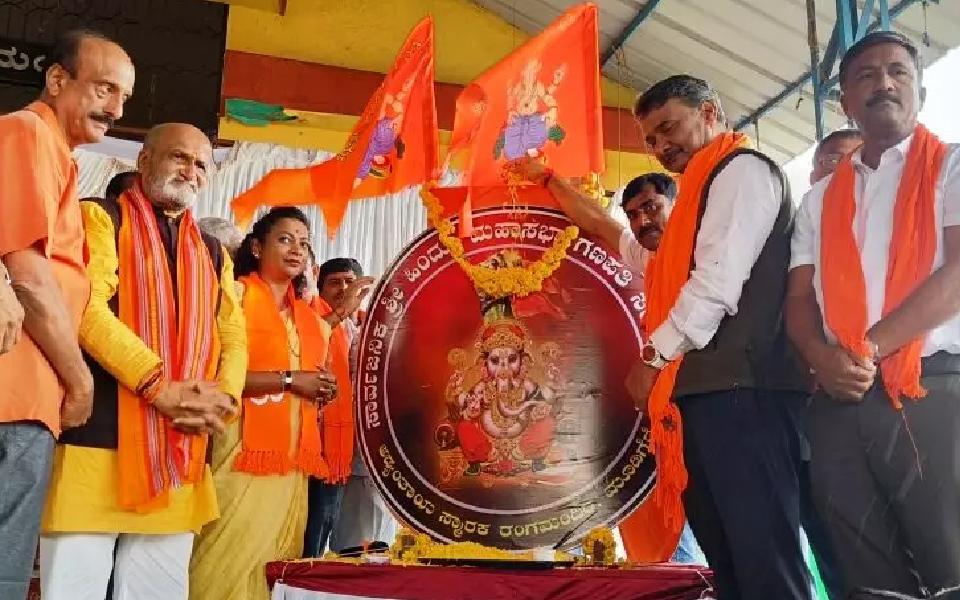
When Rahul Gandhi is out across the country opening Mohabbat Ki Dukaan, why are some of his own party leaders seen shopping at the shop of hate? That’s the question many are asking after Congress MLA from Mudigere, Nayana Motamma, appeared on stage alongside Pramod Muthalik, the controversial leader of the Sri Rama Sene.
What message does Nayana Motamma’s presence on that platform send? Why would someone who claims to wear saffron for religious identity stand next to someone who constantly spreads hate against an entire community? And how can she so casually disregard the efforts made by her own party workers who worked hard to get her elected?
Let’s break it down.
Nayana Motamma, an educated youth leader with a law degree from the prestigious National Law School of India University and international exposure, stood on a public stage beside a man who is known for his communal and inflammatory speeches. Pramod Muthalik, the Sri Rama Sene chief, has long been associated with hate-filled rhetoric, and has criminal cases filed against him.
Even more surprisingly, Nayana didn’t just appear there; she went a step further. She claimed that she was not there as a Congress MLA but as the president of the Ganapati Seva Samiti, which was hosting the event. According to her, this was a public Ganesh Utsav event, and she asked not to be seen from a party-specific lens.
She added that she came wearing a saffron shawl as a Hindu, a Dalit, and a woman. She claimed it was part of her identity. But what message does it really send when a Dalit woman leader, educated and elected by secular votes, decides to share the stage with someone who has often been accused of undermining the rights of minorities and women?
Nayana even made comments about changing political sides in the future. She said, “Whether I will remain in Congress, or join BJP, BSP, or SDPI — that will be decided three years from now.” This ambiguous statement has only added fuel to the speculation that she might be preparing for a shift in political ideology or party.
Unsurprisingly, her actions and words have triggered widespread reactions. Dalit groups, progressive voices, and even Congress supporters have expressed shock and disappointment. The person who stood next to her on the stage, Pramod Muthalik, used the opportunity to praise her in his own speech. That only deepened the controversy.
Let’s not forget — Nayana Motamma is the daughter of Motamma, a powerful political figure who carved a name for herself as a Dalit woman leader in Karnataka politics. Hailing from a small town called Maggalamakki in the Malnad region, Motamma served as MLA for multiple terms (1978–1983, 1989–1994, and 1999–2004), and also held the post of Minister for Women and Child Welfare. She was also the Leader of Opposition in the Karnataka Legislative Council. A woman who rose from grassroots, endured humiliation and prejudice, and continued to serve the people. Even Indira Gandhi had attended her wedding — a testament to her stature in the Congress party.
Despite political ups and downs, Motamma never left Congress, even when her political mentor D.B. Chandre Gowda joined other factions. She stayed loyal to the party and grew through public service. However, in her later years, even she moved away from political ideology and was seen leaning towards self-proclaimed spiritual gurus — a development that had raised eyebrows.
Now, her daughter Nayana, who began her political career under the shadow and legacy of Motamma, seems to be making questionable choices. Why would someone so educated, so well-informed, take such a drastic ideological turn at such an early stage of her political career?
This incident is not isolated. There’s a pattern. Earlier, when DK Shivakumar participated in the Kumbh Mela and praised its rituals, there was unease within the Congress ranks. The issue was not about visiting a religious gathering. It was about the optics and timing — when the party is fighting forces that are actively promoting Hindutva politics, such public acts by its own leaders undermine the struggle.
The same goes for Nayana Motamma now. Her decision to appear with a figure like Muthalik, and to make open-ended comments about her political future, sends confusing signals to voters. The people of Karnataka voted out the BJP and chose Congress with a clear mandate. They were rejecting communal politics and giving a chance to a party that promised inclusiveness. But when elected leaders start associating with the very ideologies voters rejected, it not only confuses the public, it weakens the party’s moral ground.
There are also questions about her intent. Did she really need to share the stage with someone like Muthalik to express her religious identity? There are hundreds of Hindu saints, religious institutions, and spiritual spaces in her own district. Why pick this specific event, hosted by a controversial figure, to express her faith?
Does her political career need an image makeover so badly that she is willing to sit next to someone who is widely seen as an agent of communal hatred? Has her politics hit such a low point that this is what is needed to stay relevant?
This entire episode raises critical questions about her political values. It makes one wonder whether she has truly understood Babasaheb Ambedkar’s teachings, his life, his message. Can anyone who genuinely follows Ambedkar ever feel comfortable next to someone like Muthalik?
This is not just a betrayal of her party. It is a betrayal of her identity, her education, her legal knowledge, her family background, and her ideological commitment. Her presence on that stage was not just a mistake — it was, in many eyes, a colossal act of political treachery.
If Nayana Motamma continues to behave this way, the secular voters of Mudigere must think seriously before trusting her again. If she is the Congress candidate in the next election, every secular voter should vote against her and teach both her and the party a lesson.
In the end, the question remains — what does Nayana really stand for? Her words and actions suggest that she is moving away from the very principles that helped her win the people’s trust. And if that is indeed the case, it is not just her political future at stake, but the credibility of the party she represents.
Let the Truth be known. If you read VB and like VB, please be a VB Supporter and Help us deliver the Truth to one and all.
One person taken into custody after woman found dead in Himachal forest

Nahan (HP) (PTI): A suspect has been taken into custody after a woman's partially burnt body was found in a forest near a police battalion camp in Himachal Pradesh's Sirmour district, police said.
The body of the woman, who is stated to be in her late 30s, was spotted in the dense forest of the Karaunde Wali Ghati area near Dhaula Kuan by locals on Wednesday morning. The identity of the deceased has not yet been established.
The accused in the case was taken into custody at Bata Bridge in Paonta Sahib on Wednesday evening following scanning of the CCTV footage of the area coupled with inputs from Haryana Police, police said.
According to police, the accused is a resident of Barara town in Ambala district of Haryana. A case of kidnapping has already been registered against him in Ambala.
Sirmour District Superintendent of Police Nischint Singh Negi said one person has been taken into custody following contact with Haryana Police.
Postmortem examination of the woman is scheduled to be conducted on Thursday at the Dr. Yashwant Singh Parmar Government Medical College at Nahan.
Police are currently investigating whether the woman was murdered in Barara itself, and if her body was subsequently dumped in the Paonta forest and set on fire.