Divided in Love, Rishi-Ranbir are united in their hate of media
Subhash K. Jha
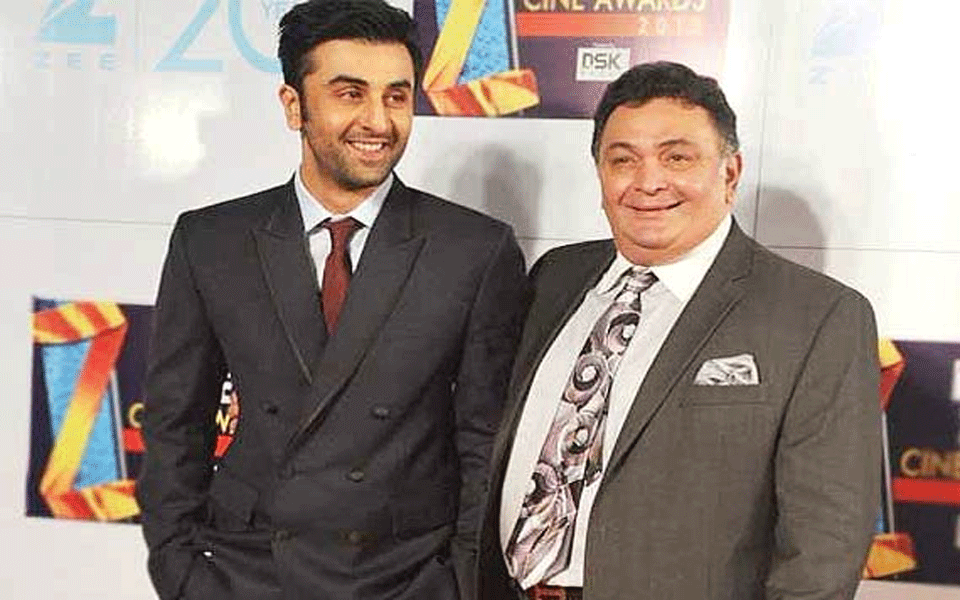
Rishi Kapoor and his son Ranbir don't see eye to eye on any issue. Both father and son have told me that the relationship is, at best, troubled and unfulfilled, and that father and son communicate through Neetu Kapoor.
While they agree to disagree on most issues, there is one thing that Rishi and Ranbir agree on. It is their aversion to the press. While Ranbir discreetly chooses to stay away from the paparazzi and secretly holds them responsible for his relationship problems (how? Don't ask). Rishi openly and contemptuously lashes out at the media at every given opportunity. This seems a little silly considering how much he likes to talk.
Rishi, of course, conveniently retracts when the situation gets sticky for him. Repeatedly, he puts his foot in his mouth and then blames the media for it.
In his latest outburst against the media, Rishi was joined by his elder brother Randhir, who complained that his grandson Taimur Ali Khan (daughter Kareena's son) was not getting a normal upbringing because of the intrusive paparazzi.
But, isn't the exposure of the child to the media the parents' choice? If Taimur and the earlier star-kid favourite AbRam are getting more attention than Aamir Khan's little son Azaad, does it mean Saif Ali Khan and Shah Rukh Khan are bigger stars than Aamir? Or that Taimur and AbRam are more popular children in the media than Azaad or Aaradhya?
No. Aamir has chosen to keep his son away from the limelight. And the Bachchans too have decided they will limit Aaradhya's public appearance.
"Normal" is a state of mind which most celebrities are progressively isolated from. Before seeking normality, Taimur's family needs to define it and decide what is normal for them. Being in the limelight is not normal for children from working-class homes. Being celebrity parents if you have a problem with your child getting undue public exposure, then the choice is yours.
Just say no. Unfortunately, it is not a "no" that Bollywood's biggest want. They want yes-men masquerading as mediapersons to write exactly what they want. Sadly, in the hunger for news, the entertainment media is swallowing every bone in the mistaken hope of finding some meat. This week there were two absurd reports which no one swallowed. One suggested that Shah Rukh Khan had turned down two roles offered by Sanjay Leela Bhansali.
First, our actors should know it is extremely bad manners to talk about turning down roles. Nowhere else in the world do actors and their overzealous PR machinery speak on roles that are turned down. Secondly, which are these two films that Bhansali is making to offer them to Mr Khan? He hasn't even begun planning his next. Thirdly, at this juncture in his career, when the projects that he's choosing are letting him down, why would Mr Khan turn down Bhansali?
Even more ludicrous are reports that Priyanka Chopra is likely to do a sequel to "Aetraaz". So says producer Subhash Ghai. Is Priyanka Chopra mad to return to the role of a female predator who crawls and slobbers all over her employee Akshay Kumar. In this era of Harvey Weinstein, the last role Priyanka Chopra would play is that of a sexual predator.
Stars want to be politically correct in their postures both off and on screen. But for that to happen, they first need to look at their own lives and rectify the anomalies and contradictions. So please don't give interviews after downing a few pegs in the evening and then deny your quotes when you see them staring at you the next morning.
(Subhash K Jha can be contacted at jhasubh@gmail.com)
Let the Truth be known. If you read VB and like VB, please be a VB Supporter and Help us deliver the Truth to one and all.
BJP using women's quota bill as front to pass Delimitation Bill that will break India: Mamata
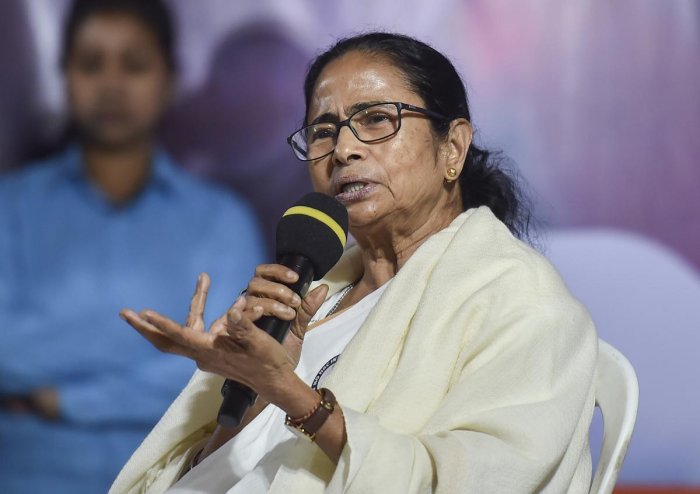
Cooch Behar (WB) (PTI): Chief Minister Mamata Banerjee on Friday alleged the BJP-led NDA government at the Centre was using the proposed amendment to the women's quota law in Parliament as a front for the Delimitation Bill that would "break the country into pieces".
The TMC will fight this Central government's move at every step, she asserted at her party's poll rally here.
The Constitution (131st Amendment) Bill to tweak the women's quota law, along with the Delimitation Bill and the Union Territories Laws (Amendment) Bill, to implement the proposed amended women's quota law, in the Union territories of Delhi, Puducherry and Jammu and Kashmir, were introduced in the Lok Sabha on Thursday.
According to the Constitution amendment bill, Lok Sabha seats will be increased to a maximum of 850 from the current 543 to "operationalise" the women's reservation law before the 2029 parliamentary polls, following a delimitation exercise based on the 2011 Census.
Seats will also be increased in state and Union territory assemblies to accommodate 33 per cent reservation for women.
Opposing the Centre's move, Banerjee alleged that "the BJP brought the Delimitation Bill while keeping the women's reservation bill at the front".
"The BJP is trying to increase the number of seats in the Lok Sabha to nearly 850 through the Delimitation Bill. It will break the country into pieces," the TMC supremo said.
She also alleged that Prime Minister Narendra Modi was not speaking the truth about the development of north Bengal at a BJP rally last week.
"The prime minister said nothing was done for the development of north Bengal. But we spent Rs 1.72 lakh crore on the development of the region," Banerjee said and asked Modi to cross-check data before making such remarks.