Go, Watch Kaala, to get a glimpse of a mutiny !
Review by P. Manivannan, IAS
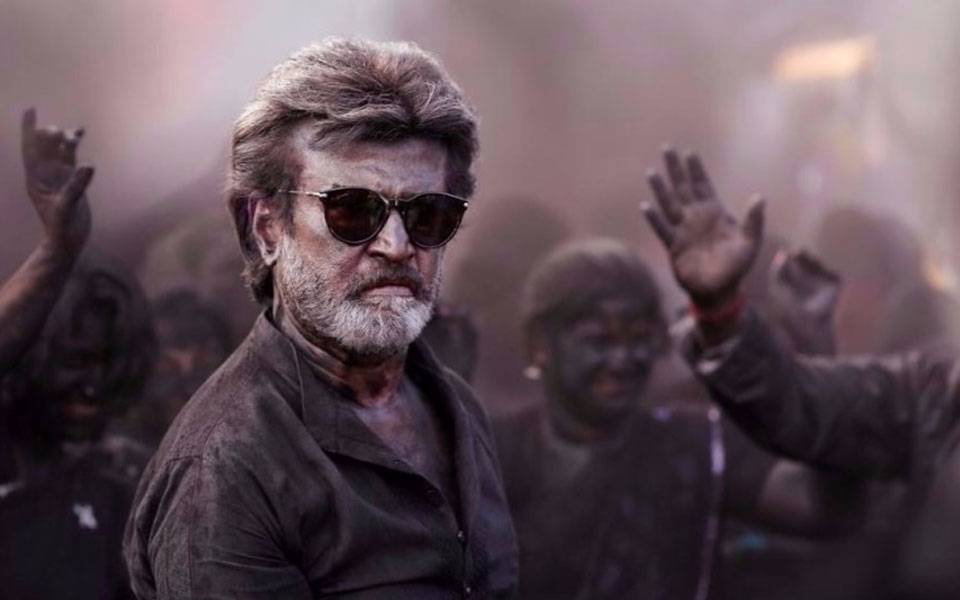
The Rajinikanth starrer Kaala, like the earlier Kabali, is a movie whose time has come.
Indeed, it’s a trite late, but has come from the most expected place of all, Tamil Nadu, where the mutinies started many years ago, led by E.V. Ramaswamy, fondly called as Periyar.
The mutinies that our country is going through now, has just spilled over into the art screen, as Kaala.
It had to.
And it has.
More such movies are to be expected, which will rewrite Ramayana and other symbols of feudalism.
We are going to have, or already having, the eruptions that are questioning the oppression inflicted on millions of India’s sons and daughters for hundreds of years.
***
My exposure into Indian history, beyond what is taught to us in the school, happened when I prepared for my IAS.
Poring over the books, I learned that the Hinduism we see today is a mosaic of religious history of thousands of years, starting from the Rig Veda, Pantheism, Buddhism, Jainism etc.
Indeed, as many would agree, it was not a monolithic religion, but a way of life. As it was different from what the Christians and Muslims professed, they called everything beyond their religion, as Hinduism.
One of the discernible aspects of Hinduism is castesim. Castesim established and maintained feudalism in Indian society, without the need for the sword.
At one level, it can be called as a master stroke for keeping different classes together and making them work towards common existence. But, clearly, it was oppressive to many, which was typical of any feudal system.
The concept of Rule of Law pre-supposes that everyone is equal. Thus, Rule of law is an antithesis to Feudalism.
The law of the land until the British established themselves in 1858, was differentiative and feudalistic. Manu was clear on that!
The indigenous rulers didn’t want to upset the applecart, and hence it continued, till the British, sitting safely in London, ventured to upset it.
Thus, things changed visibly since 1858, a year after the bloody revolt, a mutiny of gigantic proportion, in 1857, when the British brought its system based on Rule of Law. In fact, many would say that 1857 was itself a voice, that was not in resonance with feudalism.
The British, whether knowingly or unknowingly, tinkered with the existing feudalism in India. This sent shock waves. Suddenly, the law for the Brahmin and Sudra became the same! Manu’s law of thousands of years was overturned! This was bound to be bring mixed reactions.
Change is never easy. And when it’s about changing the status quo that existed for thousands of years, that defined and decided the socio-politico-economic fabric, it was destined to cause an upheaval in society, and it did.
And it got channelized and echoed in the struggle for freedom. Surely, Mahatma Gandhi didn’t miss to take note of it. ‘Chauri Chaura’ might have reminded him the course it could take if the mutinies are not controlled or regulated.
***
Post-independence, these voices grew more, after a brief lull of expectations of a utopia.
Emergency indeed acted as a spring released. When it unwound, it gave fillip to these mutinies. Since then, the democratic institutions kept the fire burning, fueled by education.
Post 1991, the competitions forced the people to wake up and fight for survival.
Logically, the wide differences in different sections of society, wrought by the feudalistic history of India, came to the fore, as never before. The flat world forced mutinies, as equality of opportunities became a sine qua non for survival.
Thus, the upheavals that started a hundred and fifty years back found more force and started erupting. Needless to say, every force leads to opposite forces. That explains the raise of right-wing politics and forces in the country.
These opposing forces have to led to clashes and eruptions as never before.
Thus, Kaala is a volcano that erupted on the screen!
How else will you explain Ravana killing Ram?!
The epics of India, as expected, were products of the zeitgeist. So, when the mutinies raise, they tear down the established norms; those imposed overtly and covertly in support of feudal system.
The rule books are torn, and even Gods are questioned!
As V.S. Naipaul wrote in his famous book, India: A Million Mutinies Now, we will see more of such eruptions, and their right-wing counters.
India bypassed renaissance, and the bloody revolution, thanks to the crafty caste system. But, these small-scale mutinies will be the order of the say in the coming years.
There would be violent swings, from left to right! And Kaala is a beautiful portrayal of the swing on the left.
Go, watch it, to get a glimpse of a mutiny!
(Trichy-born P.Manivannan, a naturalised Kannadiga, is a secretary in the government of Karnataka. He is headed to Harvard to do his masters in public administration)
This review was first published in churumuri.blog
Let the Truth be known. If you read VB and like VB, please be a VB Supporter and Help us deliver the Truth to one and all.
US VP JD Vance says Lebanon not part of ceasefire, calls it ‘misunderstanding’
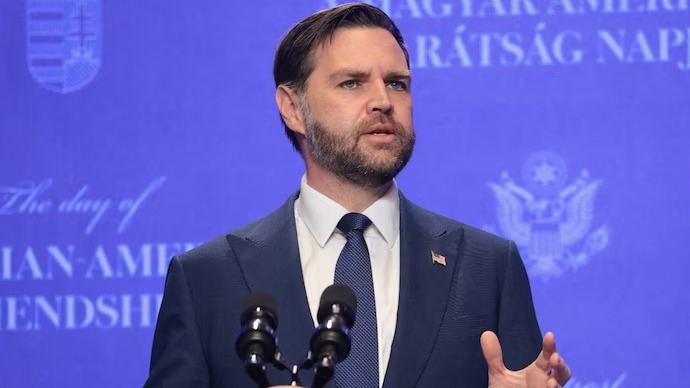
Budapest/Washington: US Vice President J D Vance has said that Lebanon was never included in the ceasefire understanding with Iran, describing the confusion as a “legitimate misunderstanding”.
Speaking to reporters before departing from Hungary, Vance said, “I think the Iranians thought that the ceasefire included Lebanon and it just didn’t. We never made that promise.”
He stressed that the United States had not included Lebanon in the scope of the ceasefire at any stage.
His remarks come amid continued Israeli strikes in Lebanon, where more than 200 people were reported killed, even as ceasefire talks between Iran and the US move forward.
Vance said Israel had “offered … to check themselves a little bit in Lebanon because they want to make sure that our negotiation is successful”.
He warned that if Iran allows the situation in Lebanon to affect the negotiations, it could derail the talks.
“If Iran wants to let this negotiation fall apart in a conflict where they were getting hammered over Lebanon, which has nothing to do with them and which the United States never once said was part of the ceasefire, that’s ultimately their choice,” he said.