Ricky Kej wins third Grammy Award, dedicates honour to India
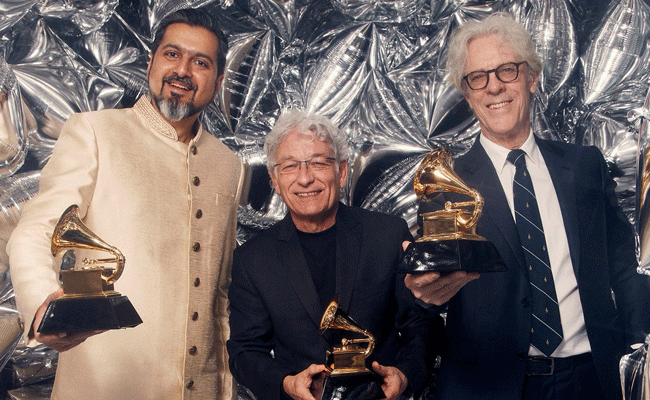
Los Angeles (PTI): Music composer Ricky Kej, based out of Bengaluru, has won his third Grammy Award for the album 'Divine Tides' and dedicated the honour to his home country, India.
The US-born musician shared the award with Stewart Copeland, the drummer of the iconic British rock band The Police, who collaborated with Kej on the album.
At the 65th Annual Grammy Awards, the duo earned the gramophone trophy in the best immersive audio album winner category. They had won a Grammy in the best new age album category for the same album last year.
"Congrats Best Immersive Audio Album winner - 'Divine Tides' Eric Schilling, immersive mix engineer; @copelandmusic, @rickykej & Herbert Waltl, immersive producers (Stewart Copeland & Ricky Kej) #GRAMMYs," announced the Recording Academy, the organisation behind Grammy Awards, on its official Twitter page on Sunday night.
Kej said he was "grateful" for the recognition.
"Just won my 3rd Grammy Award. Extremely grateful, am speechless! I dedicate this Award to India. @copelandmusic. Herbert Waltl Eric Schilling Vanil Veigas Lonnie Park," the composer captioned a series of pictures on his Twitter page.
Other nominees in the category were: Christina Aguilera ('Aguilera'), The Chainsmokers ('Memories... Do Not Open'), Jane Ira Bloom ('Picturing The Invisible- Focus 1'), and Nidarosdomens Jentekor & Trondeheimsolistene ('Tuvahyun - Beatitudes for a Wounded World').
'Divine Tides' is a nine-song album that aims to deliver the message that "each individual life plays a crucial role in maintaining the balance that serves all equally".
Kej took home his first Grammy in the best new age album category for 'Winds of Samsara' back in 2015.
As part of his work with The Police, Copeland has won five Grammys. With Kej as collaborator, this is his second award.
Let the Truth be known. If you read VB and like VB, please be a VB Supporter and Help us deliver the Truth to one and all.
8 children between ages of 1 and 14 dead after mass shooting in Louisiana, police say
Shreveport(US) (AP): A gunman in Louisiana killed eight children in shootings at two different homes early Sunday in the nation's deadliest mass shooting in more than two years, police in Shreveport said.
The victims ranged in age from one to about 14 years old, said Shreveport police spokesperson Chris Bordelon. A total of 10 were shot and some of the children were related to the suspect, Bordelon said.
The gunman later died after a chase with officers who fired at the suspect, Bordelon said. The suspect stole a car while leaving the scene of the shootings and was followed by police, according to Bordelon.
Police did not release the name of the suspect but did say he was an adult male. The shootings were the result of a “domestic disturbance,” Bordelon said.
Officials said they were still gathering details at the crime scenes south of downtown Shreveport — the two homes and a third location.
“This is an extensive scene unlike anything most of us have ever seen,” he said.
It was the deadliest mass shooting in the US since eight people were killed in a Chicago suburb in January 2024, according to a database maintained by The Associated Press and USA Today in partnership with Northeastern University.
At a news conference outside the residence where one of the shootings occurred, officials appeared stunned, requesting patience and prayers from the community as they sorted through multiple crime scenes.
“I just don't know what to say, my heart is just taken aback,” Shreveport Police Chief Wayne Smith said. “I cannot begin to imagine how such an event could occur.”
“This is a tragic situation — maybe the worst tragic situation we've ever had,” said Tom Arceneaux, mayor of the city in northwestern Louisiana with about 180,000 residents. “It's a terrible morning.”
Louisiana State Police say their detectives have been asked by Shreveport police to investigate. In a statement, state police say no officers were harmed in the shooting that involved an officer after a police pursuit into Bossier City on Sunday morning.
State police are asking anyone with pictures, video or information to share it with state police detectives.
Louisiana Gov Jeff Landry said in a statement that he and his wife were heartbroken. “We're deeply grateful to the law enforcement officers and first responders working tirelessly on the scene,” he added.