Samsung Galaxy Note 9 launched, Noida unit to make for India

New York, Aug 9 : Sounding the bugle for its annual warfare with Apple right on its home turf, Samsung on Thursday launched its flagship Galaxy Note 9 -- a device with a mammoth 1TB memory, bigger battery and a Bluetooth-equipped S Pen.
The smartphone will be available globally from August 24 and for the India market, it will be manufactured at Samsung's largest mobile manufacturing plant in Noida that was recently inaugurated by Indian Prime Minister Narendra Modi.
The 6.4-inch Note 9 comes in four colours and two variants -- 6GB RAM and 128GB in-built internal memory (expandable up to 512GB) and 8GB RAM with 512GB ROM that can be expanded up to 1TB with an additional 512GB microSD card -- a delight for the gamers and heavy-duty users.
"The Note has always been our showcase for premium technology and industry defining innovations. It is designed for a level of performance power and intelligence that today's power users need," D.J. Koh, President and CEO of IT & Mobile Samsung Electronics, said at the jam-packed Brooklyn's Barclays Center in New York City.
Both variants of the phablet will arrive in India by the end of this month and the price and exact availability date will be announced on August 10. However, not all the four colour models may initially make their way to India.
"The pricing will play a bigger role in deciding whether Samsung wants to fight the Chinese players or continue its focus on the premium customers in India," Satish Meena, Senior Forecast Analyst at Forrester Research, told IANS over phone.
The device that runs OS Android 8.1 (Oreo) will have the latest Qualcomm Snapdragon 845 system-on-chip (SoC) for the US customers and the models powered by Samsung's very own "Exynos 9 Series 9810" chips will head to the rest of the world, including India.
The device will sport dual camera system (12MP+12MP) with dual optical image stabilisation (OIS) at the rear -- with 2 times more powerful optical zoom and up to 10 times powerful digital zoom -- and an 8MP front shooter.
Note 9 with Quad HD+ Super AMOLED display houses 4000mAh battery -- 21 per cent bigger that Note 8 -- that is paired with fast-charging technology compatible with both wired and wireless charging.
When it comes to Stylus Pen (the company calls it S Pen), there is much more to experience this time.
"S Pen now has remote control functionality along with Bluetooth connectivity and extremely fast charging," the company executive explained.
"S Pen can control anything, from YouTube or photo gallery to operating the phone camera. It can guide entire presentations at office meetings. We have opened software development kit (SDK) for S Pen and will soon have more applications and features," he added.
The fingerprint scanner is comfortably located just below the rear camera system.
Note 9 also comes with dust and waterproof IP68 rating (including S Pen) and houses "Samsung Knox" enterprise mobile security solution pre-installed for enhanced security.
The flagship smartphone has also retained the iconic 3.5-mm headphone jack.
Let the Truth be known. If you read VB and like VB, please be a VB Supporter and Help us deliver the Truth to one and all.
Allahabad HC orders probe into 'reinstatement' of teacher in UP's Barabanki
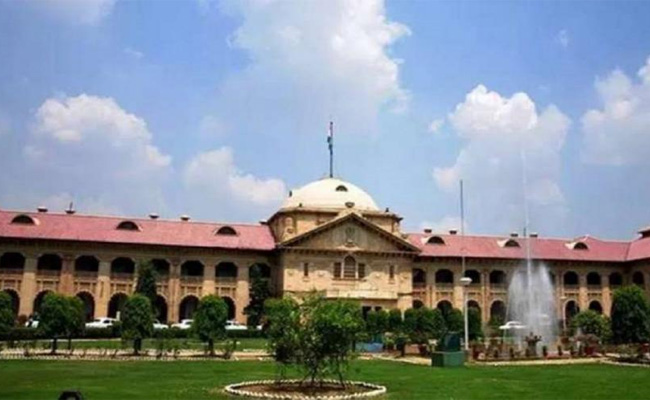
Lucknow (PTI): The Lucknow Bench of the Allahabad High Court on Friday ordered a probe by the special task force (STF) into alleged irregularities in the rejoining of a teacher at City Intermediate College in Barabanki, observing that the reinstatement appeared to be prima facie illegal.
The court also directed the recovery of the salary paid to the teacher during the disputed period.
A bench of Justice Rajeev Singh passed the order on a petition filed by the college management committee. The court expressed doubts over the roles of the District Inspector of Schools (DIOS), Barabanki, the college principal and the teacher concerned and hence, directed a detailed inquiry into the matter.
Taking note of alleged manipulation of records and misleading submissions, the court ordered the immediate transfer of the Barabanki DIOS to ensure a fair probe. It also directed the initiation of disciplinary proceedings against the then joint director of education of the Ayodhya division.
In its order, the court found that the teacher, Abhay Kumar, was initially appointed as an assistant teacher in 2018 but joined an Eklavya Model Residential School in Chhattisgarh as a lecturer in June 2024 without obtaining permission from the management. His subsequent request to retain the lien was rejected.
Despite this, he was allowed to rejoin the Barabanki College in September 2025 on the directions of the joint director of education and the DIOS, and was even paid the salary for October 2025. The court termed the rejoining "wholly illegal" and lacking any legal basis.
The bench also expressed concern over lapses in communication within the education department and directed the Uttar Pradesh chief secretary to ensure that official orders are communicated through email and WhatsApp as well, to prevent disputes.
The matter is next listed for hearing on May 28 when a compliance report is sought.