Ajman: K’taka Ministers visit Thumbay Medicity, to explore collaboration in Medical Education
Collaboration in healthcare, skill development discussed
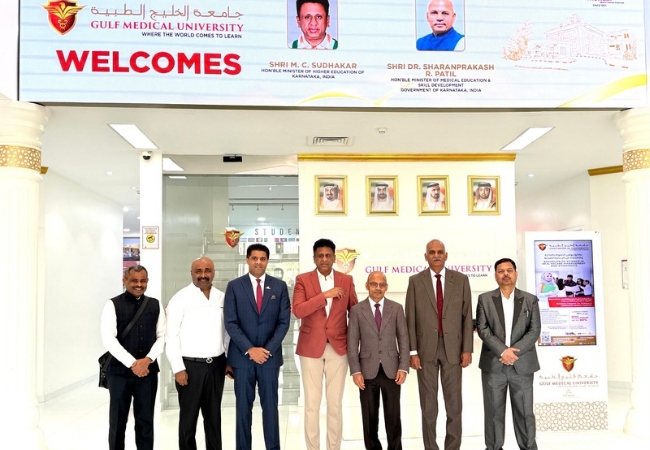
Ajman: Two ministers from the Karnataka government visited Thumbay Medicity in Ajman to study possible collaboration in medical education, healthcare and skill development. Thumbay Medicity, founded by Dr. Thumbay Moideen, houses Gulf Medical University (GMU) and a network of teaching hospitals and training centres.
The delegation included Dr. Sharanprakash R. Patil, Minister for Medical Education and Skill Development, and Dr. M. C. Sudhakar, Minister for Higher Education. They were received by Akbar Moideen Thumbay, Vice President – Healthcare Division, Thumbay Group, along with Prof. Manda, Chancellor of GMU, and members of the university’s senior leadership.
The visit began at Gulf Medical University with a tour of its academic and research facilities, including simulation centres, laboratories and interprofessional learning spaces that bring together students from more than 111 nationalities. The ministers then toured the Thumbay Physical Therapy and Rehabilitation Hospital, the Thumbay Dental Hospital and the Thumbay University Hospital, which is among the largest academic hospitals in the UAE.
Speaking during the visit, Dr. Sharanprakash R. Patil said: “Walking through Thumbay Medicity gives a clear sense of how a strong vision can transform education and healthcare. The way Dr. Thumbay Moideen has built this entire ecosystem in such a short time is truly remarkable. His commitment to global-standard training, innovation, and service is evident at every corner of Gulf Medical University and its hospitals. We look forward to exploring collaborations that will benefit students, clinicians, and institutions in Karnataka.”
Dr. M. C. Sudhakar said: “It is inspiring to see how far Dr. Thumbay Moideen has taken the Thumbay name on the global stage. Being from Karnataka, he has made us proud with what he has created here in the UAE. Thumbay Medicity stands as a world-class model for integrated higher education and healthcare. The academic environment at GMU, the diversity of students, and the strong research focus open meaningful opportunities for joint programs, exchange pathways, and collaborative research with institutions back home.”
Dr. U.T. Iftikhar Ali, Chairman of the State Allied and Health Care Council, and Mohd Mohsin, Principal Secretary to the Karnataka government, were also part of the delegation.
Let the Truth be known. If you read VB and like VB, please be a VB Supporter and Help us deliver the Truth to one and all.
Bhojshala case: Disputed structure built from remains of pre-existing temples, claims ASI
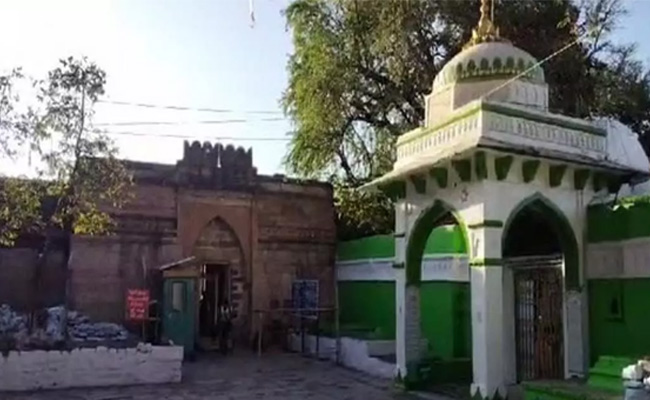
Indore (PTI): The ASI has told the Madhya Pradesh High Court that a massive structure dating back to the Paramara kings' rule existed at the disputed Bhojshala temple-Kamal Maula mosque complex, and the current structure was built from the remains of temples.
The Archaeological Survey of India (ASI) made the claim on Tuesday based on its 98-day scientific survey and over 2,000-page report.
The Hindu community considers Bhojshala a temple dedicated to Vagdevi (Goddess Saraswati), while the Muslim side claims the monument as the Kamal Maula Mosque. The disputed complex is protected by the ASI.
During the hearing before Justices Vijay Kumar Shukla and Alok Awasthi of the HC's Indore bench, Additional Solicitor General Sunil Kumar Jain, representing the ASI, presented a detailed account of the scientific survey conducted two years ago at the complex.
Referring to the ASI's survey report, he said, "Retrieved architectural remains, sculptural fragments, large slabs of inscriptions with literary texts, Nagakarnika inscriptions on pillars, etc, suggest that a large structure associated with literary and educational activities existed at the site. Based on scientific investigations and archaeological remains recovered during the investigations, this pre-existing structure can be dated to the Paramara period."
It can be said that the existing structure was made from the parts of earlier temples, based on scientific investigations, survey and archaeological excavations conducted, study and analysis of retrieved finds, study of architectural remains, sculptures, and inscriptions, art and sculptures, Jain said quoting the report.
Summarising the report, he also drew the court's attention to the fact that the archaeological study identifies that many architectural components, such as pillars and beams, were originally part of temple structures before being repurposed for a mosque.
"The evidence of this transition includes Sanskrit and Prakrit inscriptions that were damaged or hidden, alongside sculptures of deities and animals that were often mutilated or defaced," Jain contended.
The report also states that "all Sanskrit and Prakrit inscriptions are older than the Arabic and Persian inscriptions, indicating that users or engravers of the Sanskrit and Prakrit inscriptions occupied the place earlier".
In light of the Muslim side's earlier objections, the bench wanted to know why there were some discrepancies in the ASI's responses regarding the status of the disputed complex in the cases filed over the years.
The Additional Solicitor General argued that earlier studies of the complex involved only officials, while the current survey involved scientists and the use of advanced technologies such as Ground Penetrating Radar (GPR).
The hearing in the Bhojshala case will continue on Wednesday.
The high court has been regularly hearing four petitions and one writ appeal regarding the religious nature of the Bhojshala temple-Kamal Maula mosque complex since April 6.