Byndoor MLA Sukumar Shetty visits Thumbay Medicity in Ajman
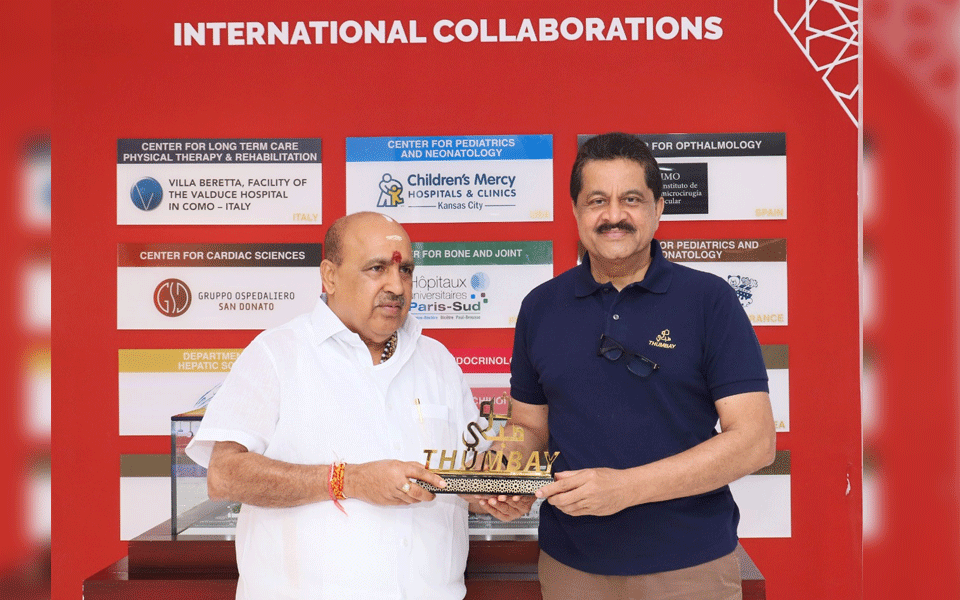
Ajman: BJP MLA from Byndoor, Sukumar Shetty visited Thumbay Medicity, the hub of state-of-the-art medical education, healthcare, and research, on 3rd December. He was welcomed at Thumbay Medicity by Dr. Thumbay Moideen – Founder President of Thumbay Group.
Touring the hospitals and the university, Mr. Sukumar Shetty commended Thumbay Medicity for the excellent facilities for healthcare and medical education, as he observed the various services at Thumbay Dental Hospital – the first private dental hospital in the country and the largest academic dental hospital in the Middle East region’s private sector, as well as Thumbay Physical Therapy and Rehabilitation Hospital – the biggest and most advanced hospital for physical therapy and rehabilitation. He appreciated Thumbay Group’s efforts in bringing the latest technology and innovation in healthcare and medical education to the region. He was quite impressed with 350-bedded Thumbay University Hospital – the largest private academic hospital in the region.
Dr. Thumbay Moideen said that Thumbay Medicity is envisioned as the healthcare and medical education hub of the region, to serve a floating population of 20,000. The 350- bed academic hospital – Thumbay University Hospital – the largest private academic hospital in the region, combined with the dental and rehabilitation hospitals make Thumbay Medicity a unique destination for specialized care. Thumbay Medicity is also a referral facility to which primary and secondary care hospitals and clinics refer to serious cases,” he explained.
The specialized hospitals of Thumbay Medicity are Academic Health Centers of the Gulf Medical University Academic Health System (GMUAHS), which give them a unique advantage of having the expertise of doctors who are also academicians and researchers. GMUAHS has the distinction of being the first private academic health system in the region.
Thumbay Medicity is one of the biggest additions to the UAE’s healthcare sector, and the first such project in the private sector. Located in Ajman, Thumbay Medicity features the most modern technology and global expertise in teaching/training, healthcare delivery and research/innovation, attracting the best student and professional talent towards shaping the future of education, healthcare, and research. Thumbay Medicity also features an array of leisure and hospitality amenities such as Body & Soul Health Club and Spa, Thumbay Food Court, The Terrace Restaurant, Blends & Brews Coffee Shop etc., as well as the Thumbay Housing Project to accommodate 2500 staff and students. Thumbay Medicity has a total area of 1 million sq.ft. and a built-up area of 1.2 million sq.ft.
Let the Truth be known. If you read VB and like VB, please be a VB Supporter and Help us deliver the Truth to one and all.
AIITA welcomes Karnataka’s ban on obscene songs in school events
Bhatkal: The Karnataka unit of the All India Ideal Teachers Association (AIITA) has welcomed the Karnataka government’s decision to strictly ban school children from dancing to obscene songs during educational and cultural programmes in government, aided, and private schools across the state.
AIITA Karnataka State President M. R. Manvi congratulated the government for taking what he termed an important step to preserve the sanctity of education.
“Such decisions to safeguard the dignity of school children and uphold the values of education are the need of the hour. This rule should not be limited to government schools alone but must be strictly implemented in all private educational institutions as well,” he said.
He further urged the government to address other concerns within school programmes.
“The government should not only prohibit obscene dances in the name of school anniversaries, but also ensure that plays and dialogues that incite religious hatred are avoided. Schools should be centres of harmony, not platforms for spreading hatred,” he added.
According to a recent circular issued by the Department of School Education and Literacy, obscene dances are adversely affecting the mental health and moral values of students.
In this regard, schools have been advised to use songs that promote nationalism, positive thinking, the greatness of Kannada culture, and value-based traditions instead of inappropriate content during programmes.
The circular also emphasises that students should be dressed in decent attire.
AIITA also backed the department’s warning that disciplinary action would be taken against head teachers if such guidelines are violated. The association has further demanded that district Deputy Directors of Public Instruction strictly monitor the implementation of these rules.