
510 New Future Heroes Welcomed to Gulf Medical University in Virtual White Coat Ceremony

The new batches of students of the six colleges under Gulf Medical University (GMU) owned and run by Thumbay Group, were welcomed into their healthcare professions through a white coat ceremony organized by the University, on 1st October 2020, receiving their first white coats as they participated in the time-honored tradition, albeit a virtual one this year, in the wake of the global pandemic.
Dr. Thumbay Moideen, Founder, President Board of Trustees, GMU was the chief guest of the ceremony. Prof. Hossam Hamdy, the Chancellor of GMU presided. Also present at the ceremony organized at the University were Mr. Akbar Moideen Thumbay - Vice President of the Healthcare Division of Thumbay Group, as well as the Vice Chancellors and Deans of the University.
Welcoming the gathering, Prof. Manda Venkatramana, Vice Chancellor Academics said that this year the new students numbered 510, representing 50 different nationalities. Those receiving their white coats were students in the first year of various programs: Bachelor of Medicine and Bachelor of Surgery (MBBS), Bachelor of Biomedical Sciences (BBMS), Associate Degree in Pre-Clinical Sciences (ADPCS), Doctor of Dental Medicine (DMD), Doctor of Pharmacy (PharmD), Bachelor of Physiotherapy (BPT), Bachelor of Science – Medical Laboratory Sciences (B.Sc. MLS), Bachelor of Science – Medical Imaging Sciences (B.Sc. MIS), Bachelor of Science - Anesthesia Technology (B.Sc. AT), Bachelor of Science in Nursing (BSN) and Bachelor of Science in Healthcare Management and Economics (B.Sc. HME).
Addressing the students, Prof. Hossam Hamdy reminded them that they were making history as the class of 2020, starting their medical and health professions education in the midst of the catastrophic global viral pandemic, COVID-19. Quoting the French philosopher Alain Badiou, he explained that COVID-19, as an event, had disrupted all aspects of our life, creating a new normal. “The next few years at the University are not going to be easy for you. But is it easy to achieve something that is truly meaningful,” he said, adding, “There will be challenges, but there will also be rewards.”
Prof. Hossam Hamdy further reminded the students that the world around them was changing rapidly in terms of communication, travel, treating patients, use of technology etc. “An important competency which will remain unchanged is the communication between human beings. The patients, the students, the healthcare providers and the medical educators are all humans. How to communicate, connect and interact and feel will play a key role in educating health professionals,” he explained, adding that nurturing ethicality and trustworthiness would be part of their learning process at GMU.
Emphasizing the importance of teamwork, Prof. Hossam Hamdy said, “Medical practice is no longer a case of a single doctor caring for his or her patients. You are part of a team, bringing in the expertise of a larger group of professionals, working within a healthcare system. Teamwork is the one of the important competency you have to acquire during your studies and beyond. At GMU we have established, for the first time, the Center for Interprofessional Education, Practice and research, the only one in the region.”
He also elaborated on the cutting-edge technologies like 3D learning, Artificial Intelligence and the Distance Learning and Blended Learning methodologies, which are all part of the learning experience at GMU. “We now have 27 accredited programs imparted through the six colleges of GMU. Very soon, the University will have a PhD program and residency programs,” he said.
Thanking Dr. Thumbay Moideen the Founder for the vision, values, leadership, hard work and ethical values of GMU, Prof. Hossam Hamdy stated that GMU now boasted unparalleled reputation in the region, attracting students from over 86 nationalities.
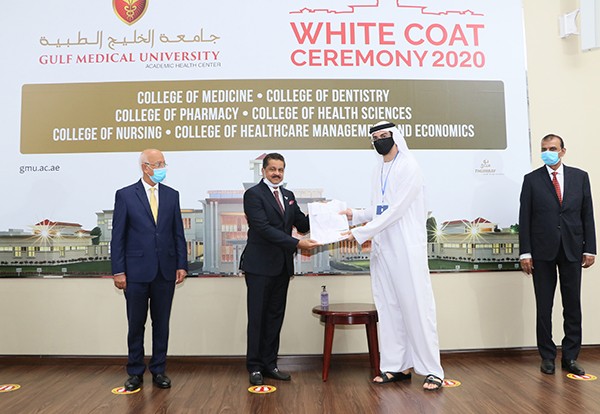
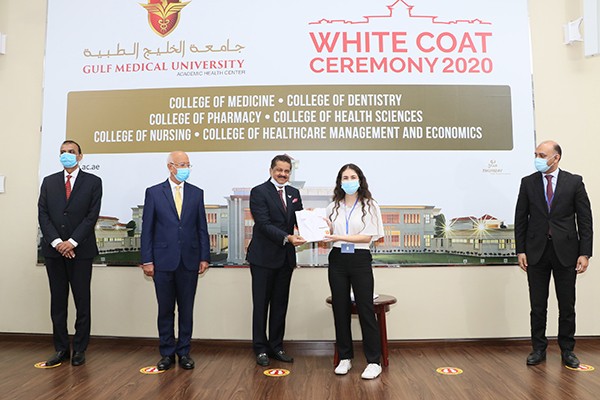
Selected representatives from the new batches of different programs received their white coats from the chief guest as part of the ceremony, as their batch mates joined in virtually from different parts of the world, donning their white coats to take the first step in their journeys as healthcare professionals.
Let the Truth be known. If you read VB and like VB, please be a VB Supporter and Help us deliver the Truth to one and all.
Min. Priyank Kharge to expresses concern over implementation of VB-G Ram G

Bengaluru: Rural Development and Panchayati Raj Minister Priyank Kharge has expressed concern over the uncertainty surrounding the implementation of the proposed VB-G Ram G scheme, stating that the MNREGA programme, which has been a lifeline for rural India for nearly two decades, appears to be facing an uncertain future.
Speaking to media, Kharge said that as March 31 draws to a close, there is no clarity on the rollout of the new scheme from April 1. He pointed out that the central government has not yet issued the necessary guidelines for implementing the scheme for rural workers and villages.
He criticised the Centre for its lack of preparedness, stating that there is no clarity on fund allocation, no final parameters for classifying gram panchayats, and key processes such as social audits have not been defined.
Kharge said the situation comes at a critical time, as summer marks a peak period for rural employment demand, when many people depend heavily on wage employment for their livelihood.
He added that reports have emerged of delays in approvals and families not receiving work despite demand.
He further alleged that the Centre’s move to shift from a statutory employment guarantee to a rule-based allocation system is already showing negative consequences.
Kharge also raised concerns over provisions such as a mandatory 60-day halt during agricultural seasons, which he said would further limit employment opportunities for rural workers.
The BJP-led central government had claimed that the new scheme would transform rural India, but in reality it is turning out to be detrimental to people’s livelihoods, he said.
“The crisis in rural India due to the stalling of MNREGA is beginning to unfold. Given the Centre’s past record in handling such situations, there is growing concern over the impact on rural livelihoods,” Kharge said.


